Goliad in Goliad County, Texas — The American South (West South Central)
A Strategic Location
Photographed by James Hulse, October 23, 2023
1. A Strategic Location Marker
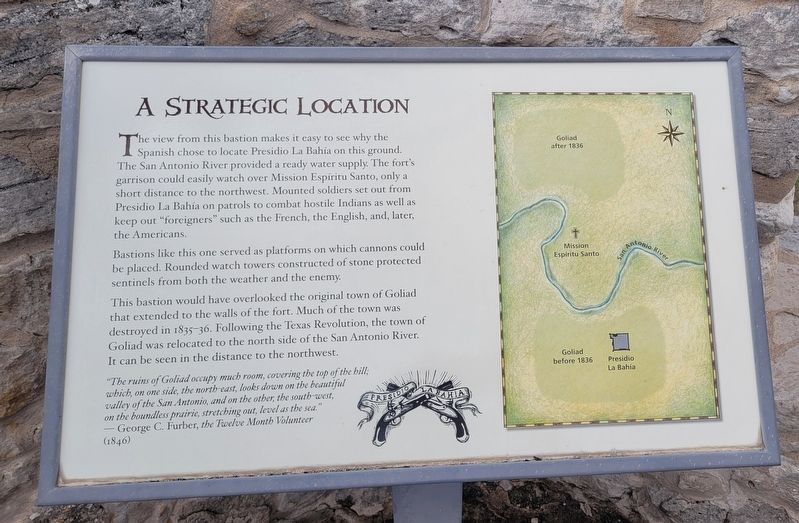
The view from this bastion makes it easy to see why the Spanish chose to locate Presidio La Bahía on this ground. The San Antonio River provided a ready water supply. The fort's garrison could easily watch over Mission Espíritu Santo, only a short distance to the northwest. Mounted soldiers set out from Presidio La Bahía on patrols to combat hostile Indians as well as keep out "foreigners" such as the French, the English, and, later, the Americans.
Bastions like this one served as platforms on which cannons could be placed. Rounded watch towers constructed of stone protected sentinels from both the weather and the enemy.
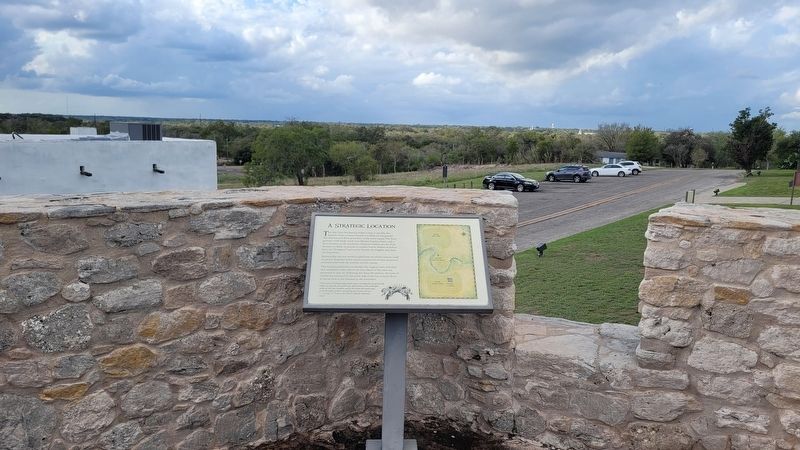
This bastion would have overlooked the original town of Goliad that extended to the walls of the fort. Much of the town was destroyed in 1835-36. Following the Texas Revolution, the town of Goliad was relocated to the north side of the San Antonio River. It can be seen in the distance to the northwest.
"The ruins of Goliad occupy much room, covering the top of the hill; which, on one side, the north-east, looks down on the beautiful valley of the San Antonio, and on the other, the south-west, on the boundless prairie, stretching out, level as the sea."
George
this page online
Erected by Presidio la Bahía State Historic Site.
Topics. This historical marker is listed in these topic lists: Forts and Castles • Hispanic Americans • Religion & Religious Structures • War, Texas Independence.
Location. 28° 38.837′ N, 97° 22.977′ W. Marker is in Goliad, Texas, in Goliad County. It is at the intersection of Calle Cinco de Mayo and Camino de Bexar on Calle Cinco de Mayo. The marker is located inside the courtyard at the southwest corner of the presidio. Touch for map. Marker is in this post office area: Goliad TX 77963, United States of America. Touch for directions.

Regionally, this marker is in South Texas. It is also in the American South. Globally, it is in North America, a Gulf of Mexico state, the Western Hemisphere, the Western World, and the Anglosphere. Historically, it finds itself in what was once New Spain, the Republic of Texas, and one of the Confederate States of America.
Other nearby markers. At least 8 other markers are within walking distance of this marker: A Pitiful Site
Photographed by James Hulse, October 23, 2023
2. The city of Goliad can be seen in the far distance behind the marker
More about this marker. The fort and markers are located on the grounds of the Presidio la Bahía State Historic Site which requires a small entrance fee to access.
Also see . . . Presidio la Bahía State Historic Site. Texas Historical Commission
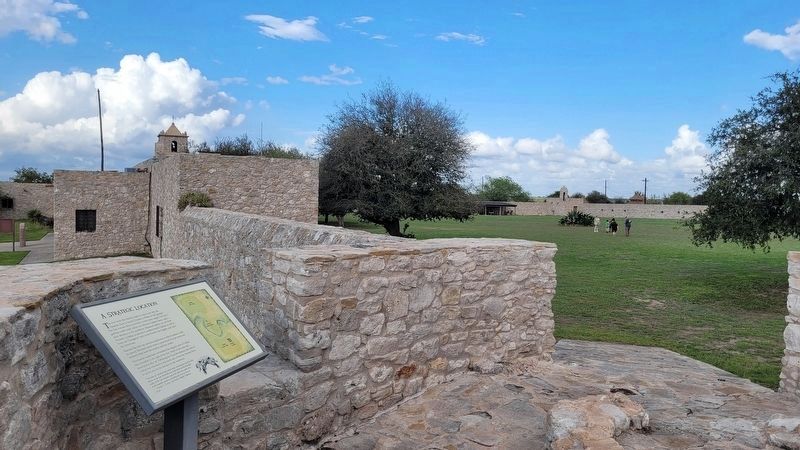
The Presidio, established in 1749 on this site during the Spanish colonial period, was crucial to the development of Texas. Witnessing filibustering expeditions and playing a role in the Mexican war for independence from Spain, the Presidio was the site of(Submitted on October 27, 2023, by James Hulse of Medina, Texas.)the Goliad Massacre on Palm Sunday, March 1836. It played host to one of the bloodiest chapters in Texas' quest for independence from Mexico after the shocking Texian defeat at the Battle of Coleto Creek. The massacre prompted the rallying cry, "Remember Goliad" heard at the Battle of San Jacinto.Photographed by James Hulse, October 23, 20233. The view of the marker on the bastion
Photographed by James Hulse, October 23, 2023
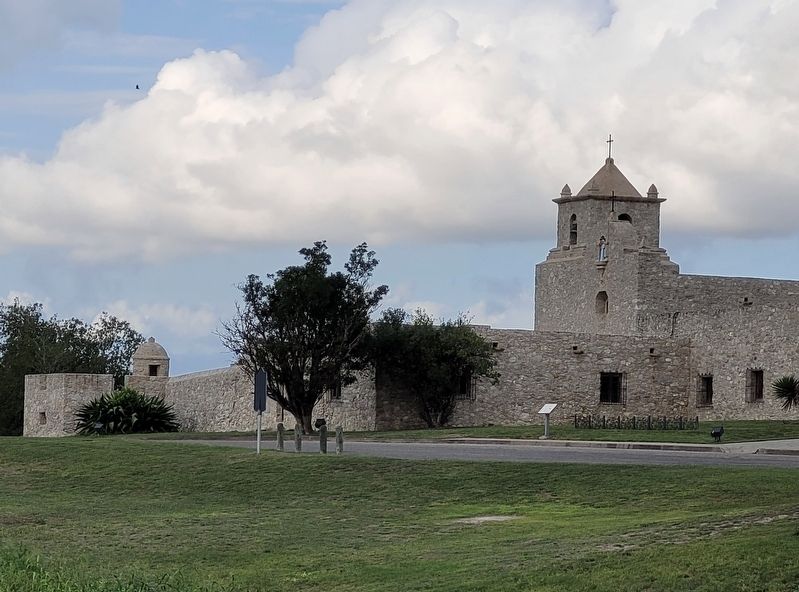
4. The outside view of the presidio and chapel
Credits. This page was last revised on February 28, 2024. It was originally submitted on October 27, 2023, by James Hulse of Medina, Texas. This page has been viewed 235 times since then and 15 times this year. Photos: 1, 2, 3, 4. submitted on October 27, 2023, by James Hulse of Medina, Texas.
