Pella in Marion County, Iowa — The American Midwest (Upper Plains)
Why the Dutch Left Their Homeland
November 5, 2023
1. Why the Dutch Left Their Homeland Marker
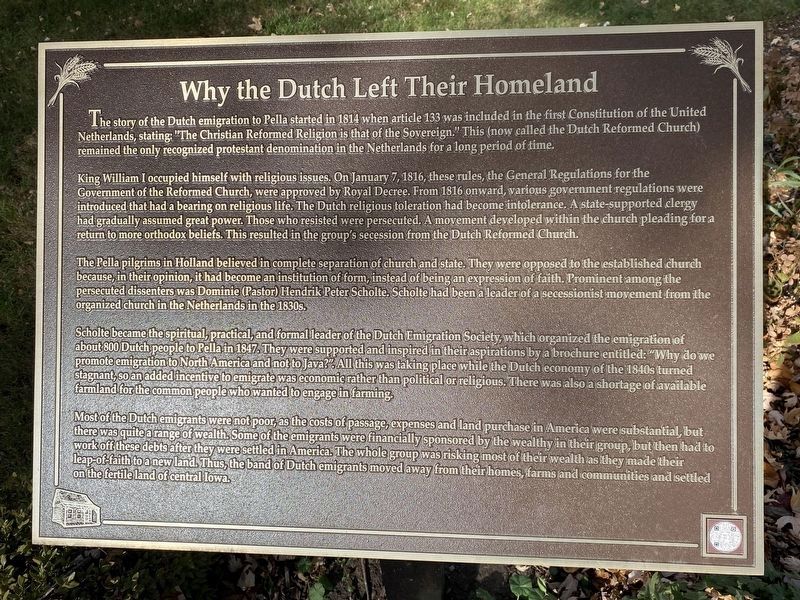
King William I occupied himself with religious issues. On January 7, 1816, these rules, the General Regulations for the Government of the Reformed Church, were approved by Royal Decree. From 1816 onward, various government regulations were introduced that had a bearing on religious life. The Dutch religious toleration had become intolerance. A state-supported clergy had gradually assumed great power. Those who resisted were persecuted. A movement developed within the church pleading for a return to more orthodox beliefs. This resulted in the group's secession from the Dutch Reformed Church.
The Pella pilgrims in Holland believed in complete separation of church and state. They were opposed to the established church because, in their opinion, it had become an institution
this page online
Scholte became the spiritual, practical, and formal leader of the Dutch Emigration Society, which organized the emigration of about 800 Dutch people to Pella in 1847. They were supported and inspired in their aspirations by a brochure entitled: "Why do we promote emigration to North America and not to Java?". All this was taking place while the Dutch economy of the 1840s turned stagnant, so an added incentive to emigrate was economic rather than political or religious. There was also a shortage of available farmland for the common people who wanted to engage in farming.
Most of the Dutch emigrants were not poor, as the costs of passage, expenses and land purchase in America were substantial, but there was quite a range of wealth. Some of the emigrants were financially sponsored by the wealthy in their group, but then had to work off these debts after they were settled in America. The
November 5, 2023
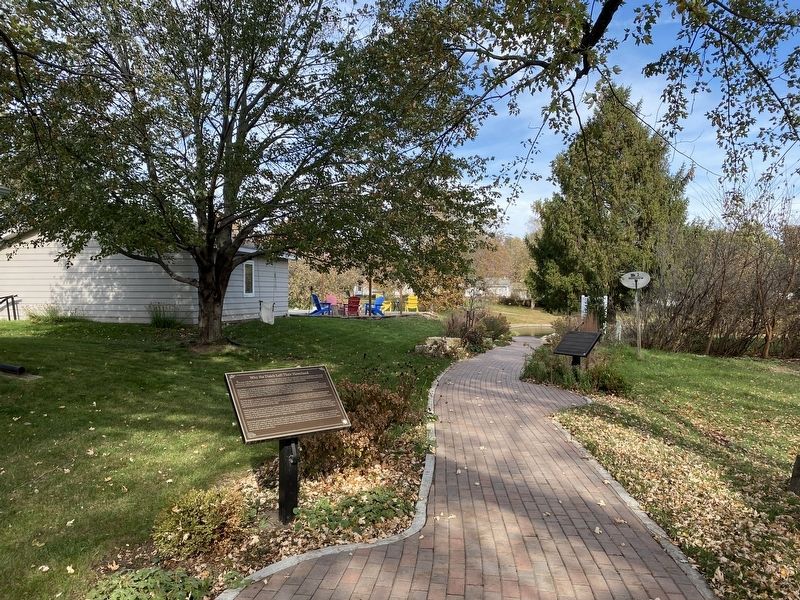
2. Why the Dutch Left Their Homeland Marker, from the south
Erected 2021 by Historic Pella Trust.
Topics. This historical marker is listed in these topic lists: Immigration • Religion & Religious Structures. A significant historical year for this entry is 1814.
Location. 41° 24.664′ N, 92° 54.951′ W. Marker is in Pella, Iowa, in Marion County. It can be reached from Lincoln Street west of Houston Avenue, on the right when traveling west. Located along the Tuttle Learning Walk, between Tuttle Cabin and Sunken Garden Park. Touch for map. Marker is at or near this postal address: 608 Lincoln St, Pella IA 50219, United States of America. Touch for directions.

Regionally, this marker is in Southern Iowa. It is also in the American Midwest and in the Corn Belt. Globally, it is in North America, the Western Hemisphere, the Western World, and the Anglosphere. Historically, it finds itself in what was once the territory of the Mississippian Culture and also the Louisiana Purchase.
Other nearby markers. At least 8 other markers are within walking distance of this marker: A Nod to the Baptists (a few steps from this marker); The Early Years (a few steps from this marker); The Land Before the Dutch (a few steps from this marker); Pella and the Civil War (within shouting distance of this marker); Tuttle Cabin (within shouting distance of this marker); Tulip Time and Sunken Garden (within shouting distance of this marker); Dutch Influence on Today's Pella (within shouting distance of this marker); Pella Civil War Monument (approx. ¼ mile away). Touch for a list and map of all markers in Pella.
Credits. This page was last revised on November 19, 2023. It was originally submitted on November 18, 2023. This page has been viewed 190 times since then and 21 times this year. Photos: 1, 2. submitted on November 18, 2023.
