
Pella in Marion County, Iowa — The American Midwest (Upper Plains)
The Early Years
November 5, 2023
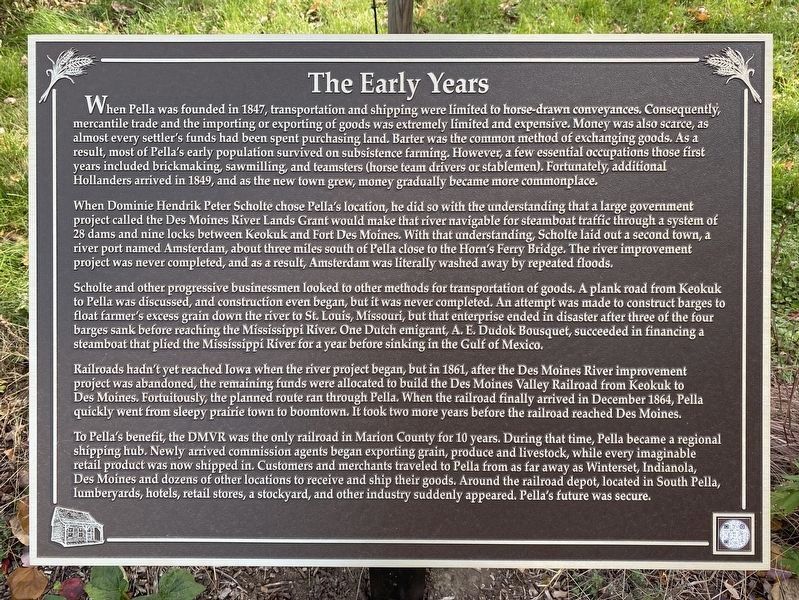
1. The Early Years Marker
When Dominie Hendrik Peter Scholte chose Pella's location, he did so with the understanding that a large government project called the Des Moines River Lands Grant would make that river navigable for steamboat traffic through a system of 28 dams and nine locks between Keokuk and Fort Des Moines. With that understanding, Scholte laid out a second town, a river port named Amsterdam, about three miles south of Pella close to the Horn's Ferry Bridge. The
this page online
Scholte and other progressive businessmen looked to other methods for transportation of goods. A plank road from Keokuk to Pella was discussed, and construction even began, but it was never completed. An attempt was made to construct barges to float farmer's excess grain down the river to St. Louis, Missouri, but that enterprise ended in disaster after three of the four barges sank before reaching the Mississippi River. One Dutch emigrant, A. E. Dudok Bousquet, succeeded in financing a steamboat that plied the Mississippi River for a year before sinking in the Gulf of Mexico.
Railroads hadn't yet reached Iowa when the river project began, but in 1861, after the Des Moines River improvement project was abandoned, the remaining funds were allocated to build the Des Moines Valley Railroad from Keokuk to Des Moines. Fortuitously, the planned route ran through Pella. When the railroad finally arrived in December 1864, Pella quickly went from sleepy prairie town to boomtown. It took two more years before the railroad
November 5, 2023
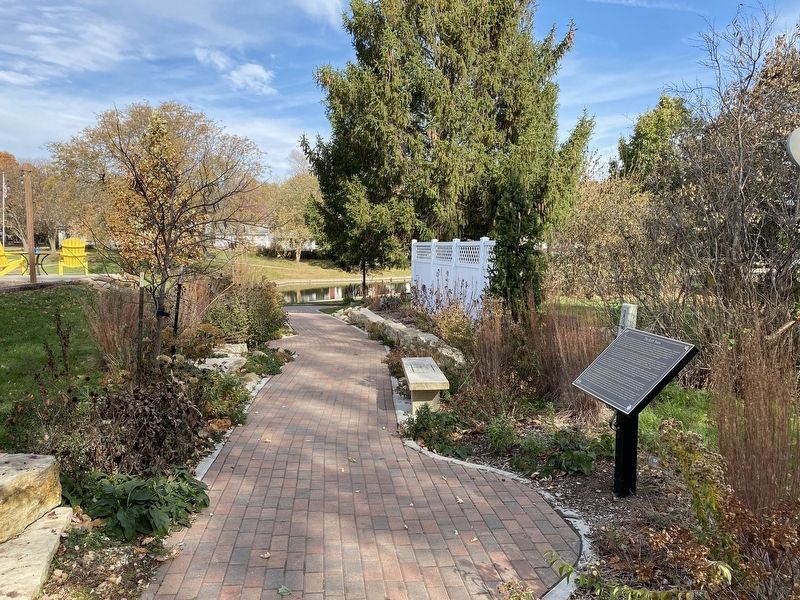
2. The Early Years Marker, from the south
To Pella's benefit, the DMVR was the only railroad in Marion County for 10 years. During that time, Pella became a regional shipping hub. Newly arrived commission agents began exporting grain, produce and livestock, while every imaginable retail product was now shipped in. Customers and merchants traveled to Pella from as far away as Winterset, Indianola, Des Moines and dozens of other locations to receive and ship their goods. Around the railroad depot, located in South Pella, lumberyards, hotels, retail stores, a stockyard, and other industry suddenly appeared. Pella's future was secure.
Erected 2021 by Historic Pella Trust.
Topics. This historical marker is listed in these topic lists: Railroads & Streetcars • Roads & Vehicles • Waterways & Vessels. A significant historical year for this entry is 1847.
Location. 41° 24.673′ N, 92° 54.948′ W. Marker is in Pella, Iowa, in Marion County. It can be reached from Lincoln Street west of Houston Avenue, on the right when traveling west. Located along the Tuttle Learning Walk, between Tuttle Cabin and Sunken Garden Park. Touch for map. Marker is at or near this postal address: 608 Lincoln St, Pella IA 50219, United States of America. Touch for directions.

Regionally, this marker is in Southern Iowa. It is also in the American Midwest and in the Corn Belt. Globally, it is in North America, the Western Hemisphere, the Western World, and the Anglosphere. Historically, it finds itself in what was once the territory of the Mississippian Culture and also the Louisiana Purchase.
Other nearby markers. At least 8 other markers are within walking distance of this marker: A Nod to the Baptists (a few steps from this marker); Pella and the Civil War (a few steps from this marker); Why the Dutch Left Their Homeland (a few steps from this marker); Tulip Time and Sunken Garden (a few steps from this marker); Dutch Influence on Today's Pella (a few steps from this marker); The Land Before the Dutch (within shouting distance of this marker); Tuttle Cabin (within shouting distance of this marker); Pella Civil War Monument (approx. 0.3 miles away). Touch for a list and map of all markers in Pella.
Credits. This page was last revised on November 19, 2023. It was originally submitted on November 18, 2023. This page has been viewed 164 times since then and 20 times this year. Photos: 1, 2. submitted on November 18, 2023.
