Chinatown in Vancouver in Metro Vancouver, British Columbia — Canada’s West Coast (North America)
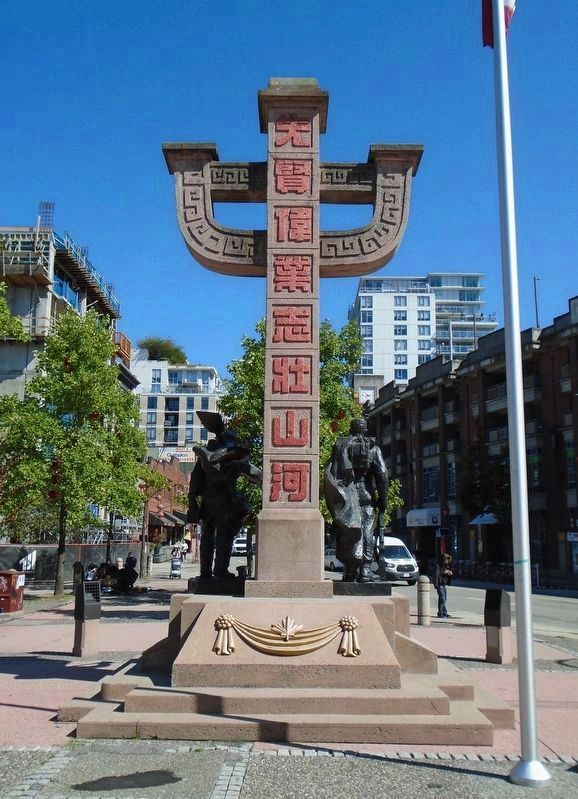
Chinatown Memorial Monument
加華豐功光昭日月
| — | 先賢偉業志壯山河 | — |

Photographed by Adam Margolis, October 14, 2023
1. Chinatown Memorial Monument
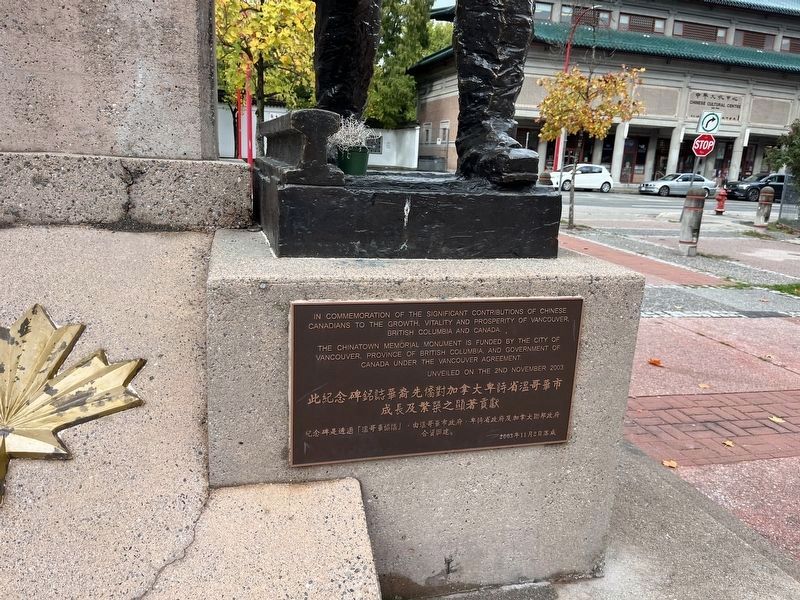
Sculpture by Arthur Shu-Ren Cheng.
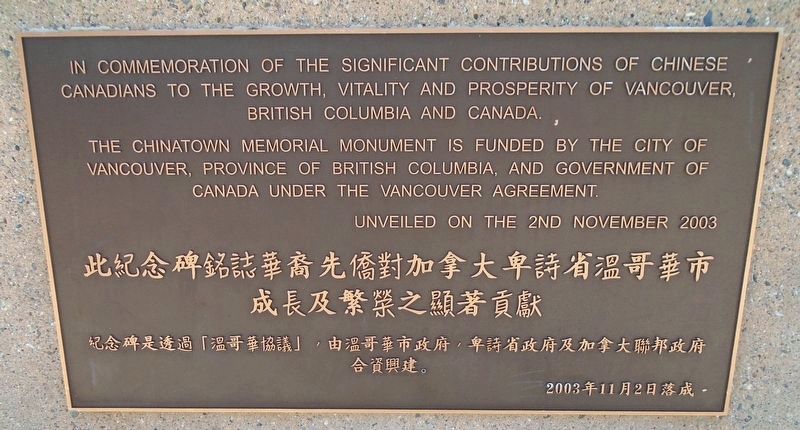
Vancouver, British Columbia and Canada.
The Chinatown Memorial Monument is funded by the City of Vancouver, Province of British Columbia, and Government of Canada
under the Vancouver Agreement
Unveiled on the 2nd November 2003
此紀念碑銘誌華裔先僑對加拿大卑詩省溫哥華市
成長及繁榮之顯著貢獻
紀念碑是透過「溫哥華協議」, 由溫哥華市政府 , 卑詩省政府及加拿大聯邦政府
合資興建。
2003年11月2日落成
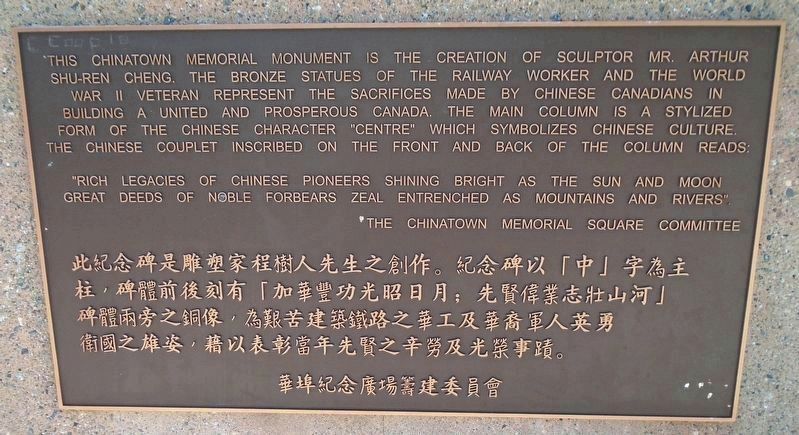
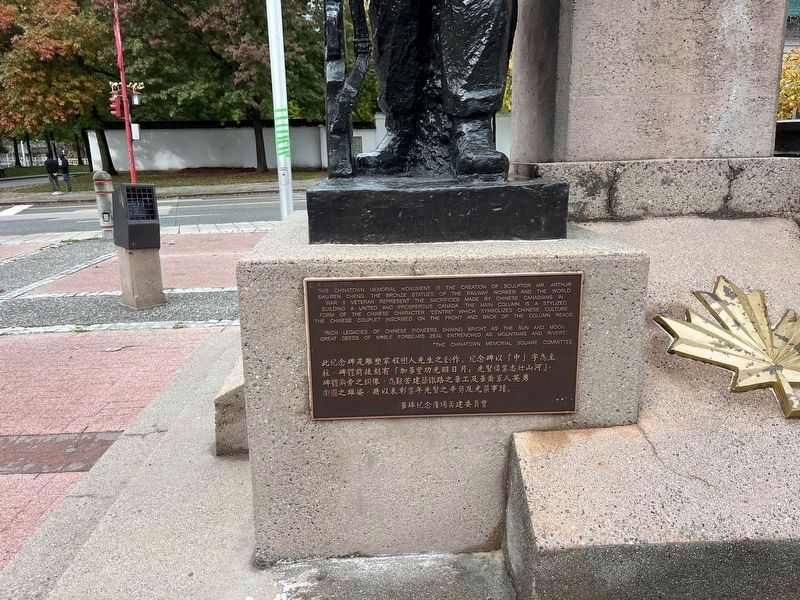
This Chinatown Memorial Monument is the creation of sculptor Mr. Arthur
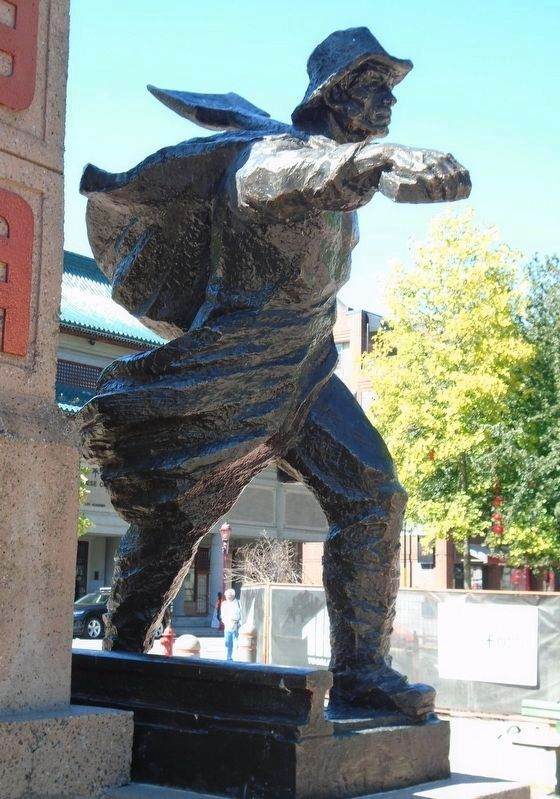
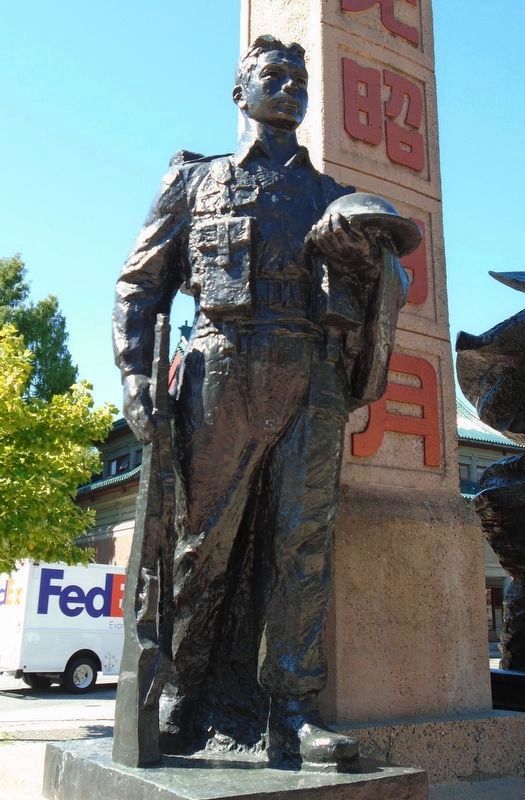
Shu-Ren Cheng. The bronze statues of the railway worker and the World War II veteran represent the sacrifices
this page online
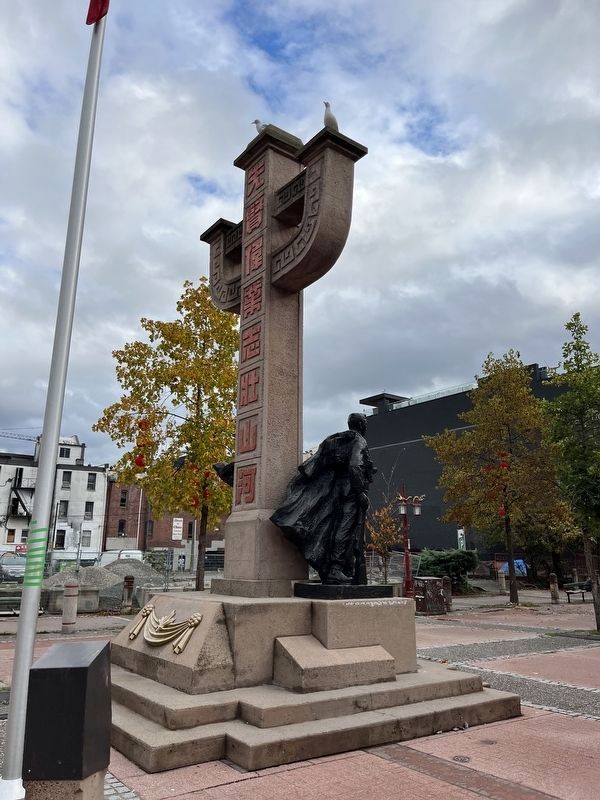
"Rich legacies of Chinese pioneers shining bright as the sun and moon
Great deeds of noble forbears zeal entrenched as mountains and rivers".
The Chinatown Memorial Square Committee
此紀念碑是雕塑家程樹人先生之創作。紀念碑以「中」字為主
柱,碑體前後刻有「加華豐功光昭日月;先賢偉業志壯山河」
碑體兩旁之銅像,為艱苦建築鐵路之華工及華裔軍人英勇
衛國之雄姿,藉以表彰當年先賢之辛勞及光榮事蹟。
華埠紀念廣場籌建委員會
Erected 2003
Photographed by William Fischer, Jr., August 28, 2024
2. Chinatown Memorial Monument (rear)
Sculpture by Arthur Shu-Ren Cheng.
Topics. This monument and memorial is listed in these topic lists: Immigration • Railroads & Streetcars • Settlements & Settlers • War, World II.
Location. 49° 16.771′ N, 123° 6.12′ W. Monument is in Vancouver, British Columbia, in Metro Vancouver. It is in Chinatown. It is on Keefer Street. Touch for map. Monument is at or near this postal address: 135-137 Keefer St, Vancouver BC V6A 4H5, Canada. Touch for directions.

Regionally, this memorial monument is on the Lower Mainland and in Coast & Mountains. Globally, it is in North America, in the Cascade Range, in the Inside Passage, on the Ring of Fire, on the Pacific Rim, in the Western Hemisphere, in the Western World, and in the Anglosphere. Historically, it finds itself in what was once a British colony.
Other nearby markers. At least 8 other markers are within walking distance of this marker: Chinese Cultural Centre (about 120 meters away, measured in a direct line); Chinese Freemasons Building (about 240 meters away); Carnegie Library (about 240 meters away);
Photographed by William Fischer, Jr., August 28, 2024
3. Chinatown Memorial Monument Dedication
Also see . . .
1. Chinese-Canadian secret warriors in the Pacific. Excerpt:
The first use of Chinese Canadians in the Pacific was for Operation Oblivion. Its aim was to infiltrate the Chinese mainland around Hong Kong and work with anti-Japanese forces in conducting clandestine operations against the Japanese. The SOE sent Major Mike Kendall, a Canadian who had lived in Hong Kong and whose wife was Chinese-American, to recruit Chinese Canadians for the operation. With the assistance of the Canadian military and RCMP, he was able to start recruiting Chinese Canadians. By May 1944 he had recruited Roger Cheng, the first Chinese Canadian officer in the Royal Canadian Corps of Signals, and thirteen soldiers on training in the Canadian Army for the operation.(Submitted on July 8, 2024.)
2. Bill Chong (Agent 50), a secret agent whose career never had a dull moment.
Photographed by William Fischer, Jr., August 28, 2024
4. Chinatown Memorial Monument Symbolism
Bill Chong, born in Vancouver, was caught up with the Japanese takeover of Hong Kong in 1941 and volunteered with the British Army Aid Group, an intelligence unit, serving as Agent 50 under extreme dangerous and hostile conditions in China. ...(Submitted on July 23, 2025.)
Chong survived the war, and at 91, is one of a select group of veterans — Chinese-Canadians — who joined up to fight for Canada and the British Empire at a time when they weren’t allowed to vote or go into professions such as medicine or law.
3. From Oblivion to Triumph - How Two Vancouverites Meeting in Free China Changed Canadian History. Approx. one hour YouTube illustrated presentation by Rick Green. (Submitted on July 24, 2025.)
Additional commentary.
1. Regarding "Also see" Link No. 1
Regarding the sentence "The first use of Chinese Canadians in the Pacific was for Operation Oblivion."
— William Gun "Bill" Chong was recruited into the British Army Aid Group in May 1942, two years before Oblivion. (See Also See Link No. 2.)
Also, Operation Oblivion was cancelled on 26 January 1945. Therefore, as such, Oblivion was not "the
Photographed by Adam Margolis, October 14, 2023
5. Chinatown Memorial Monument
Regarding "The SOE sent Major Mike Kendall..."
— Francis Woodley "Mike" Kendall was a Canadian civilian who served in the Special Operations Executive. He was never in the military. As such, it is incorrect to refer to him as "Major". This gives the incorrect impression that he was a soldier in the military. Kendall only assumed a nominal rank when liaising with the military so that he would be afforded courtesies appropriate to his status and mission role. This differed from those recruited into SOE from the military who retained their military rank.
Regarding: "...Roger Cheng, the first Chinese Canadian officer in the Royal Canadian Corps of Signals, and thirteen soldiers..."
— The original recruits for Operation Oblivion numbered 13 in total, including Roger Cheng: They were:
John Ko Bong • Roy Sin Twe Chan • Roger Kee Cheng • Eddie Chow • Douglas Jung • Louis “Louey” King • George Thomas “Tom/Tommy” Lock • Norman Mon Low • Raymond Young Lowe • James “Jim/Jimmy” Shiu • Henry Albert (Hank) Wong • Norman Donald Wong • Wing Lee Wong
The significance of Operation Oblivion was that it provided the
Photographed by Adam Margolis, October 14, 2023
6. Chinatown Memorial Monument
— Submitted July 23, 2025.
Photographed by Adam Margolis, October 14, 2023
7. Chinatown Memorial Monument
Sculpture by Arthur Shu-Ren Cheng.
Photographed by William Fischer, Jr., August 28, 2024
8. Chinatown Memorial Monument Railway Worker
2003 bronze by Arthur Shu-Ren Cheng.
Photographed by William Fischer, Jr., August 28, 2024
9. Chinatown Memorial Monument Soldier
2003 bronze by Arthur Shu-Ren Cheng.
Credits. This page was last revised on July 28, 2025. It was originally submitted on November 19, 2023, by Adam Margolis of Mission Viejo, California. This page has been viewed 473 times since then and 113 times this year. Photos: 1. submitted on November 19, 2023, by Adam Margolis of Mission Viejo, California. 2, 3, 4. submitted on August 29, 2024, by William Fischer, Jr. of Reynoldsburg, Ohio. 5, 6, 7. submitted on November 19, 2023, by Adam Margolis of Mission Viejo, California. 8, 9. submitted on August 29, 2024, by William Fischer, Jr. of Reynoldsburg, Ohio. • J. Makali Bruton was the editor who published this page.
