Decorah in Winneshiek County, Iowa — The American Midwest (Upper Plains)
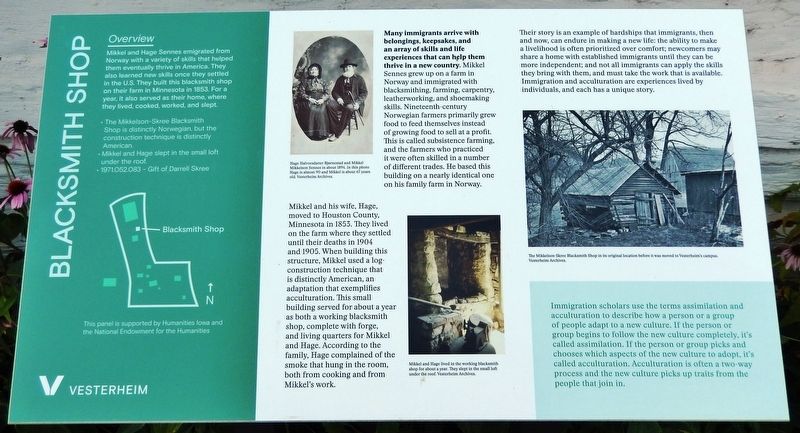
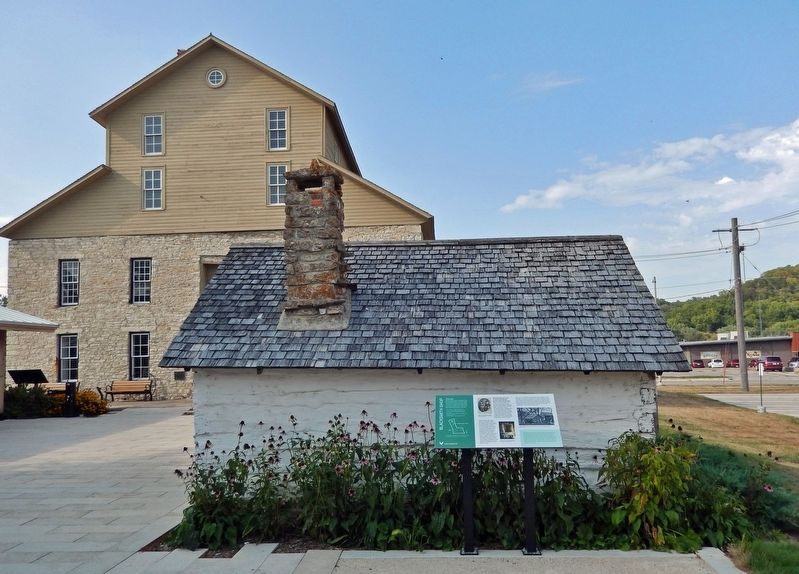
Blacksmith Shop
Heritage Park, Vesterheim Norwegian-American Museum
Photographed by Cosmos Mariner, September 9, 2023
1. Blacksmith Shop Marker
Overview
Mikkel and Hage Sennes emigrated from Norway with a variety of skills that helped them eventually thrive in America. They also learned new skills once they settled in the U.S. They built this blacksmith shop on their farm in Minnesota in 1853. For a year, it also served as their home, where they lived, cooked, worked, and slept.
• The Mikkelson-Skree Blacksmith Shop is distinctly Norwegian, but the construction technique is distinctly American.
• Mikkel and Hage slept in the small loft under the roof.
• 1971.052.083 — Gift of Darrell Skree
Many immigrants arrive with belongings, keepsakes, and an array of skills and life experiences that can help them thrive in a new country. Mikkel Sennes grew up on a farm in Norway and immigrated with blacksmithing, farming, carpentry, leatherworking, and shoemaking skills. Nineteenth-century Norwegian farmers primarily grew food to feed themselves instead of growing food to sell at a profit. This is called subsistence farming, and the farmers who practiced it were often skilled in a number of different trades. He based this building on a nearly identical one on his family farm
this page online
Mikkel and his wife, Hage, moved to Houston County, Minnesota in 1853. They lived on the farm where they settled until their deaths in 1904 and 1905. When building this structure, Mikkel used a log-construction technique that is distinctly American, an adaptation that exemplifies acculturation. This small building served for about a year as both a working blacksmith shop, complete with forge, and living quarters for Mikkel and Hage. According to the family, Hage complained of the smoke that hung in the room, both from cooking and from Mikkel's work.
Their story is an example of hardships that immigrants, then and now, can endure in making a new life: the ability to make a livelihood is often prioritized over comfort; newcomers may share a home with established immigrants until they can be more independent; and not all immigrants can apply the skills they bring with them, and must take the work that is available. Immigration and acculturation are experiences lived by individuals, and each has a unique story.
Immigration scholars use the terms assimilation and acculturation to describe how a person or a group of people adapt

Vesterheim Archives
2. Marker detail: Hage Halvorsdatter Bjǿrnestad and Mikkel Mikkelson Sennes in about 1894.
In this photo Hage is almost 90 and Mikkel is about 67 years old.
Erected by Vesterheim Norwegian-American Museum.
Topics and series. This historical marker is listed in these topic lists: Architecture • Immigration • Settlements & Settlers. In addition, it is included in the Norwegian-Americans series list. A significant historical year for this entry is 1853.
Location. 43° 18.333′ N, 91° 47.525′ W. Marker is in Decorah, Iowa, in Winneshiek County. It can be reached from North Mill Street just north of West Water Street, on the right when traveling north. The marker is located in Vesterheim Norwegian-American Museum Heritage Park. Touch for map. Marker is at or near this postal address: 520 West Water Street, Decorah IA 52101, United States of America. Touch for directions.

Regionally, this marker is in Northeast Iowa — the Driftless Area and in Eastern Iowa.

Vesterheim Archives
3. Marker detail: Mikkel and Hage lived in the working blacksmith shop for about a year.
They slept in the small loft under the roof.
Other nearby markers. At least 8 other markers are within walking distance of this marker: Stovewood House (here, next to this marker); Painter-Bernatz Mill (a few steps from this marker); Conservation (a few steps from this marker); Timber Framing (a few steps from this marker); Haugan House (within shouting distance of this marker); Rovang Schoolhouse (within shouting distance of this marker); Stabbur (within shouting distance of this marker); Bethania Church (within shouting distance of this marker). Touch for a list and map of all markers in Decorah.
Related markers. Click here for a list of markers that are related to this marker. Vesterheim Norwegian-American Museum Heritage Park
Also see . . . Mikkelson-Skree Blacksmith Shop. (Includes link to a virtual tour of the interior.) Excerpt:
Sheldon Township, Houston County, Minnesota (1854). Mikkel and Hage Sinnes came from Telemark, Norway in 1849, finally settling in Minnesota in 1853. Two years later, Mikkel erected this building, a blend of Norwegian and American vernacular architecture. It is typical in form to blacksmith shops found on farms in Norway, but uses the efficient pioneer method of log construction with dovetail notching.(Submitted on November 23, 2023, by Cosmos Mariner of Cape Canaveral, Florida.)

Vesterheim Archives
4. Marker detail: The Mikkelson-Skree Blacksmith Shop in its original location.
Before it was moved to Vesterheim's campus.
Photographed by Cosmos Mariner, September 9, 2023
5. Blacksmith Shop Marker
Looking north through Heritage Park. Marker is on the south side of the Blacksmith Shop.

Photographed by Cosmos Mariner, September 9, 2023
6. Blacksmith Shop (southwest elevation)
Credits. This page was last revised on November 24, 2023. It was originally submitted on November 22, 2023, by Cosmos Mariner of Cape Canaveral, Florida. This page has been viewed 265 times since then and 50 times this year. Photos: 1, 2, 3, 4, 5, 6. submitted on November 23, 2023, by Cosmos Mariner of Cape Canaveral, Florida.
