Cape Girardeau in Cape Girardeau County, Missouri — The American Midwest (Upper Plains)
Fort D

Photographed by Cosmos Mariner, August 21, 2021
1. Fort D Marker
“Fort D,” one of the four forts erected in Cape Girardeau by Union forces in 1861, is the only one preserved. Its site southeast of the town was chosen to command the entire bend of the river southward, and also the river road from downstream.
Inclined embankments were built with ditches on the outside. A rectangular gun emplacement projected diagonally at each corner. These earthworks may still be seen.
The soldiers made a bowling alley on the terreplein of the Fort using huge sticks of wood for pins and 32 pound cannon balls to bowl them over.
During extremely cold weather some of the soldiers dug caves into the steep hillside north of the Fort and became temporarily troglodytes; but most of them decided the extra comfort did not warrant the extra work.
Erected by Rotary International.
Topics and series. This historical marker is listed in these topic lists: Architecture • Charity & Public Work • Forts and Castles • War, US Civil. In addition, it is included in the National Register of Historic Places (NRHP), the Rotary International, and the Works Progress Administration (WPA) projects series
this page online
Location. 37° 17.444′ N, 89° 31.597′ W. Marker is in Cape Girardeau, Missouri, in Cape Girardeau County. It can be reached from the intersection of Fort Street and Westport Street, on the right when traveling west. The marker is mounted at ground level, just inside the fort entrance, overlooking the fort. Touch for map. Marker is at or near this postal address: 920 Fort Street, Cape Girardeau MO 63701, United States of America. Touch for directions.

Regionally, this marker is in Southeast Missouri. It is also in the American Ozarks, in the Lewis & Clark Corridor, in the Corn Belt, and in the Great River Road Region. Globally, it is in North America, the Western Hemisphere, the Western World, and the Anglosphere. Historically, it finds itself in what was once the territory of the Mississippian Culture, the Louisiana Purchase, and the Antebellum South.
Other nearby markers. At least 8 other markers are within walking distance of this marker: Grant Takes Command (here, next to this marker); Unwanted, Untrained & Indispensable (here, next to this marker); The 20th Illinois Regiment
Photographed by Cosmos Mariner, August 21, 2021
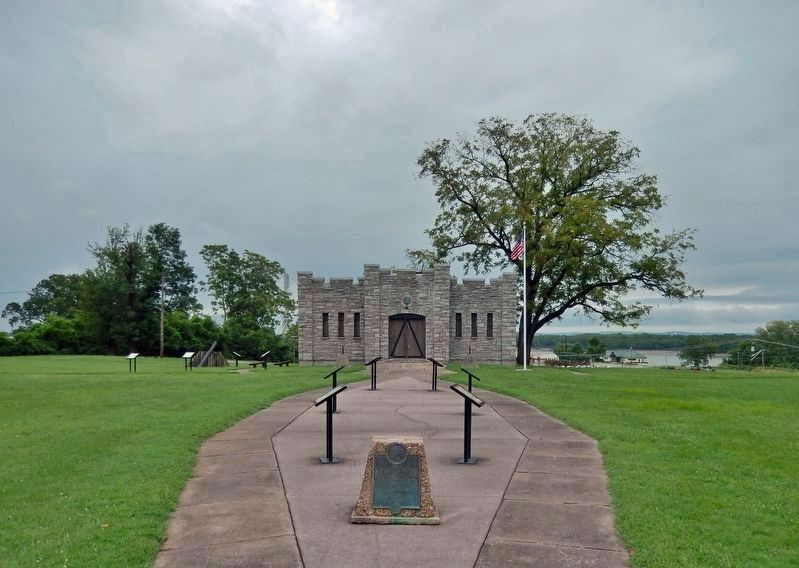
2. Fort D Marker
Marker is in the foreground, at the center of the walkway. The Fort D Museum/Blockhouse and the Mississippi River are in the background.
Regarding Fort D. National Register of Historic Places #100004219.
From the National Register Nomination:
The fort was one of four earthworks structures around three sides of the city of Cape Girardeau, the fourth side being the Mississippi River. The purpose of the forts was to prevent attack from the land sides of the city, the Mississippi River protecting the city on its eastern flank. Fort D is the only surviving remnant of Missouri’s numerous “city” forts, which were forts surrounding Missouri centers of population during the Civil War. The fort originally consisted of a continuous earthwork called a redan that resembles two sides of a triangle with wings. The third side of the triangle was not made of earth, but rather was a simple wooden palisade wallor fence, of indeterminate height, that served to define the rear of the redan, an area called a gorge.Photographed by Cosmos Mariner, August 21, 20213. National Register of Historic Places Marker(mounted in front of the Museum/Blockhouse)
☆ 1861 ☆National Register
of
Historic Places
2019Located within the earthwork walls is a museum structure, constructed in 1937 by the WPA. This museum was also built to be the meeting house for the American Legion. The style of the building is WPA Rustic. The walls of this structure, locally referred to as the blockhouse, are made of limestone that was salvaged from another building. The foundation is concrete. The roof line of the building resembles a castellated parapet, giving the building a distinct, small-scale castle-like appearance.

Related markers. Click here for a list of markers that are related to this marker. Fort D Historic Site
Also see . . .
1. Fort D (Wikipedia). Excerpt:
Work on Fort D began on August 6, 1861, under the direction of Lieutenant John W. Powell of Illinois. Later, Powell recruited a company of men from Cape Girardeau to serve in the Union army. Fort D is the only surviving fortification built by Union troops in the area during the Civil War.(Submitted on November 25, 2023, by Cosmos Mariner of Cape Canaveral, Florida.)The fort was saved from development in the early 20th century. The earthworks were repaired
by the Works Progress Administration during the 1930s. The stone blockhouse was also built by the WPA in 1936 and has been used for various purposes since.Photographed by Cosmos Mariner, August 21, 20214. Fort D Museum/Blockhouse (southwest/front elevation)From the National Register Nomination: The front of the building, which faces southwest, has an entrance area with door aperture and six window apertures. The entrance makes up the central bay and projects out from the rest of the building; buttresses are located at each end of the projecting central bay and at the corners of the façade. Three narrow window openings are situated to either side of the central bay. The doorway is slightly arched, with a metal gate serving as the entry door, above which is a circular emblem for the American Legion.

2. John Wesley Powell’s Fort D Historic Site.
In December of 1860 South Carolina seceded from the Union following the election of Abraham Lincoln in November. The first regular Union troops, members of the 20th Illinois Volunteer Regiment, landed in Cape Girardeau on July 6th, 1861. Rumors abounded as to the likelihood of the city being attacked by secessionist forces. Construction work on Fort D began on August 6, 1861, under the direction of Lieutenant John Wesley Powell.(Submitted on November 25, 2023, by Cosmos Mariner of Cape Canaveral, Florida.)

Photographed by Cosmos Mariner, August 21, 2021
5. Fort D Museum/Blockhouse (northwest elevation)
From the National Register Nomination: The northwest elevation shows how the front section of the building is wider than the rear section.

Photographed by Cosmos Mariner, August 21, 2021
6. Fort D Museum/Blockhouse (southeast elevation)
From the National Register Nomination: The southeast elevation has one door aperture, situated in the rear or northeast portion of the building which today has a steel gate. The door is reached by a concrete platform with two steps.
Photographed by Cosmos Mariner, August 21, 2021
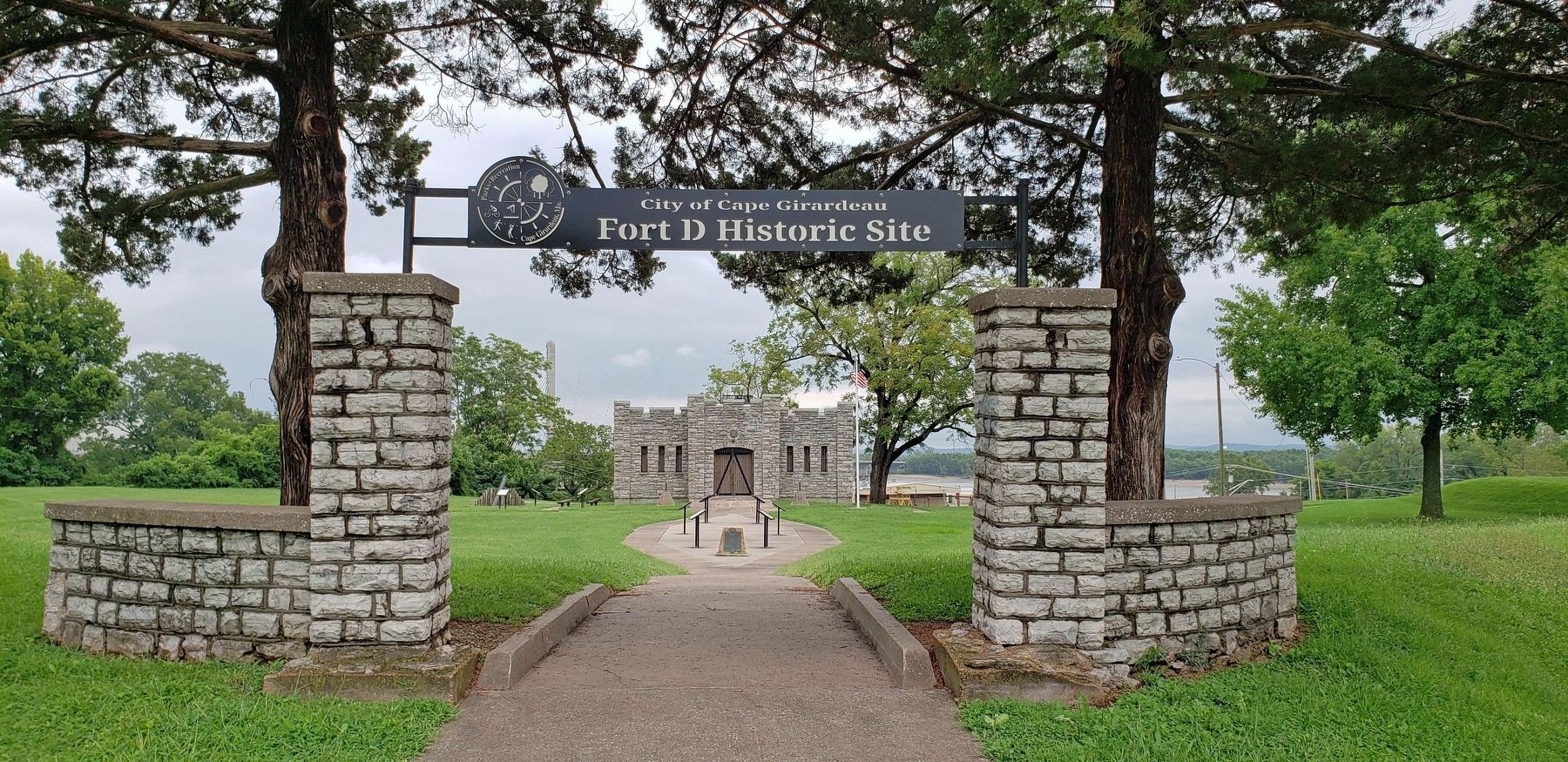
7. Fort D Historic Site Entrance
Looking northeast from the intersection of Fort Street and Westport Street. The entry gate was built by the Works Progress Administration in 1936-1937.
Photographed by Cosmos Mariner, August 21, 2021
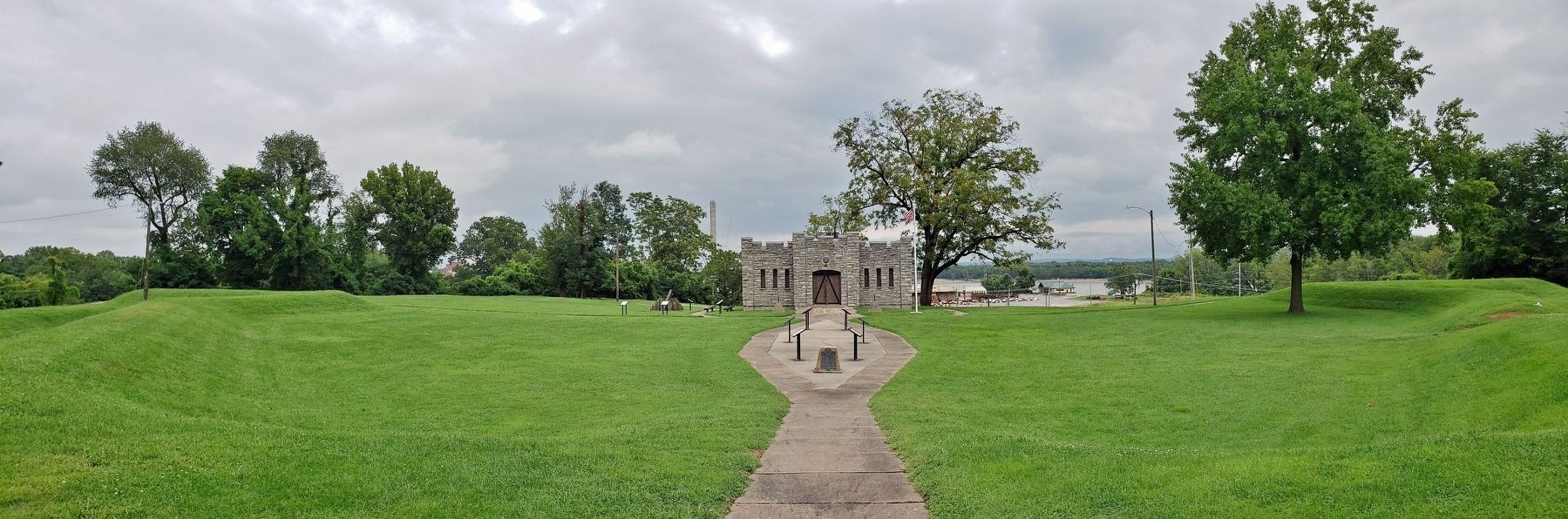
8. Fort D Historic Site
Credits. This page was last revised on November 28, 2023. It was originally submitted on November 25, 2023, by Cosmos Mariner of Cape Canaveral, Florida. This page has been viewed 528 times since then and 103 times this year. Photos: 1, 2, 3, 4, 5, 6, 7. submitted on November 25, 2023, by Cosmos Mariner of Cape Canaveral, Florida. 8. submitted on November 28, 2023, by Cosmos Mariner of Cape Canaveral, Florida.
