Greeneville in Greene County, Tennessee — The American South (East South Central)
Andrew Johnson
National Historic Site
| — | Andrew Johnson National Cemetery | — |
Photographed by Stanley and Terrie Howard, September 27, 2009
1. Andrew Johnson Marker
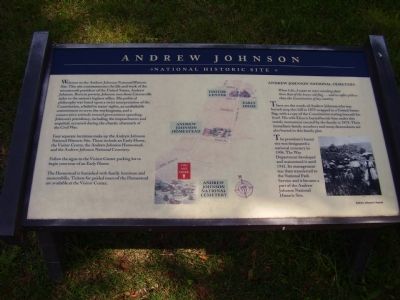
Welcome to the Andrew Johnson National Historic Site. This site commemorates the life and work of the seventeenth president of the United States, Andrew Johnson. Born in poverty, Johnson rose from Greeneville tailor to the nation's highest office. His political philosophy was based upon a strict interpretation of the Constitution, a belief in states' rights, an unshakable commitment to serve the workingman, and a conservative attitude toward government spending. Johnson's presidency, including the impeachment and acquittal, occurred during the chaotic aftermath of the Civil War.
Four separate locations make up the Andrew Johnson National Historic Site. These include an Early Home, the Visitor Center, the Andrew Johnson Homestead, and the Andrew Johnson National Cemetery.
Follow the signs to the Visitor Center parking lot to begin your tour of an Early Home.
The Homestead is furnished with family furniture and memorabilia. Tickets for guided tours of the Homestead are available at the Visitor Center.
Andrew Johnson National Cemetery
When I die, I want no more winding sheet than that of the brave old flag...and no softer pillow than the Constitution of my country.
These
this page online
The president's burial site was designated a national cemetery in 1906. The War Department developed and maintained it until 1942. Its management was then transferred to the National Park Service and it became a part of the Andrew Johnson National Historic Site.
Topics and series. This historical marker is listed in this topic list: Cemeteries & Burial Sites. In addition, it is included in the Former U.S. Presidents: #17 Andrew Johnson, and the National Cemeteries series lists. A significant historical year for this entry is 1875.
Location. 36° 9.33′ N, 82° 50.258′ W. Marker is in Greeneville, Tennessee, in Greene County. It is on Monument Avenue. Touch for map. Marker is at or near this postal address: 121 Monument Avenue, Greeneville TN 37743, United States of America. Touch for directions.

Regionally,
Photographed by Bill Coughlin, August 12, 2012
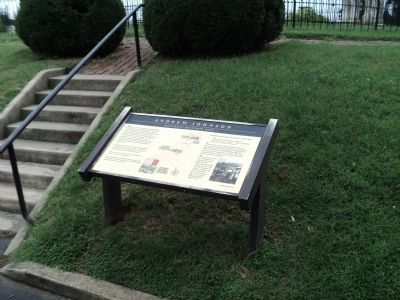
2. Andrew Johnson Marker
Other nearby markers. At least 8 other markers are within walking distance of this marker: Andrew Johnson and Eliza Johnson Grave Marker (a few steps from this marker); A Hill with a Pleasant View (within shouting distance of this marker); World War I Memorial (about 300 feet away, measured in a direct line); Andrew Johnson National Cemetery (about 400 feet away); Address by President Lincoln (about 400 feet away); Greene County / Hawkins County (approx. 0.4 miles away); Classic American La France (approx. 0.4 miles away); McKee Street "Flagship of Greeneville Mayoralty" (approx. 0.4 miles away). Touch for a list and map of all markers in Greeneville.
Also see . . . A Short History of the (Andrew Johnson) National Cemetery.
Photographed by Bill Coughlin, August 12, 2012
3. Andrew Johnson Marker
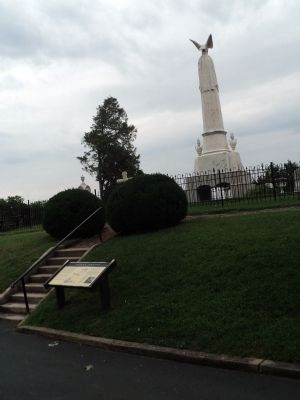
The grave of Andrew Johnson can be seen behind the marker.
Photographed by Stanley and Terrie Howard, September 27, 2009
4. Andrew Johnson Marker
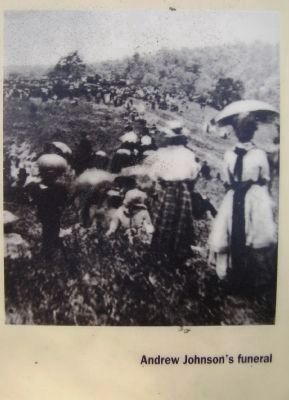
A picture taken at Andrew Johnson's funeral is featured in the lower right of the marker.
Photographed by Stanley and Terrie Howard, September 27, 2009
5. Andrew Johnson Marker
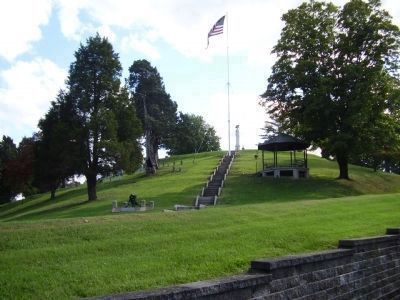
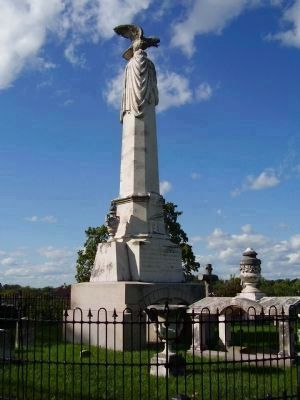
The family erected a tall obelisk over Andrew and Eliza Johnson’s grave in 1878. There was a dedication ceremony, and afterwards, this became known as “Monument Hill.”
Photographed by Stanley and Terrie Howard, September 27, 2009
6. Andrew Johnson Grave Monument
Photographed by Stanley and Terrie Howard, September 27, 2009
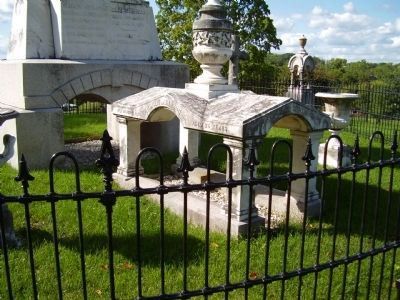
7. Andrew Johnson Grave Monument
Photographed by Stanley and Terrie Howard, September 27, 2009
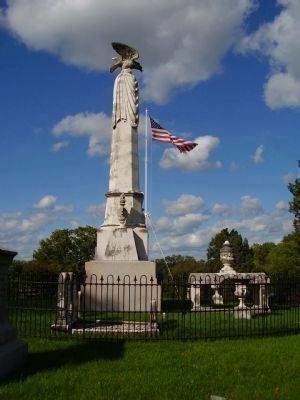
8. Andrew Johnson Grave Monument
Photographed by Stanley and Terrie Howard, September 27, 2009
9. Andrew Johnson Grave Monument
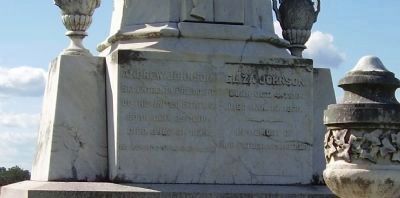
Andrew Johnson, seventeenth President of the United States. Born Dec. 29, 1808, died July 31, 1875. His faith in the people never wavered.
Eliza Johnson, Born Oct 4, 1810, died Jan, 15, 1876. In memory of our father and mother.
Eliza Johnson, Born Oct 4, 1810, died Jan, 15, 1876. In memory of our father and mother.
Photographed by Stanley and Terrie Howard, September 27, 2009
10. Caretaker's House
Photographed by Stanley and Terrie Howard, September 27, 2009
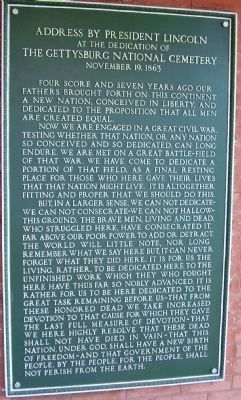
11. Address by President Lincold at the Dedication of the Gettysburg National Cemetery November 19,1863
President Lincoln's Gettysburg Address is a common fixture at all National Cemeteries.
Photographed by Stanley and Terrie Howard, September 27, 2009
12. President Lincoln's Gettysburg Address Plaque
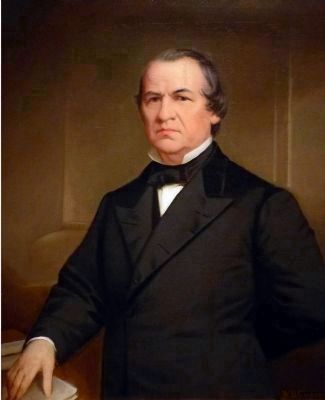
Photographed by Allen C. Browne, February 16, 2015
13. Andrew Johnson
This portrait by Washington B. Cooper hangs in the National Portrait Gallery in Washington DC.
“A onetime tailor whose wife had taught him to read, Andrew Johnson had a gift for public speaking that launched him on a successful political career leading to a Senate seat in 1856. In 1864, Abraham Lincoln, in a gesture of unity, chose Johnson — a southern Democrat from Tennessee but a staunch defender of the Union — as his running mate. When Johnson succeeded to the presidency after Lincoln's assassination in April 1865, it became clear that his view of Reconstruction, which would return power to the white southern planters and allow returning southern states to deprive freed slaves of their rights, clashed not only with Lincoln's views but with the Republican majority in Congress. The resultant clash led to his impeachment, from which he survived conviction by only one vote.
Washington B. Cooper was a leading Tennessee portraitist, and Johnson sat for him on several occasions. Although this likeness is undated, Johnson's apparent age in the picture suggests that it was painted during his presidency.” — National Portrait Gallery
“A onetime tailor whose wife had taught him to read, Andrew Johnson had a gift for public speaking that launched him on a successful political career leading to a Senate seat in 1856. In 1864, Abraham Lincoln, in a gesture of unity, chose Johnson — a southern Democrat from Tennessee but a staunch defender of the Union — as his running mate. When Johnson succeeded to the presidency after Lincoln's assassination in April 1865, it became clear that his view of Reconstruction, which would return power to the white southern planters and allow returning southern states to deprive freed slaves of their rights, clashed not only with Lincoln's views but with the Republican majority in Congress. The resultant clash led to his impeachment, from which he survived conviction by only one vote.
Washington B. Cooper was a leading Tennessee portraitist, and Johnson sat for him on several occasions. Although this likeness is undated, Johnson's apparent age in the picture suggests that it was painted during his presidency.” — National Portrait Gallery
Credits. This page was last revised on February 11, 2022. It was originally submitted on October 26, 2009, by Stanley and Terrie Howard of Greer, South Carolina. This page has been viewed 2,974 times since then and 60 times this year. Photos: 1. submitted on October 26, 2009, by Stanley and Terrie Howard of Greer, South Carolina. 2, 3. submitted on August 13, 2012, by Bill Coughlin of Woodland Park, New Jersey. 4, 5, 6, 7, 8, 9, 10, 11, 12. submitted on October 26, 2009, by Stanley and Terrie Howard of Greer, South Carolina. 13. submitted on March 27, 2015, by Allen C. Browne of Silver Spring, Maryland. • Kevin W. was the editor who published this page.
