Jackson in Cape Girardeau County, Missouri — The American Midwest (Upper Plains)
Most…are poor and exceedingly dissipated.
| — | Trail of Tears National Historic Trail | — |
Photographed by Cosmos Mariner, August 21, 2021
1. Most...are poor and exceedingly dissipated. Marker
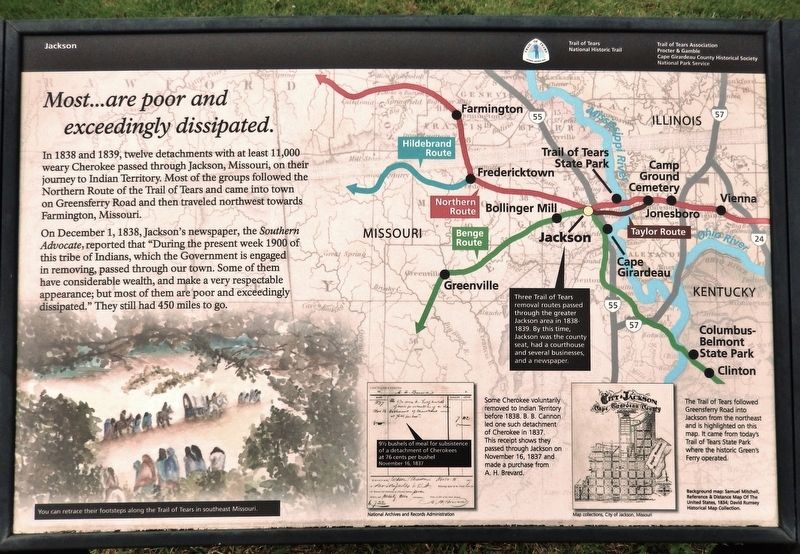
In 1838 and 1839, twelve detachments with at least 11,000 weary Cherokee passed through Jackson, Missouri, on their journey to Indian Territory. Most of the groups followed the Northern Route of the Trail of Tears and came into town on Greensferry Road and then traveled northwest towards Farmington, Missouri.
On December 1, 1838, Jackson's newspaper, the Southern Advocate, reported that “During the present week 1900 of this tribe of Indians, which the Government is engaged in removing, passed through our town. Some of them have considerable wealth, and make a very respectable appearance; but most of them are poor and exceedingly dissipated.” They still had 450 miles to go.
You can retrace their footsteps along the Trail of Tears in southeast Missouri.
Erected by Trail of Tears Association; Procter & Gamble; Cape Girardeau County Historical Society; and National Park Service.
Topics and series. This historical marker is listed in these topic lists: Indigenous Peoples and Communities • Roads & Vehicles. In addition, it is included in the Trail of Tears series list. A significant historical date for this entry is December 1, 1838.
Location. 37° 22.961′ N,
this page online

Regionally, this marker is in Southeast Missouri. It is also in the American Ozarks, in the Lewis & Clark Corridor, in the Corn Belt, and in the Great River Road Region. Globally, it is in North America, the Western Hemisphere, the Western World, and the Anglosphere. Historically, it finds itself in what was once the territory of the Mississippian Culture, the Louisiana Purchase, and the Antebellum South.
Other nearby markers. At least 8 other markers are within 8 miles of this marker, measured as the crow flies: They Passed This Way (here, next to this marker); World War I Memorial (within shouting distance of this marker); Pfc. Richard Wilson (approx. 5.1 miles away);
2. Marker detail: Trail of Tears Routes
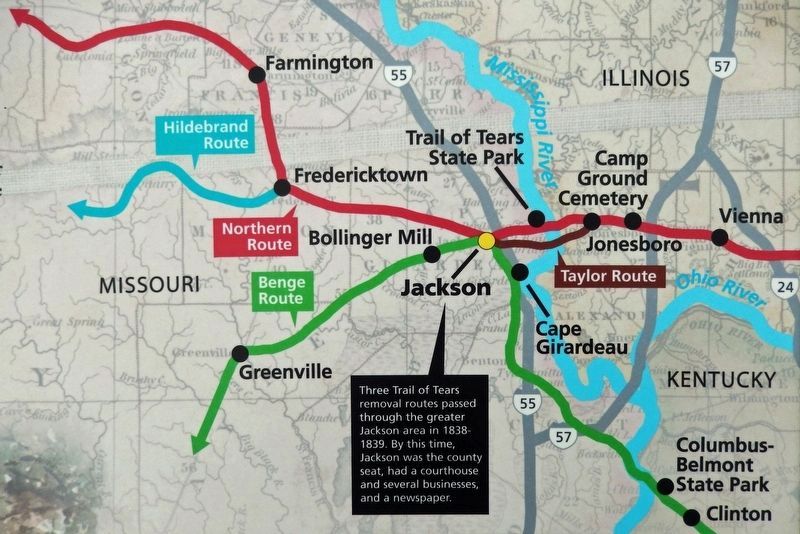
Three Trail of Tears removal routes passed through the greater Jackson area in 1838-1839. By this time, Jackson was the county seat, had a courthouse and several businesses, and a newspaper.
Background map: Samuel Mitchell, Reference & Distance Map Of The United States, 1834; David Rumsey Historical Map Collection.
Related markers. Click here for a list of markers that are related to this marker.
Additional keywords. Most...are poor and exceedingly dissipated.
National Archives and Records Administration
3. Marker detail: November 16, 1837 Receipt
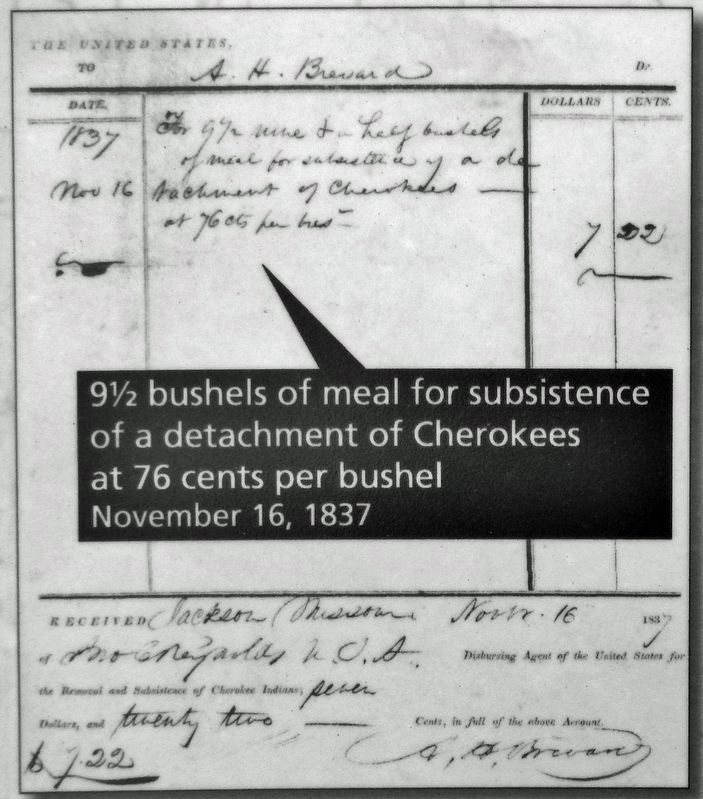
9½ bushels of meal for subsistence of a detachment of Cherokees at 76 cents per bushel November 16, 1837.
Some Cherokee voluntarily removed to Indian Territory before 1838. B. B. Cannon led one such detachment of Cherokee in 1837. This receipt shows they passed through Jackson on November 16, 1837 and made a purchase from A. H. Brevard.
Map collections, City of Jackson, Missouri
4. Marker detail: City of Jackson Map
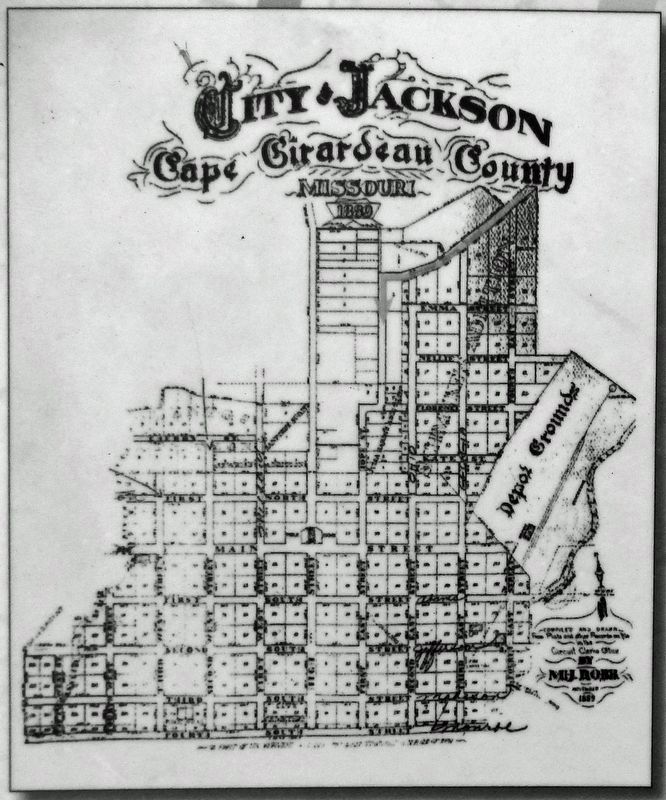
The Trail of Tears followed Greensferry Road into Jackson from the northeast and is highlighted on this map. It came from today's Trail of Tears State Park where the historic Green's Ferry operated.
Photographed by Cosmos Mariner, August 21, 2021
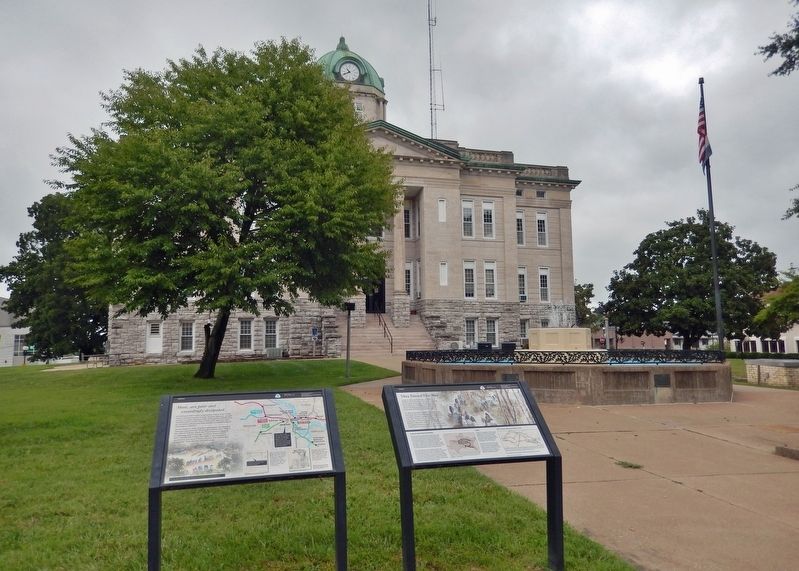
5. Most...are poor and exceedingly dissipated. Marker
Leftmost of two related markers at this location. Cape Girardeau County Courthouse in background.
Credits. This page was last revised on June 27, 2024. It was originally submitted on November 26, 2023, by Cosmos Mariner of Cape Canaveral, Florida. This page has been viewed 345 times since then and 18 times this year. Photos: 1, 2, 3, 4, 5. submitted on November 26, 2023, by Cosmos Mariner of Cape Canaveral, Florida.
