Trevi in Roma in Città metropolitana di Roma Capitale, Latium, Rome, Italy — Central Italy (Tyrrhenian Coast)
Auditoria di Adriano
⎯⎯⎯
Hadrian's Auditoria

Photographed by James Hulse, June 24, 2023
1. Auditoria di Adriano / Hadrian's Auditoria Marker

this page online
Fasi linea del tempo
125\135 d.C.
Auditoria Atheneum Hadriani
VI secolo d.C.
Officina metallurgica
VII-VIII secolo d.C.
Area sepolcrale
847 d.C.
Abbandono a causa di crolli per forte sisma
XII - XIII secolo d.C.
Impianto di 3 calcare
1564
Edificazione dell'Ospedale della Confraternita dei Fornari
1871
Demolizione dell'Ospedale
1885-1911
Grandi demolizioni nell'area per la costruzione del Vittoriano
1933
Giardini e aiuole di Via dei Fori Imperiali
2007-2011
Scavi Metro C
2021
Approvazione del progetto definitivo Metro C con percorso fruitivo degli Auditoria direttamente dall'atrio della Stazione Venezia fino alla Basilica Ulpia - Colonna di Traiano (mediante tunnel di collegamento) e quindi al Foro Romano e Palatino.
The

Photographed by James Hulse, June 24, 2023
2. The Hadrian's Auditoria Marker and the Monument to Victor Emmanuel II
The marker has the same text on both sides.

Photographed by James Hulse, June 24, 2023
3. The Hadrian's Auditoria and Marker
The marker is located on the far side of the archeological ruins.
Timeline phases
125\135 AD
Auditoria Atheneum Hadriani
6th century AD
Metallurgical workshop
7th-8th century AD
Burial area
847 AD
Abandonment due to collapse caused by strong earthquake
12th-13th century AD
Establishment of 3 limekilns
1564
Construction of the Ospedale della Confraternita dei Fornari
1871
Demolition of the Ospedale
1885-1911
Major demolition in the area for the construction of the Vittoriano
1933
Gardens and flowerbeds in Via dei Fori Imperiali
2007-2011
Metro C excavations
2021
Approval of the final Metro C project with the Auditoria's fruition route directly from the atrium of Venezia Station to the Basilica Ulpia - Trajan's Column (through a connecting tunnel) and then to the Roman Forum and Palatine.
Erected by PArCo
Photographed by James Hulse, June 24, 2023
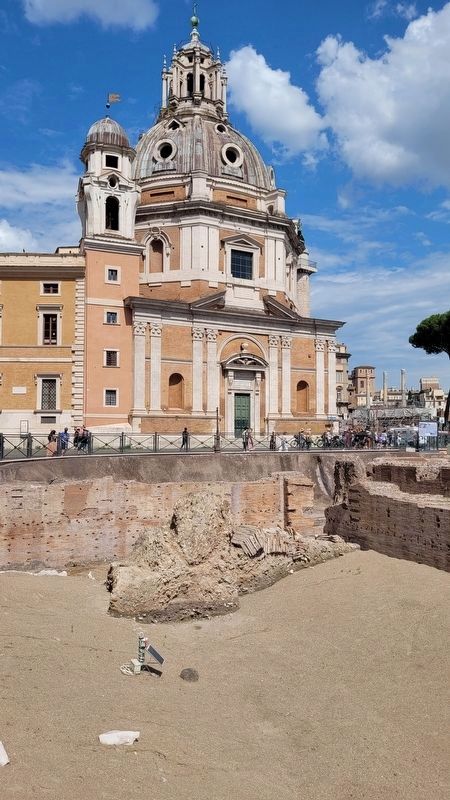
4. The archeological site of Hadrian's Auditoria and the Santa Maria di Loreto Church
Topics. This historical marker is listed in this topic list: Anthropology & Archaeology. A significant historical year for this entry is 1871.
Location. 41° 53.758′ N, 12° 28.981′ E. Marker is in Roma, Lazio (Latium, Rome), in Città metropolitana di Roma Capitale. It is in Trevi. It is at the intersection of Piazza della Madonna di Loreto and Piazza Venezia, on the right when traveling east on Piazza della Madonna di Loreto. The marker is located along the northwest corner of the intersection of the archaeological ruins. Touch for map. Marker is at or near this postal address: Piazza della Madonna di Loreto 16, Roma, Lazio 00187, Italy. Touch for directions.

Regionally, it is in Europe, the European Union, the Schengen Area, a coastal Mediterranean country, and the Western World. Historically, it finds itself in what was once the Roman Empire.
Other nearby markers. At least 8 other markers are within walking distance of this marker: A different marker also named Auditoria di Adriano / Hadrian's Auditoria (within shouting distance of this marker); Italian government officially recognized Czech-Slovakia (within shouting distance of this marker); Chiesa di Santa Maria di Loreto / Church of Santa Maria of Loreto (within shouting distance of this marker); Michelangelo’s House (within shouting distance of this marker); Vittoriano (within shouting distance of this marker); Palazzo Valentini (within shouting distance of this marker); Museo Nazionale del Palazzo di Venezia / National Museum of Palazzo Venezia (about 90 meters away, measured in a direct line); Vittorio Emanuele II (about 90 meters away). Touch for a list and map of all markers in Roma.
More about this marker. There is a second duplicate marker on the southeastern corner of the archeological ruins.
Related marker. Click here for another marker that is related to this marker.
Credits. This page was last revised on December 1, 2023. It was originally submitted on November 28, 2023, by James Hulse of Medina, Texas. This page has been viewed 142 times since then and 20 times this year. Photos: 1. submitted on November 28, 2023, by James Hulse of Medina, Texas. 2, 3, 4. submitted on November 29, 2023, by James Hulse of Medina, Texas.
