Goliad in Goliad County, Texas — The American South (West South Central)
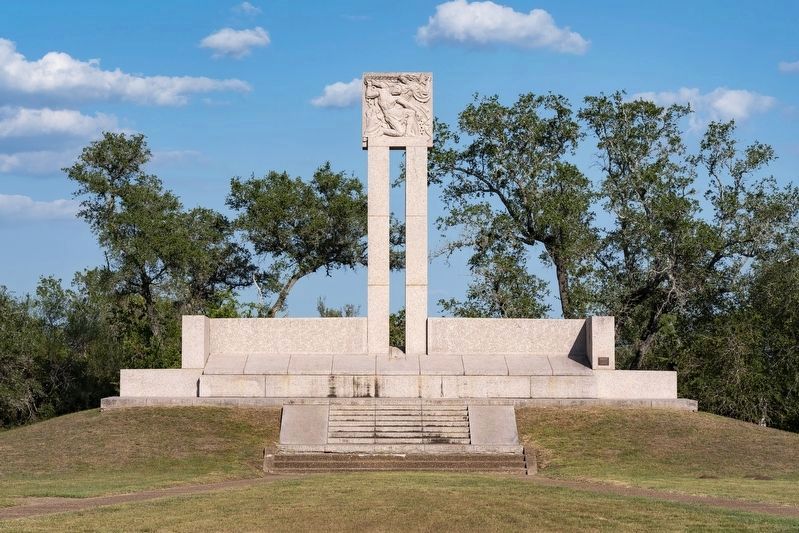
Fannin Burial Monument
Photographed by Mansfieldphoto.com, September 26, 2025
1. Fannin Burial Monument
Inscription.
Texan soldiers of Colonel Fannin's command killed and mortally wounded in battle of March 19, 1836 and buried in Texan trenches on the battlefield
Alfred Dorsey • Conrad Eigenauer • John Jackson • John Kelly • William H. Mann • George McKnight • H. Francis Petrussewicz • William Quinn • William F. Savage • Archibald Swords
Erected by the State of Texas in honor of the Texan soldiers killed in the Battle of Coleto March Nineteenth 1836 under Colonel James Walker Fannin who were buried on the battlefield and of Colonel Fannin and his men executed March twentyseventh 1836 by order of General Santa Anna and their bodies burned beneath this monument repose their charred remains.
Remember Goliad
Left Panel
Wiley A. Abercrombie • James Moss Adams • Isaac Aldridge • John Aldridge • Layton Allen • Peter Allen • Alfred Allison • William L. Allison • Allison Ames • Patrick H. Anderson • James S. Bagby • Augustus Baker • Stephen Baker • John H. Barnley • John N. Barnhill • Thomas B. Barton • Anthony Bates • James S. Batts • Josias B. Beall • John F. Beck • Marvin Bell • Fred J. Bellows • Henry Hogue Bentley • Joseph H.
Click or scan to see this page online
Blackwell • Thomas M. Blake • Gabriel Bouch • Lesue G.H. Bracey • James A. Bradford • Richard G. Brashear • Nathaniel E. Brister • John Sowers Brooks • J.S. Brown • Oliver Brown • William S. Brown • John M. Bryson • Daniel Buckley • Thomas Burbidge • Benjamin F. Burt • Moses Butler • Alfred Bynum • Matthew Byrne • J.W. Cain • Mariano Carabajal • George Washington Carlisle • Charles J. Carrier • Michall E. Carroll • Ewing Caruthers • George W. Cash • Joseph M. Chadwick • John Chew • Enoch P. Gains Chisum • Thomas T. Churchill • Joseph H. Clark • Seth Clark • John G. Coe • George W. Coglan • William H. Cole • Jacob Coleman • William John Colston • William Comstock • Cullen Conrad • Mathew Conway • Thomas H. Cosby • William W. Cowan , Harvey Cox • Henderson Cozart • John Gross • George W. Cummings • John D. Cunningham • George Curtman • George Washington Daniell • Thomas Jefferson Dasher • Robert T. Davidson • George A. Davis • Walter W. Daws • H.B. Day • Napoleon Debicki • George Dedrick • Joseph Dennis • Randolph DeSpain • Michael Devereaux • William P. Dickerman • Noah Dickinson Jr. • Abishai Dickson • Henry H. Dickson • Richard Disney
Photographed by James Hulse, October 23, 2023
2. Fannin Burial Monument - 1st Panel
• John Donoho • Henry L. Douglass • William G. Douglas • Henry M. Downman • William Perry Brown Dubose • J.E. Duffield • James W. Duncan • Francis J. Dusanque • Burr H. Duval • George Dyer • Andrew H. Eddy • Samuel M. Edwards • Otis G. Eels • James E Ellis • Michael Ellis • John Ely • Robert English • Escott • George Eubanks • John Fadden • James Walker Fannin • Samuel Farney • Robert Fenney • Joseph G. Ferguson • Charles Fine • John H. Fisher • Edward Fitzsimmons • Arthur G. Folly • J.A. Foster • Bradford Fowler • Elijah B. Franklin • Hugh McDonald Fraser • Charles Frazer • William Warren Frazer • Micajah G. Frazier • Thomas S. Freeman • Terrell R. Frizzell • Hezekiah Frost • Edward Fuller • Dominic Gallagher • David Gamble • Edward Garner • M.C. Garner • Lucius W. Gates • William James Gatlin • John Gibbs • Lewis C. Gibbs • Imanuel Frederic Giebenrath • William Gilbert • Francis Gilkison • George M. Gilland • John Gimble • John Gleeson • John C. Grace • Ransome O. Graves • Francis H. Gray • George Green • William T. Green • James H. Grimes • E.J.D. Grinold • Gould • William Gunter • James A. Hamilton • John J. Hand • Charles S. Hardwick
Photographed by James Hulse, October 23, 2023
3. Fannin Burial Monument - 2nd Panel
• William Harper • Jesse Harris • William Harris • Erasmus D. Harrison • Charles Ready Haskell • Henry Hastie • William R. Hatfield • Norborne B. Hawkins • Ebenezer Smith Heath • Wilson Helms • William Hemphill • John Heyser • Stuart Hill • John Hitchard • Nathan Hodge • Edward Hufty • Wesley Hughes • Wiley Hughes • Jesse C. Humphries • Francis M. Hunt • William Hunter • Stephen Decatur Hurst • James Thomas Ouirk
Right Panel
John James • Charles B. Jennings • Henry W. Jones • David Johnson • Edward J. Johnson • William P. Johnston • James Kelly • John Kelly • James P. Kemp • Montgomery B. King • Allen O. Kinney • P.T. Kissam • John Kornicky • Adams G. Lamond • Charles Lantz • Green Lee • Oscar P. Leverett • Charles Linley • John C. Logan • Alexander J. Loverly • A.M. Lynch • A.H. Lynde • Dennis Mahoney • Henry Martin • Peter Mattern • Samuel A.J. Mays • James McCoy • James A. McDonald • John McGloan • Dennis McGowan • John McGowen • Kenneth McKenzie • Charles McKinley • Alexander McLennan • J.B. McMannomy • William McMurray • James McSherry • William Jefferson Merrifield • Isaac H. Miller • James M. Miller • Seaborn A. Miles •
Photographed by James Hulse, October 23, 2023
4. Fannin Burial Monument - National Register of Historic Places plaque
Charles C. Milne • Drury Hugh Minor • Warren Jordan Mitchell • Washington Mitchell • Claiborne D. Mixon • John Moat • Edward Moody • John O. Moore • John F. Morgan • David Moses • Charles Rufus Munson • David A. Murdock • Patrick Neven • Watkins Nobles • James Noland • John Numlin • John M. Oliver • Zeno R. O'Neal • Patrick Osborn • Robert Smith Owings • Robert A. Pace • Georce W. Paine • John K. Parker • William S. Parker • William Parvin • Charles Patton • George W. Penny • Austin Perkins • D.A.J. Perkins • A. Adolph Petrussewicz • Samuel Overton Pettus • Rufus R. Petty • Charles Phillips • Stephen Pierce • James F. Pittman • Samuel C. Pittman • Lewis Powell • John M. Powers • William G. Preusch • Robert Raimey • James Reed • Thomas B. Rees • Perry Reese • Thomas Reeves • John Richards • Samuel Riddell • Joseph P. Riddle • Henry D. Ripley • Thomas H. Roberts • Cornelius Rooney • Gideon Rose • Samuel Rowe • Thomas Rumley • Edward Ryan • Samuel Smith Sanders • Wade H. Sanders • Charles Sargent • James H. Saunders • Henry Lewis Schultz • R.J. Scott • John Sealy • J.M. Seaton Frederick Sevenman • John Seward • Fortunatus S. Shackelford
Photographed by James Hulse, October 23, 2023
5. The view of the Fannin Burial Monument from the street
• William J. Shackelford • Zachariah H. Short • S. Simmons • Lawson S. Simmons • Randolph Slatier • James Smith • Sidney Smith • William A. Smith • Henry Spencer • Samuel Sprague • William Stephens • Abraham Stevens • Charles Stewart • Joseph A. Stovall • Bennett Strunk • Benjamin W. Taliaferro • Memory B. Tatom • Joseph R. Tatom • Kneeland Taylor • George J.W. Thayer • Evan B. Thomas • John Stephen Thorn • Isaac Ticknor • Lewis Tilson • Wilkins S. Turberville • John Tyler • James Vaughan • William E. Vaughan • George Marion Vigal • Frederick J. Volckman • William A.O. Wadsworth • William Waggoner • A.J. Wallace • Benjamin C. Wallace • Samuel P. Wallace • William Ward • Nicholas B. Waters • Joseph W. Watson • Alman Weaver • James Webb • James West • Thomas Weston • Ira J. Westover • Orlando Wheeler • James S. Wilder • Henry Wilkey • Abney B. Williams • James Williams • Napoleon B. Williams • Robert W. Wilson • Samuel Wilson • Edward Wingate • James C. Winn • William S. Winningham • Stephen Winship • Andrew Winter • Hughes Witt • Henry H. Wood • John Wood • Samuel Wood • William P. Wood • Allen Wren • Isaac Newton Wright • Elias Robert
Public Domain - unknown author, circa 1820s
6. James W. Fannin
This is a portrait of James W. Fannin. According to page 134 of Exploring the Alamo Legends by Wallace O. Chariton (Republic of Texas Press, 1990), the painting is believed to have been completed while Fannin was a cadet at the US Military Academy during the 1820s. The painting is now owned by the Dallas Historical Society.
Yeamans • Erastus Yeamans • Harrison Young • James O. Young • Solomon Youngblood
Location. 28° 38.765′ N, 97° 22.78′ W. Monument is in Goliad, Texas, in Goliad County. It is at the intersection of Cabrera Road and Barnhill Road, on the right when traveling north on Cabrera Road. The marker is located on the east side of the monument grounds. Touch for map. Monument is in this post office area: Goliad TX 77963, United States of America. Touch for directions.
Regionally, this memorial monument is in South Texas. It is also in the American South. Globally, it is in North America, a Gulf of Mexico state, the Western Hemisphere, the Western World, and the Anglosphere. Historically, it finds itself in what was once New Spain, the Republic of Texas, and one of the Confederate States of America.
The battle of Coleto, the culmination of the Goliad Campaign of 1836, occurred near Coleto Creek in Goliad County on March 19 and 20, 1836. Originally called "the battle of the prairie" and "la batalla del encinal [oak grove] del Perdido [Creek]," it was one of the most significant engagements of the Texas Revolution. The battle, however, cannot properly be considered as isolated from the series of errors and misfortunes that preceded it, errors for which the Texas commander, James W. Fannin, Jr., was ultimately responsible. The most exasperating decision confronting Fannin was whether to abandon Goliad after having fortified it, and if so, when. He had already been informed of Gen. José de Urrea's advancing Mexican army by Plácido Benavides, after the defeat of Texas forces under Francis W. Johnson and James Grant at the battles of San Patricio and CreekAgua Dulce. The Mexican advance caused the Texans to abandon the port of Copano, thus making Goliad considerably less important strategically, as Fannin knew. He had received word that the Alamo had fallen as well. Still, he continued to fortify Fort Defiance, as he christened the La Bahía presidio, and awaited orders from superiors to abandon the site, knowing also that a retreat would not be well received among his men, who were eager to confront the Mexicans.
(Submitted on December 15, 2023, by James Hulse of Medina, Texas.)
Credits. This page was last revised on October 13, 2025. It was originally submitted on December 11, 2023, by James Hulse of Medina, Texas. This page has been viewed 1,647 times since then and 201 times this year. Photos:1. submitted on October 13, 2025, by James Hulse of Medina, Texas. 2, 3, 4, 5, 6, 7. submitted on December 15, 2023, by James Hulse of Medina, Texas.