Manassas, Virginia — The American South (Mid-Atlantic)
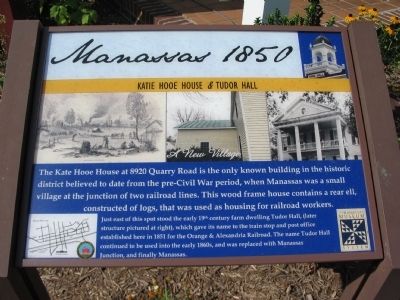
Manassas 1850
Katie Hooe House & Tudor Hall
| — | A New Village | — |
Photographed by Craig Swain, July 19, 2009
1. Manassas 1850 Marker
Just east of this spot stood the early 19th century farm dwelling Tudor Hall, (later structure pictured at right), which gave its name to the train stop and post office established here in 1851 for the Orange & Alexandria Railroad. The name Tudor Hall continued to be used into the early 1860s, and was replaced with Manassas Junction and finally Manassas.
Erected 2009 by Manassas Museum System, City of Manassas, Virginia.
Topics and series. This historical marker is listed in these topic lists: Notable Buildings • Railroads & Streetcars. In addition, it is included in the Virginia, City of Manassas series list. A significant historical year for this entry is 1850.
Location. 38° 45.148′ N, 77° 28.103′ W. Marker is in Manassas, Virginia. It is at the intersection of Quarry Road and Zebedee Street,
this page online

Regionally, this marker is in the Washington Metropolitan Area and in Northern Virginia. It is also in the American South, specifically in the Upper South, and in the Mid-Atlantic. Globally, it is in North America, the Western Hemisphere, the Western World, and the Anglosphere. Historically, it finds itself in what was once the territory of the Mississippian Culture, one of the original Thirteen Colonies, one of the Confederate States of America, and the Antebellum South.
Other nearby markers. At least 8 other markers are within walking distance of this marker: Steam Locomotive Tire Fire Alarm – 1909 (within shouting distance of this marker); Manassas 1862 (about 600 feet away, measured in a direct line); Wartime Manassas (about 700 feet away); Harry J. Parrish (about 800 feet away); a different marker also named Steam Locomotive Tire Fire Alarm – 1909 (approx. 0.2 miles away); The Right to Vote (approx. 0.2 miles away); Manassas Presbyterian Church
Photographed by Craig Swain, July 19, 2009
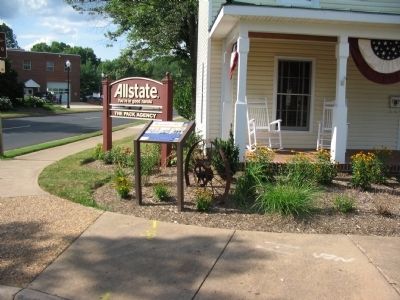
2. Manassas 1850 Marker
Another marker is no longer nearby. Katie Hooe House (was here, next to this marker but has been replaced with another marker now near it).
Also see . . .
1. National Register of Historic Places Nomination. (PDF) Covers the Old Town Manassas District. The Hooe house is discussed on page 45. (Submitted on October 29, 2009, by Craig Swain of Leesburg, Virginia.)
2. Katie Hooe House. Older marker that stood at this location. (Submitted on October 29, 2009, by Craig Swain of Leesburg, Virginia.)
Photographed by Craig Swain, July 19, 2009
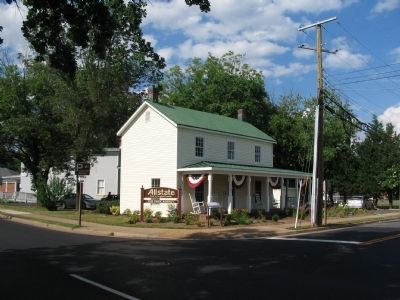
3. Marker and the Katie Hooe House
Credits. This page was last revised on July 14, 2026. It was originally submitted on October 29, 2009, by Craig Swain of Leesburg, Virginia. This page has been viewed 1,847 times since then and 94 times this year. Photos: 1, 2, 3. submitted on October 29, 2009, by Craig Swain of Leesburg, Virginia.
