Downtown Detroit in Wayne County, Michigan — The American Midwest (Great Lakes)
The Salvation Army
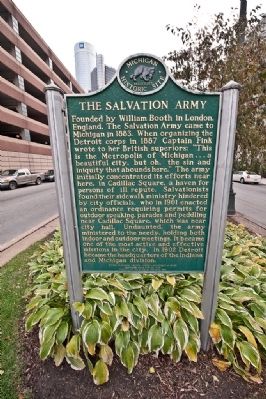
Photographed by R. C.
1. Salvation Army Marker
Erected 1984 by Bureau of Michigan History - Michigan Department of State. (Marker Number S646.)
Topics and series. This historical marker is listed in these topic lists: Charity & Public Work • Notable Events. In addition, it is included in the Michigan Historical Commission series list. A significant historical year for this entry is 1883.
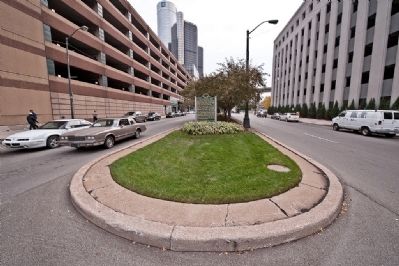
Location. 42° 19.848′ N, 83° 2.565′ W. Marker is in Detroit, Michigan, in Wayne County. It is in Downtown Detroit. It is at the intersection of Randolph Street (State Highway 3) and Congress Street, in the median on Randolph Street. Touch for map. Marker is at or near this postal address: 532 Randolph Street, Detroit MI 48226, United States of America. Touch for directions.

Regionally, this marker is in Southeast Michigan. It is also in the American Midwest. Globally, it is in North America, on the Great Lakes, in the Western Hemisphere, in the Western World, and in the Anglosphere. Historically, it finds itself in what was once
this page online
Other nearby markers. At least 8 other markers are within walking distance of this marker: Shrine Circus (here, next to this marker); Maj. General Anthony Wayne U.S.A. (about 400 feet away, measured in a direct line); University of Michigania (about 500 feet away); Mariners' Church / U.S. Topographical Engineers (about 600 feet away); U.S. Topographical Engineers (about 600 feet away); Chapoton House (about 700 feet away); George DeBaptiste Homesite (about 700 feet away); Spirit of Detroit (about 700 feet away). Touch for a list and map of all markers in Detroit.
Also see . . . Metro Detroit Salvation Army. History:
The Salvation Army landed in the United States in 1880 and began serving Detroit in 1887. However, the earliest soldiers of the Army had faced opposition in Detroit. Their concern for the poor challenged the norm and shed light on social ills that others preferred to pretend did not exist. Not long after the first Salvationists assembled in the city, the local government passed the Campus Ordinance, proclaiming, "No man may make a speech or blow(Submitted on June 8, 2025, by J.T. Lambrou of New Boston, Michigan.)a horn or beat a drum within one half-mile of city hall." As much of the Army's early work depended on street meetings designed to attract people in need of aid, the ruling was a major setback. Colonel Blanche Cox, commander of The Salvation Army in Detroit, challenged the ordinance. Over a period of months, she was arrested and brought before the court 12 times. She spent months in jail for disturbing the peace, but even as she did, a public outcry grew in her defense. Soon, The Detroit News, led by its founder, James H. Scripps, made The Salvation Army a front page issue. With support from community leaders, the law was repealed and The Salvation Army earned its right to serve those in need.Photographed by R. C.2. Salvation Army Marker
Credits. This page was last revised on June 11, 2025. It was originally submitted on October 29, 2009, by Ronald Claiborne of College Station, Texas. This page has been viewed 1,578 times since then and 59 times this year. Photos: 1, 2. submitted on October 29, 2009, by Ronald Claiborne of College Station, Texas. • Kevin W. was the editor who published this page.
