Marker Logo
THE HISTORICAL
MARKER DATABASE
“Bite-Size Bits of Local, National, and Global History”
Skidaway Island in Chatham County, Georgia — The American South (South Atlantic)
 

The Introduction of the Soybean to North America
 
 
The Introduction of the Soybean to North America Marker image. Click for full size.
Photographed by Brandon D Cross
1. The Introduction of the Soybean to North America Marker
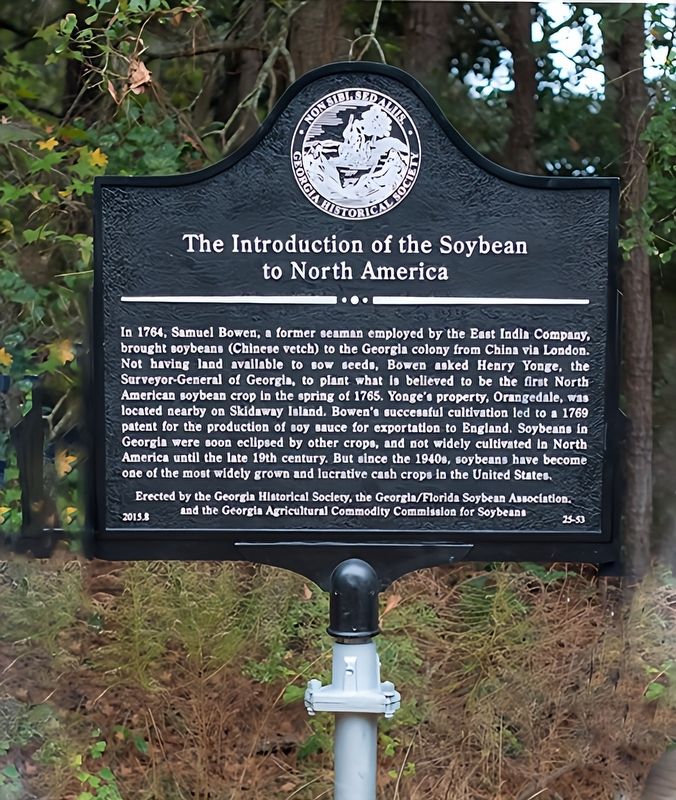
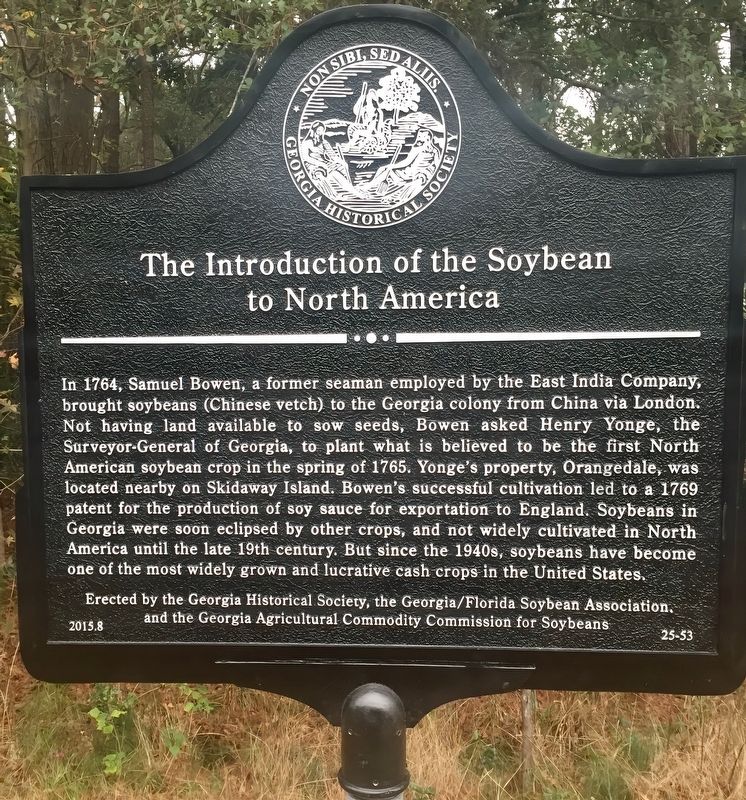
Inscription. In 1764, Samuel Bowen, a former seaman employed by the East India Company, brought soybeans (Chinese vetch) to the Georgia colony from China via London. Not having land available to sow seeds, Bowen asked Henry Yonge, the Surveyor- General of Georgia, to plant what is believed to be the first North American soybean crop in the spring of 1765. Yonge’s property, Orangedale, was located nearby on Skidaway Island. Bowen's successful cultivation led to a 1769 patent for the production of soy sauce for exportation to England. Soybeans in Georgia were soon eclipsed by other crops, and not widely cultivated in North America until the late 19th century. But since the 1940s, soybeans have become one of the most widely grown and lucrative cash crops in the United States.
 
Erected 2015 by The Georgia Historical Society, the Georgia/Florida Soybean Association, and the Georgia Agricultural Commodity Commission for Soybeans. (Marker Number 25-53.)
 
Topics. This historical marker is listed in this topic list: Agriculture. A significant historical year for this entry is 1764.
 
Location. 31° 59.251′ N, 81° 1.416′ W. Marker is on Skidaway
Paid Advertisement
Click or scan to see
this page online
Island, Georgia, in Chatham County. It is at the intersection of Ocean Science Circle and Institute of Oceanography Drive, on the left when traveling north on Ocean Science Circle. The marker is located on the grounds of the Skidaway Institute of Oceanography. Touch for map. Marker is at or near this postal address: 10 Ocean Science Circle, Savannah GA 31411, United States of America. Touch for directions.

Regionally, this marker is in Georgia’s Coastal Plain, on the Georgia Coast and the Golden Isles, in Greater Savannah, and on the Sea Islands. It is also in the American South, specifically in the Deep South, and on the Eastern Seaboard. Globally, it is in the North Atlantic Region, North America, the Western Hemisphere, the Western World, and the Anglosphere. Historically, it finds itself in what was once New Spain, the territory of the Mississippian Culture, one of the original Thirteen Colonies, one of the Confederate States of America, and the Antebellum South.

Other nearby markers. At least 8 other markers are within 4 miles of this marker, measured as the crow flies: Modena (about 600 feet away, measured
The Introduction of the Soybean to North America Marker image. Click for full size.
Photographed by Brandon D Cross, January 9, 2016
2. The Introduction of the Soybean to North America Marker
in a direct line); Isle of Hope (approx. 2 miles away); Isle of Hope Methodist Church (approx. 2.1 miles away); a different marker also named Isle of Hope (approx. 2.8 miles away); Mercer Auto Camp (approx. 2.8 miles away); Noble Jones’ “Wormslow” (approx. 3.1 miles away); Sandfly (approx. 3.1 miles away); Savannah State College (approx. 3.1 miles away).
 
Also see . . .  First soybean crop in North America was planted spring 1765 in Georgia. (Submitted on December 25, 2023, by Brandon D Cross of Flagler Beach, Florida.)
 
 
Credits. This page was last revised on May 31, 2026. It was originally submitted on December 25, 2023, by Brandon D Cross of Flagler Beach, Florida. This page has been viewed 433 times since then and 46 times this year. Photos:   1, 2. submitted on December 25, 2023, by Brandon D Cross of Flagler Beach, Florida. • J. Makali Bruton was the editor who published this page.

m=238239

CeraNet Cloud Computing sponsors the Historical Marker Database.
This website earns income from purchases you make after using our links to Amazon.com. We appreciate your support.
Paid Advertisement
Aug. 15, 2026