
Oakville in Halton Region, Ontario — Central Canada (North America)
Oakville and Trafalgar, 1806-1870
| — | Sixteen Mile Creek Trail | — |
Photographed by Tim Boyd, November 30, 2023
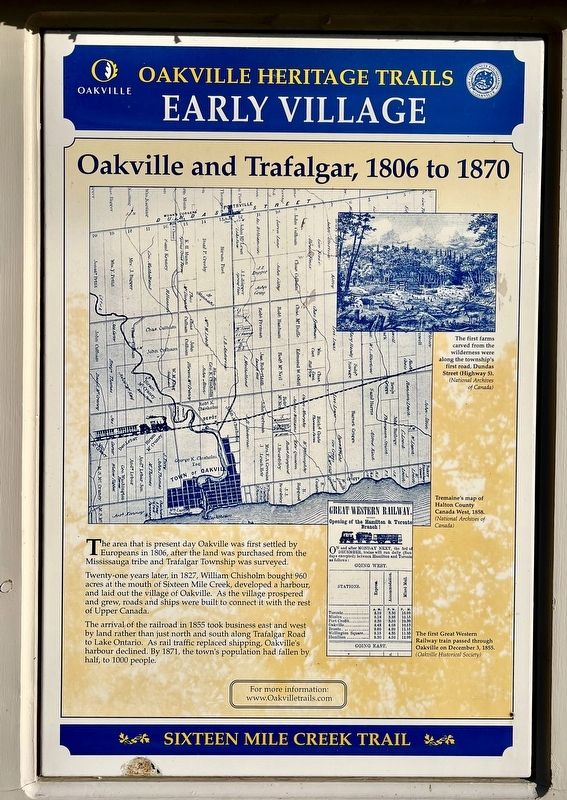
1. Oakville and Trafalgar, 1806-1870 Marker
The area that is present day Oakville was first settled by Europeans in 1806, after the land was purchased from the Mississauga tribe and Trafalgar Township was surveyed.
Twenty-one years later, in 1827, William Chisholm bought 960 acres at the mouth of Sixteen Mile Creek, developed a harbour, and laid out the village of Oakville. As the village prospered and grew, roads and ships were built to connect it with the rest of Upper Canada.
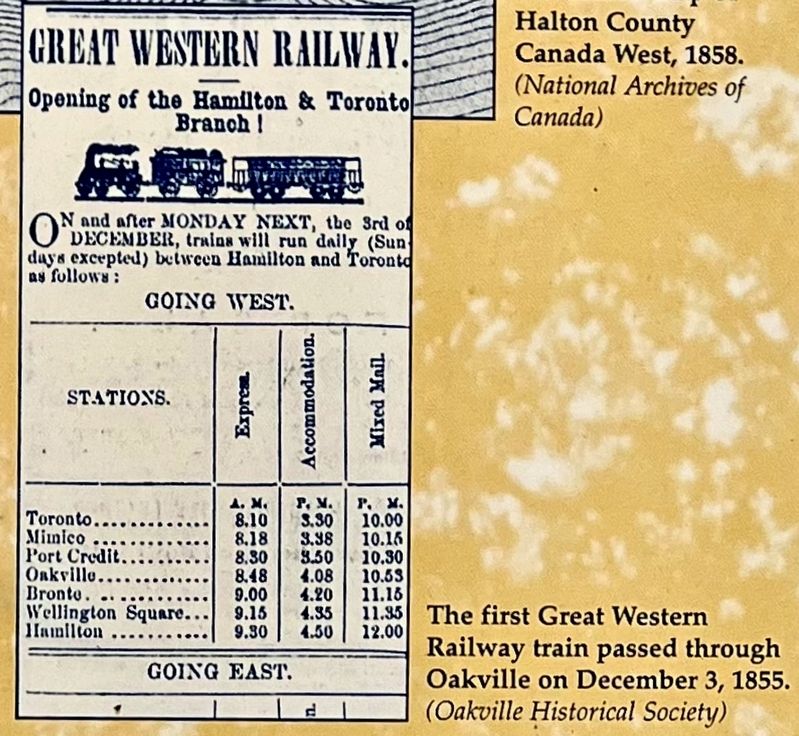
The arrival of the railroad in 1855 took business east and west by land rather than just north and south along Trafalgar Road to Lake Ontario. As rail traffic replaced shipping, Oakville's harbour declined. By 1871, the town's population had fallen by half, to 1000 people.
Erected by Town of Oakville.
Topics. This historical marker is listed in these topic lists: Colonial Era • Indigenous Peoples and Communities • Railroads & Streetcars • Settlements & Settlers. A significant historical year for this entry is 1806.
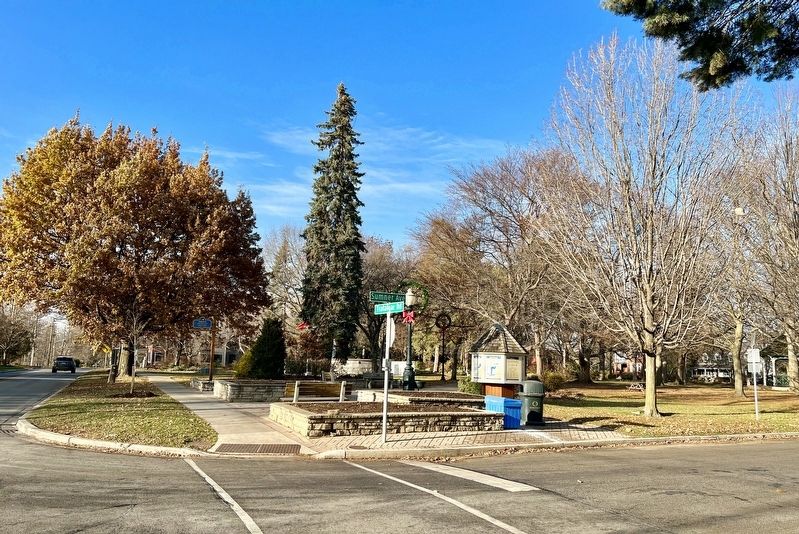
Location. 43° 26.952′ N, 79° 40.155′ W. Marker is in Oakville, Ontario, in Halton Region. It is at the intersection of Trafalgar Road and Sumner Avenue, on the right when traveling north on Trafalgar Road. The marker is at the south-west corner of George’s Square.
this page online

Regionally, this marker is in Greater Toronto, specifically on the Golden Horseshoe, in the Hamilton-Halton-Brant Area, and specifically in the Toronto Metropolitan Area. It is also in Central Canada. Globally, it is in North America, the Western Hemisphere, the Western World, and the Anglosphere. Historically, it finds itself in what was once a British colony, the Viceroyalty of New France, the Haudenosaunee (Iroquois) Confederacy, and Rupert’s Land.
Other nearby markers. At least 8 other markers are within walking distance of this marker: An Isolated Township (here, next to this marker); The Prosperous Years (here, next to this marker); Town Drinking Fountain (here, next to this marker); Churches Schools and Taverns (here, next to this marker); Heritage Homes of Trafalgar Road and George's Square (here, next to this marker); The Underground Railroad (here, next to this marker); Oakville Cenotaph (within shouting distance of this marker); The Lorne Scots (about 90 meters away, measured in a direct line). Touch for a list and map of all markers in Oakville.
Also see . . . Anishinaabek News - Head of the Lake Purchase (1806).
By 1805, the Crown had acquired almost all of the north shore of Lake Ontario around to Niagara, with the exception of a block of around 35 miles frontage at the head of the Lake, between York and Niagara. In 1797, an approach was made by the Administrator, Peter Russell, the interim head of the administration after Lt. Governor Simcoe’s departure, to the Mississaugas. At the time, Joseph Brant had been named as the land agent for the Mississaugas, following his successful leasing and sale(Submitted on January 2, 2024, by Tim Boyd of Hamilton, Ontario.)of some of the Grand River lands of the Six Nations, and he was seeking what the Crown considered to be too high a price for the lands. The Crown decided at that time not to pursue the Mississauga Tract, as it was known.Photographed by Tim Boyd, November 30, 20232. Oakville and Trafalgar, 1806-1870 Marker
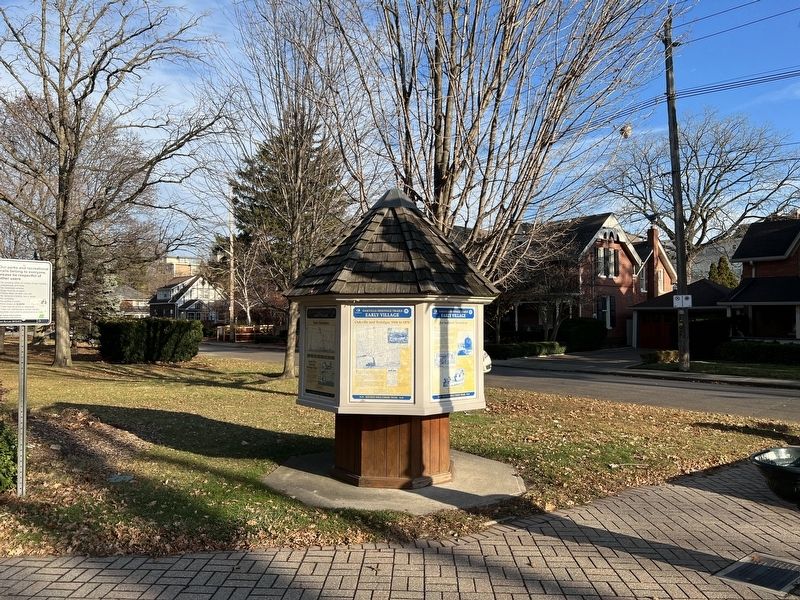
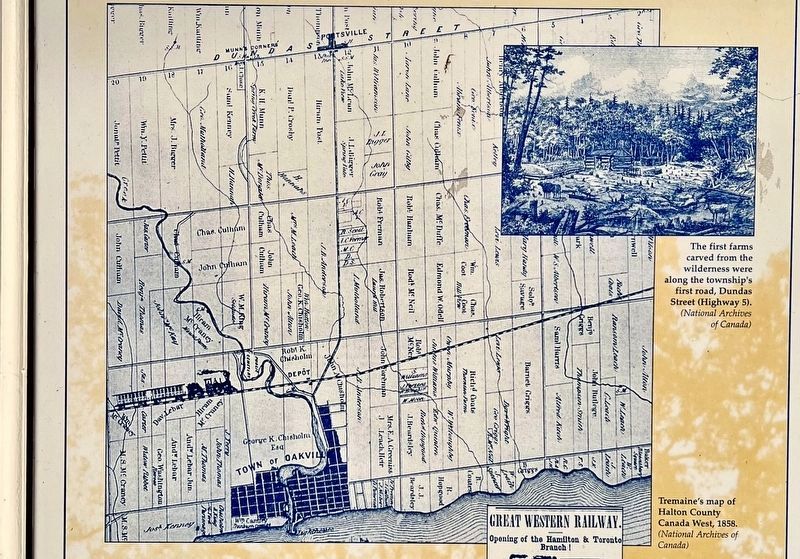
3. Oakville and Trafalgar, 1806-1870 marker photo detail
Photographed by Tim Boyd, November 30, 2023
4. Oakville and Trafalgar, 1806-1870 marker photo detail
Photographed by Tim Boyd, November 30, 2023
5. George’s Square, Oakville
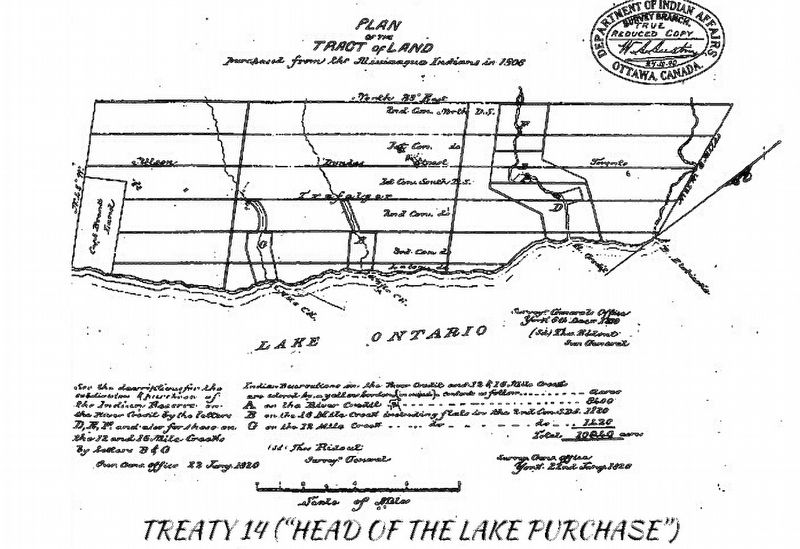
6. 1826 Plan of the Head of the Lake Purchase of 1806
Credits. This page was last revised on January 6, 2024. It was originally submitted on January 2, 2024, by Tim Boyd of Hamilton, Ontario. This page has been viewed 519 times since then and 39 times this year. Photos: 1, 2, 3, 4, 5, 6. submitted on January 2, 2024, by Tim Boyd of Hamilton, Ontario. • Andrew Ruppenstein was the editor who published this page.
