New Madrid in New Madrid County, Missouri — The American Midwest (Upper Plains)
Bissell's Submergible Saw
Photographed by William Bruce, January 13, 2015
1. Bissell's Submergible Saw Marker
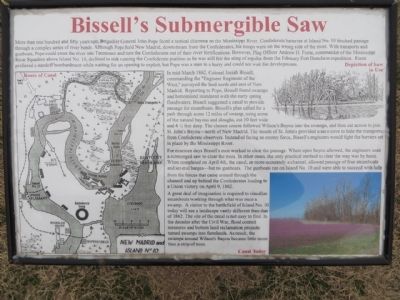
In mid-March 1862, Colonel Josiah Bissell, commanding the "Engineer Regiment of the West," surveyed the land north and east of New Madrid. Reporting to Pope, Bissell found swamps and bottomland inundated with the early spring floodwaters. Bissell suggested a canal to provide passage for steamboats.
this page online
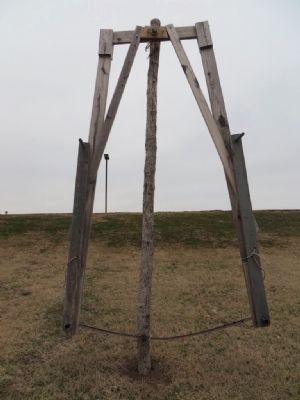
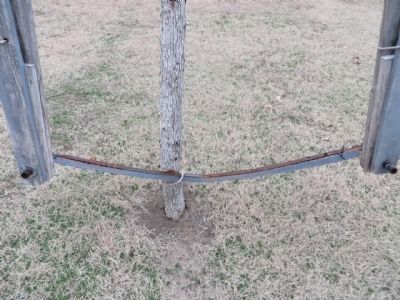
For nineteen days Bissell's men worked to clear the passage. Where open bayou allowed, the engineers used a submerged saw to clear the trees. In other cases, the only practical method to clear the way was by hand. When completed on April 4th, the canal, or more accurately a channel, allowed passage of four steamboats and several barges—but no gunboats. The gunboats ran on Island No. 10 and were able to succeed with help from the forces that came around through the channel and up behind the Confederates leading to a Union victory on April 9, 1862.
A great deal of imagination is required to visualize steamboats working through what was once
Photographed by William Bruce, January 13, 2015
2. Bissell's Submergible Saw Marker
Topics and series. This historical marker is listed in this topic list: War, US Civil. In addition, it is included in the Missouri’s Civil War series list. A significant historical month for this entry is April 1862.
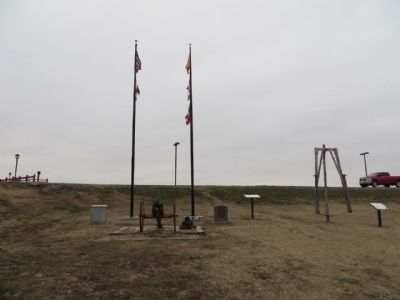
Location. 36° 35.024′ N, 89° 31.607′ W. Marker is in New Madrid, Missouri, in New Madrid County. It is at the intersection of Main Street and Levee Road, on the right when traveling south on Main Street. The marker is located directly across from the New Madrid Historical Museum. Touch for map. Marker is at or near this postal address: 1 South Main Street, New Madrid MO 63869, United States of America. Touch for directions.

Regionally, this marker is in the Missouri Bootheel. It is also in the American Midwest, in the Mississippi Delta, in the Lewis & Clark
Photographed by William Bruce, January 13, 2015
3. A modern reconstruction of Bissell's submergible saw
Other nearby markers. At least 8 other markers are within walking distance of this marker: Fort Bankhead (here, next to this marker); Battle of Island No. 10 (here, next to this marker); New Madrid (a few steps from this marker); New Madrid & Island No. Ten (within shouting distance of this marker); Water Route to Indian Territory (about 600 feet away, measured in a direct line); Higgerson School (about 600 feet away); They Passed This Way (about 600 feet away); Thomas F. Hunter Memorial (approx. 0.2 miles away). Touch for a list and map of all markers in New Madrid.
Also see . . . New Madrid Historical Museum. (Submitted on March 29, 2015.)
Photographed by William Bruce, January 13, 2015
4. A modern reconstruction of Bissell's submergible saw (detail)
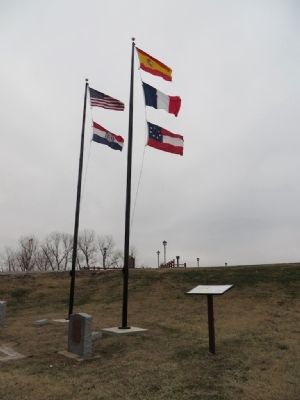
Photographed by William Bruce, January 13, 2015
5. Bissell's Submergible Saw Marker
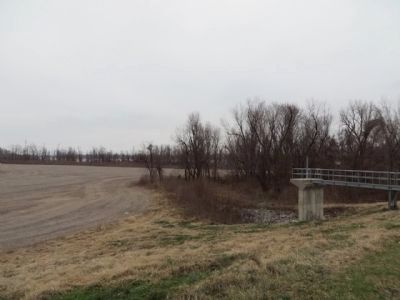
Photographed by William Bruce, January 13, 2015
6. Site of canal east along Levee Road. This image taken at 36.585438, -89.522353.
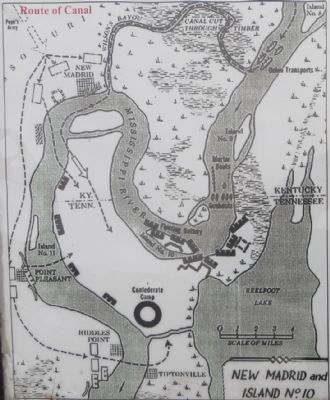
Photographed by William Bruce, January 13, 2015
7. Detail of left figure: Route of Canal
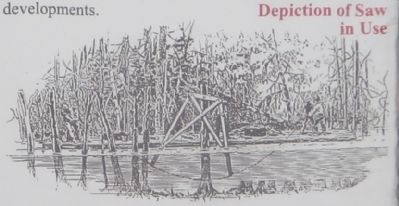
Photographed by William Bruce, January 13, 2015
8. Detail of upper right figure: Depiction of Saw in Use
Credits. This page was last revised on January 8, 2024. It was originally submitted on March 28, 2015, by William Bruce of Madison, Wisconsin. This page has been viewed 981 times since then and 42 times this year. Last updated on January 4, 2024, by Mark St. Martin of Kalamazoo, Michigan. Photos: 1, 2, 3, 4, 5, 6, 7, 8. submitted on March 28, 2015, by William Bruce of Madison, Wisconsin. • J. Makali Bruton was the editor who published this page.
