
Archaeological Ensemble of Tárraco in Tarragona, Catalonia, Spain — Southwestern Europe (Iberian Peninsula)
El podi
⎯⎯⎯
The Podium
Photographed by J. Makali Bruton, August 8, 2023
1. El podi / The Podium Marker

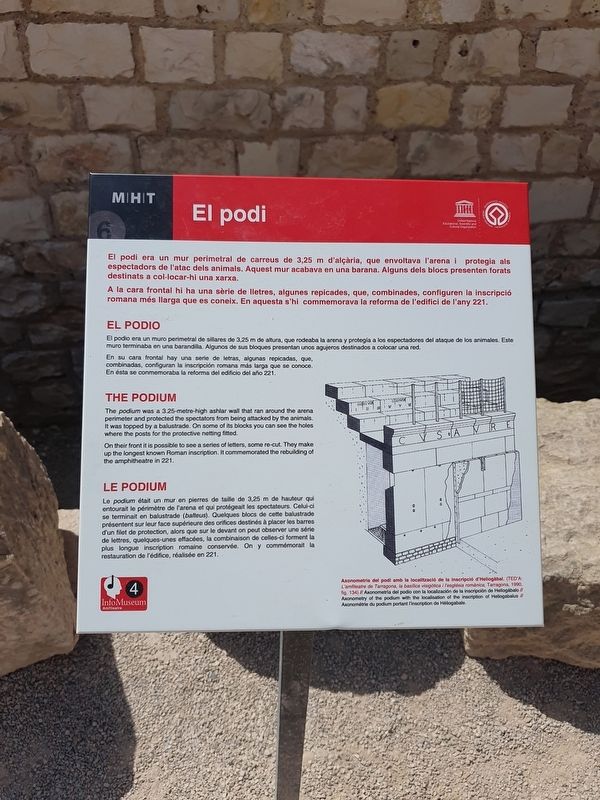
El podi era un mur perimetral de carreus de 3,25 m d'alçària, que envoltava l'arena i protegia als espectadors de l'atac dels animals. Aquest mur acabava en una barana. Alguns dels blocs presenten forats destinats a col·locar-hi una xarxa.
A la cara frontal hi ha una sèrie de lletres, algunes repicades, que, combinades, configuren la inscripció romana més llarga que es coneix. En aquesta s'hi commemorava la reforma de l'edifici de l'any 221.
Axonometria del podi amb la localització de la inscripció d'Hellogàbal. (TED'A: L'amfiteatre de Tarragona, la basilica visigòtica i l'església romànica, Tarragona, 1990, fig. 134)
El Podio
El podio era un muro perimetral de sillares de 3,25 m de altura, que rodeaba la arena y protegía a los espectadores del ataque de los animales. Este muro terminaba en una barandilla. Algunos de sus bloques presentan unos agujeros destinados a colocar una red.
En su cara frontal hay una serie de letras, algunas repicadas, que, combinadas, configuran la inscripción romana más larga que se conoce. En ésta se conmemoraba la reforma del edificio del año 221.
Axonometría del podio
this page online
The Podium
The podium was a 3.25-metre-high ashlar wall that ran around the arena perimeter and protected the spectators from being attacked by the animals. It was topped by a balustrade. On some of its blocks you can see the holes where the posts for the protective netting fitted.
On their front it is possible to see a series of letters, some re-cut. They make up the longest known Roman inscription. It commemorated the rebuilding of the amphitheatre in 221.
Axonometry of the podium with the localisation of the inscription of Heliogabalus
Le podium
Le podium était un mur en pierres de taille de 3,25 m de hauteur qui entourait le périmètre de l'arena et qui protégeait les spectateurs. Celui-ci se terminait en balustrade (balteus). Quelques blocs de cette balustrade présentent sur leur face supérieure des orifices destinés à placer les barres d'un filet de protection, alors que sur le devant on peut observer une série de lettres, quelques-unes effacées, la combinaison de celles-ci forment la plus longue inscription romaine conservée. On y commémorait la restauration

Photographed by J. Makali Bruton, August 8, 2023
2. El podi / The Podium Marker
The marker is the farthest to the left in this view of the ruins of the amphitheater.
Axonométrie du podium portant l'inscription de Héliogabale.
Erected by Museu d'Història de Tarragona (MHT). (Marker Number 6.)
Topics. This historical marker is listed in these topic lists: Anthropology & Archaeology • Architecture. A significant historical year for this entry is 1990.
Location. 41° 6.861′ N, 1° 15.516′ E. Marker is in Tarragona, Cataluña (Catalonia). It is in Archaeological Ensemble of Tárraco. It can be reached from Via William J. Bryant north of Passeig Maritim Rafael Casanova, on the right when traveling north. Touch for map. Marker is at or near this postal address: Via William J Bryant 4, Tarragona, Cataluña 43003, Spain. Touch for directions.

Regionally, it is in the North Atlantic Region, in Europe, in the European Union, in Atlantic Europe, on the Iberian Peninsula, in the Schengen Area, in a coastal Mediterranean country, and in the Western World. Historically, it finds itself in what was once the Roman Empire.
Other nearby markers. At least 8 other markers are within walking distance of this marker: La Porta Triumphalis i la inscripció inaugural de l'Amfiteatre
Photographed by J. Makali Bruton, August 8, 2023
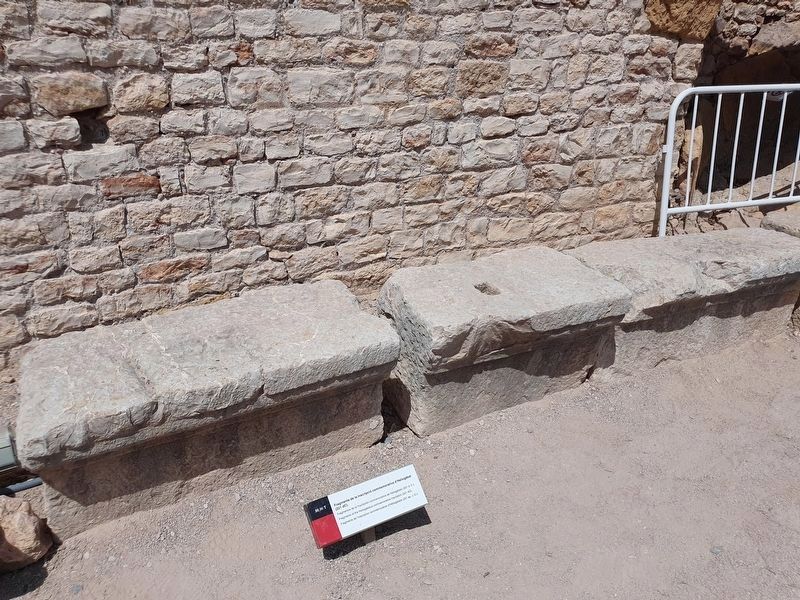
3. Remnants of the balustrade of the podium
These remnants include fragments of the rebuilding inscription and a hole for the protective netting, both mentioned in the marker's text.
Credits. This page was last revised on January 6, 2024. It was originally submitted on January 6, 2024, by J. Makali Bruton of Washington, District of Columbia. This page has been viewed 114 times since then and 13 times this year. Photos: 1, 2, 3. submitted on January 6, 2024, by J. Makali Bruton of Washington, District of Columbia.
