Downtown Jersey City in Hudson County, New Jersey — The American Northeast (Mid-Atlantic)
The Morris Canal
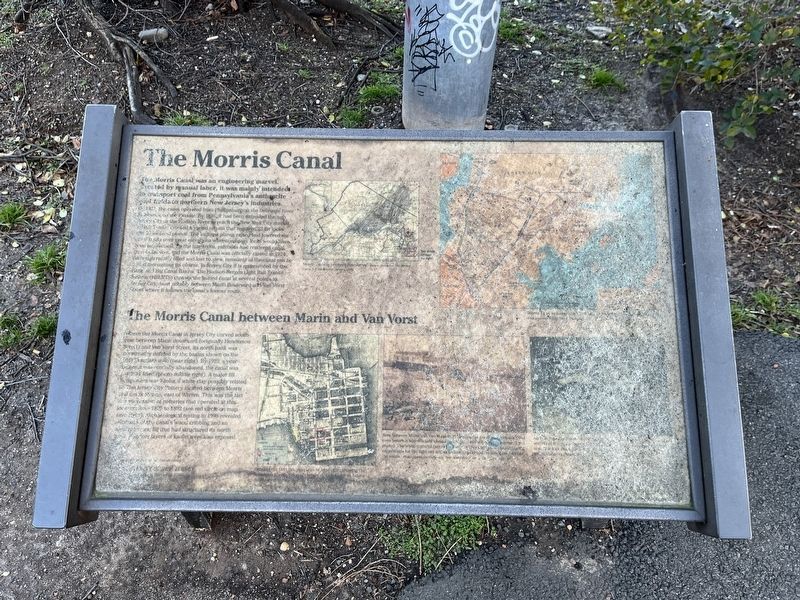
The Morris Canal was an engineering marvel. Created by manual labor, it was mainly intended to transport coal from Pennsylvania's anthracite coal fields to northern New Jersey's industries.
In 1831, the canal operated from Phillipsburg on the Delaware River to Newark on the Passaic. By 1836, it had been extended through Jersey City to the Hudson River to reach the New York City market. Its 102.3 miles crossed a varied terrain that required 23 lift locks and 23 inclined planes. The inclined planes raised and lowered the canal boats over great elevations where the ordinary locks would have been impractical. By the late 1800s, railroads had rendered canal travel obsolete, and the Morris Canal was officially closed in 1924. Although mostly filled and lost to view, remnants of the canal can be found throughout its course. In Jersey City it is represented by the Little and Big Canal Basins. The Hudson-Bergen Light Rail Transit System (HBLRTS) crosses the buried canal at several points in Jersey City, most notably between Marin Boulevard and Van Vorst Street where it follows the canal's former route.
The Morris Canal between Marin and Van Vorst
Where
this page online
Topics and series. This historical marker is listed in these topic lists: Industry & Commerce • Natural Resources • Railroads & Streetcars • Waterways & Vessels. In addition, it is included in the Morris Canal series list. A significant historical year for this entry is 1831.
Location. 40° 42.81′ N, 74° 2.495′ W. Marker has been reported unreadable.
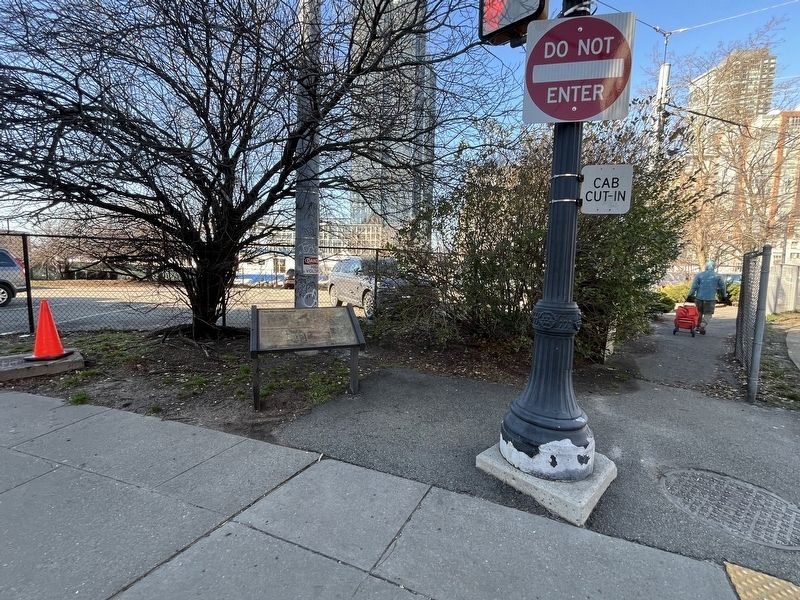

Regionally, this marker is in North Jersey, in Greater Newark, and in the New York City Metropolitan Area. It is also in the American Northeast, in the Mid-Atlantic, and on the Eastern Seaboard. Globally, it is in the North Atlantic Region, North America, the Western Hemisphere, the Western World, and the Anglosphere. Historically, it finds itself in what was once New Netherland and also one of the original Thirteen Colonies.
Other nearby markers. At least 8 other markers are within walking distance of this location: Saints Peter and Paul Cathedral (approx. 0.2 miles away); World War II Memorial (approx. 0.2 miles away); Saints Peter and Paul Orthodox Church (approx. 0.2 miles away); 105 Grand Street (approx. 0.2 miles away); Welcome to Paulus Hook Park (approx. 0.2 miles away); Korean War Veterans of Hudson County (approx. 0.2 miles away); The Morris Canal Little Basin (approx. ¼ mile away); Paulus Hook (approx. ¼ mile away). Touch for a list and map of all markers in Jersey City.
More about this marker. Unfortunately, this marker has weathered significantly and is partially unreadable.
Credits. This page was last revised on January 14, 2024. It was originally submitted on January 14, 2024, by Devry Becker Jones of Washington, District of Columbia. This page has been viewed 504 times since then and 51 times this year. Photos: 1, 2. submitted on January 14, 2024, by Devry Becker Jones of Washington, District of Columbia.
