Rockville Centre in Nassau County, New York — The American Northeast (Mid-Atlantic)
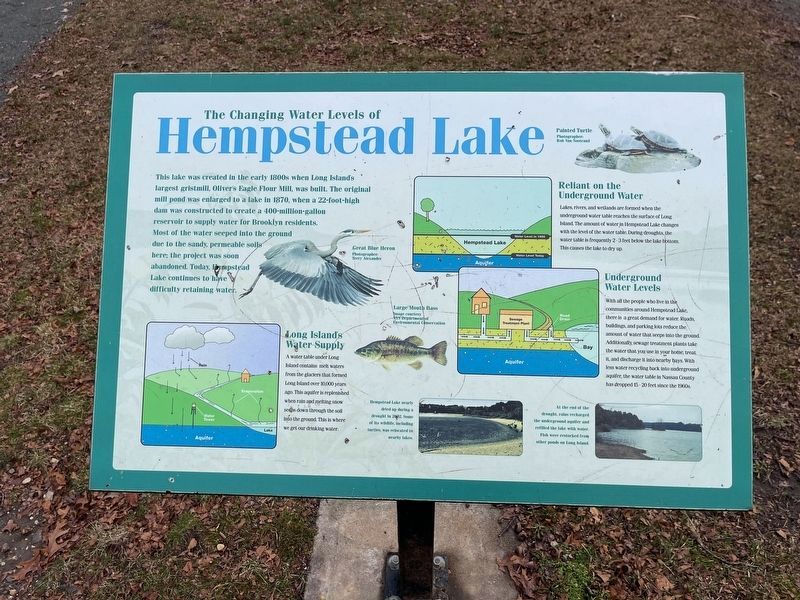
The Changing Water Levels of Hempstead Lake
Photographed by Devry Becker Jones (CC0), January 13, 2024
1. The Changing Water Levels of Hempstead Lake Marker
This lake was created in the early 1800s when Long Island's largest gristmill, Oliver's Eagle Flour Mill, was built. The original mill pond was enlarged to a lake in 1870, when a 22-foot-high dam was constructed to create a 400-million-gallon reservoir to supply water for Brooklyn residents. Most of the water seeped into the ground due to the sandy, permeable soils here; the project was soon abandoned. Today, Hempstead Lake continues to have difficulty retaining water.
Long Island's Water Supply
A water table under Long Island contains melt waters from the glaciers that formed Long Island over 10,000 years ago. This aquifer is replenished when rain and melting snow seeps down through the soil into the ground. This is where we get our drinking water.
Reliant on the Underground Water
Lakes, rivers, and wetlands are formed when the underground water table reaches the surface of Long Island. The amount of water in Hempstead Lake changes with the level of the water table. During droughts, the water is frequently 2 - 3 feet below the lake bottom. This causes the lake to dry up.
Underground Water Levels
With all
this page online
[Captions:]
Hempstead Lake nearly dried up during a drought in 2002. Some of its wildlife, including turtles, was relocated to nearby lakes.
At the end of the drought, rains recharged the underground aquifer and refilled the lake with water. Fish were restocked from other ponds on Long Island.
Erected by New York State Office of Parks, Recreation and Historic Preservation.
Topics. This historical marker is listed in these topic lists: Animals • Natural Resources • Parks & Recreational Areas • Waterways & Vessels. A significant historical year for this entry is 1870.
Location. 40° 40.278′ N, 73° 38.91′ W. Marker is in Rockville Centre, New York, in Nassau County. It can be
Photographed by Devry Becker Jones (CC0), January 13, 2024
2. The Changing Water Levels of Hempstead Lake Marker

Regionally, this marker is in the New York City Metropolitan Area and on Long Island. It is also in the American Northeast, in the Mid-Atlantic, and on the Eastern Seaboard. Globally, it is in the North Atlantic Region, North America, the Western Hemisphere, the Western World, and the Anglosphere. Historically, it finds itself in what was once New Netherland and also one of the original Thirteen Colonies.
Other nearby markers. At least 8 other markers are within walking distance of this marker: McDonald Pond (a few steps from this marker); A Fish of Mill River Legend (about 300 feet away, measured in a direct line); a different marker also named McDonald Pond (about 400 feet away); The Suburban Oasis Built by a Thirsty City (approx. 0.3 miles away); The Rev. Dr. Morgan Days Park (approx. 0.6 miles away); a different marker also named The Changing Water Levels of Hempstead Lake (approx. 0.6 miles away); DeMott Millstone (approx. 0.7 miles away); South Side Middle School World War I Memorial (approx. 0.7 miles away). Touch for a list and map of all markers in Rockville Centre.
Credits. This page was last revised on January 16, 2024. It was originally submitted on January 16, 2024, by Devry Becker Jones of Washington, District of Columbia. This page has been viewed 166 times since then and 20 times this year. Photos: 1, 2. submitted on January 16, 2024, by Devry Becker Jones of Washington, District of Columbia.
