Old Town in Alexandria, Virginia — The American South (Mid-Atlantic)
Fishtown
City of Alexandria, Est. 1749
| — | Alexandria Heritage Trail | — |
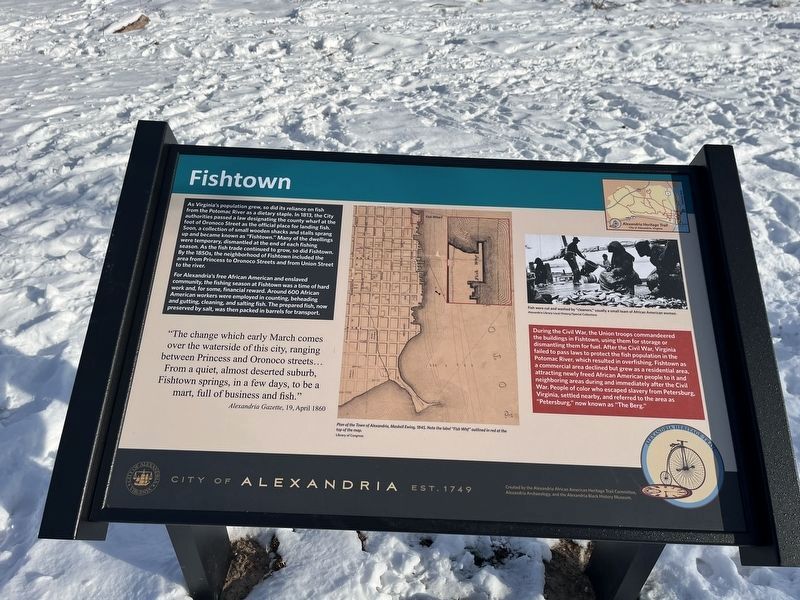
As Virginia's population grew, so did its reliance on fish from the Potomac River as a dietary staple. In 1813, the city authorities passed a law designating the county wharf at the foot of Oronoco Street as the official place for landing fish. Soon, a collection of small wooden shacks and stalls sprang up and became known as "Fishtown." Many of the dwellings were temporary, dismantled at the end of each fishing season. As the fish trade continued to grow, so did Fishtown. By the 1850s, the neighborhood of Fishtown included the area from Princess to Oronoco Streets and from Union Street to the river.
For Alexandria's free African American and enslaved community, the fishing season at Fishtown was a time of hard work and, for some, financial reward. Around 600 African American workers were employed in counting, beheading and gutting, cleaning, and salting fish. The prepared fish, now preserved by salt, was then packed in barrels for transport.
"The change which early March comes over the waterside of this city, ranging between Princess and Oronoco streets… From a quiet, almost deserted suburb, Fishtown springs,in a few days, to be a mart, full of business and fish."
Click or scan to see
this page online
Alexandria Gazette, 19, April 1860
During the Civil War, the Union troops commandeered the buildings in Fishtown, using them for storage or dismantling them for fuel. After the Civil War, Virginia failed to pass laws to protect the fish population in the Potomac River, which resulted in overfishing. Fishtown as a commercial area declined but grew as a residential area, attracting newly freed African American people to it and neighboring areas during and immediately after the Civil War. People of color who escaped slavery from Petersburg, Virginia, settled nearby, and referred to the area as "Petersburg," now known as "The Berg."
[Captions:]
Plan of the Town of Alexandria, Maskell Ewing, 1845. Note the label "Fish Whf" outlined in red at the top of the map.
Fish were cut and washed by "cleaners," usually a small team of African American women.
Erected by City of Alexandria, Virginia. (Marker Number 2.)
Topics and series. This historical marker is listed in these topic lists: African Americans • Animals • Industry & Commerce • Settlements & Settlers
Photographed by Devry Becker Jones (CC0), January 20, 2024
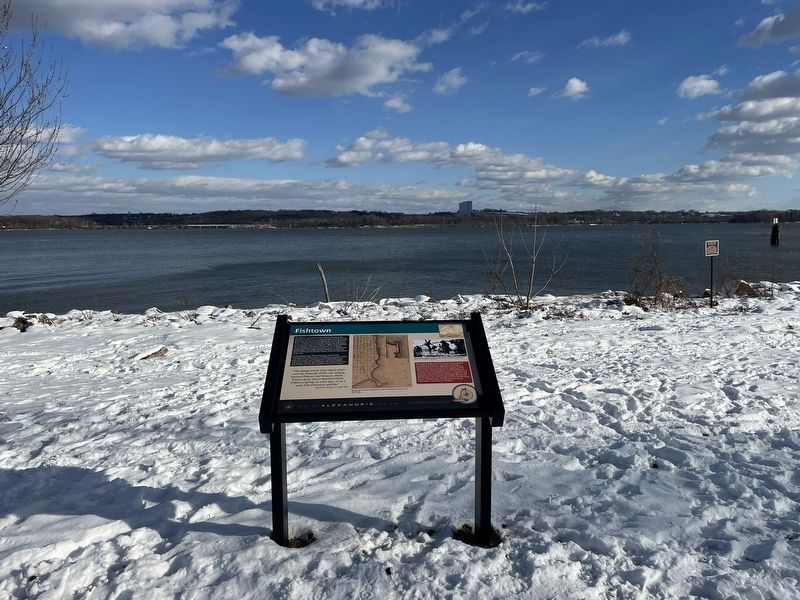
2. Fishtown marker with the Potomac River visible in the background
Location. 38° 48.447′ N, 77° 2.33′ W. Marker is in Alexandria, Virginia. It is in Old Town. It is at the intersection of North Union Street and Princess Street, on the right when traveling north on North Union Street. The marker stands on the grounds of Founders Park. Touch for map. Marker is at or near this postal address: 377 North Union Street, Alexandria VA 22314, United States of America. Touch for directions.

Regionally, this marker is in the Washington Metropolitan Area and in Northern Virginia. It is also in the American South, specifically in the Upper South, in the Mid-Atlantic, and on the Eastern Seaboard. Globally, it is in the North Atlantic Region, North America, the Western Hemisphere, the Western World, and the Anglosphere. Historically, it finds itself in what was once the territory of the Mississippian Culture, one of the original Thirteen Colonies, one of the Confederate States of America, and the Antebellum South.
Other nearby markers. At least 8 other markers are within walking distance of this marker: Retrocession (about 400 feet away, measured in a direct line); Submarine Screw (Propeller) (about 600 feet away); African American Waterfront Heritage Trail (about 700 feet away); Engin Artemel (about 800 feet away); The Civil War Comes to Alexandria (approx. 0.2 miles away); Old Town Alexandria (approx. 0.2 miles away); Torpedo Factory Art Center (approx. 0.2 miles away); United States Naval Torpedo Station (Building Two) (approx. 0.2 miles away). Touch for a list and map of all markers in Alexandria.
Other markers no longer nearby. Visiting Old Town (was approx. 0.2 miles away but has been replaced with another marker now near it); Living History (was approx. 0.2 miles away but has been replaced with another marker now near it).
Credits. This page was last revised on January 20, 2024. It was originally submitted on January 20, 2024, by Devry Becker Jones of Washington, District of Columbia. This page has been viewed 371 times since then and 39 times this year. Photos: 1, 2. submitted on January 20, 2024, by Devry Becker Jones of Washington, District of Columbia.
