Hillsdale in Columbia County, New York — The American Northeast (Mid-Atlantic)
Gen. Henry Knox Trail
Photographed by Bill Coughlin, November 2, 2009
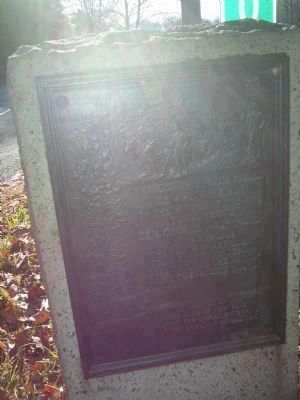
1. Gen. Henry Knox Trail Marker (NY Side)
The Henry Knox Cannon Trail follows the route that Gen. Henry Knox used to transport 59 cannons from Fort Ticonderoga and Crown Point, New York to Cambridge, Massachusetts in the winter of 1775-1776.
Gen. Henry Knox
in the winter of 1775-1776
to deliver to
Gen. George Washington
at Cambridge
the train of artillery
from Fort Ticonderoga
used to force the British
Army to evacuate Boston
Erected by
The State of New York
during the sesquicentennial
of the American Revolution
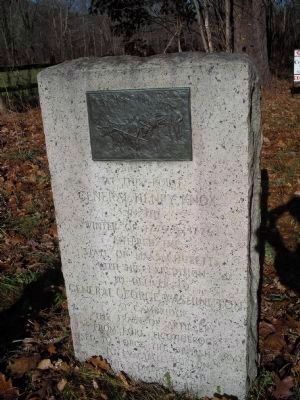
Massachusetts Side:
General Henry Knox
in the
winter of 1775 – 1776
entered the
State of Massachusetts
with his expedition
to deliver to
General George Washington
at Cambridge
the train of artillery
from Fort Ticonderoga
used to force the British Army
to evacuate Boston.
The Commonwealth
of Massachusetts
Erected 1927 by State of New York / Commonwealth of Massachusetts. (Marker Number NY-30/MA-1.)
Topics and series. This historical marker is listed in these topic lists: Notable Events • Notable Places • War, US Revolutionary. In addition, it is included in the Former U.S. Presidents: #01 George Washington, and the General Henry Knox Trail series lists. A significant historical year for this entry is 1775.
Location. 42° 14.114′ N, 73° 27.227′ W. Marker is in Hillsdale, New York, in Columbia County. It is on
this page online

Regionally, this marker is in Upstate New York and in the Hudson Valley. It is also in the American Northeast and in the Mid-Atlantic. Globally, it is in North America, the Western Hemisphere, the Western World, and the Anglosphere. Historically, it finds itself in what was once New Netherland and also one of the original Thirteen Colonies.
Other nearby markers. At least 8 other markers are within 5 miles of this marker, measured as the crow flies: A different marker also named Gen. Henry Knox Trail (approx. 2.2 miles away); General Henry Knox Trail (approx. 2.7 miles away in Massachusetts); Oscar Beckwith (approx. 3.2 miles away); East Gate Tollhouse (approx. 4 miles away); Charles Kinne (approx. 4.9 miles away); A Contribution that No Other Race Can Make (approx. 5 miles away in Massachusetts); Boulder Dedicated to the Legacy of W.E.B. Du Bois (approx. 5 miles away in Massachusetts);
Photographed by Bill Coughlin, November 2, 2009
2. Gen. Henry Knox Trail Marker (Mass Side)
This is the only monument on the Gen. Henry Knox Trail that contains the designs from both the state of New York and the Commonwealth of Massachusetts.
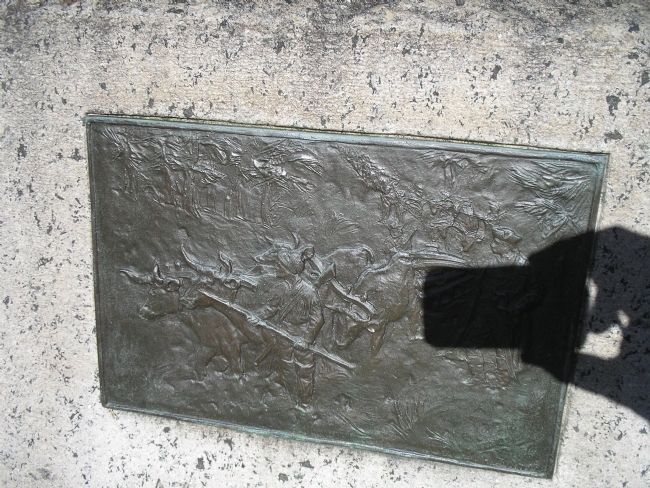
More about this marker. The top of both markers contain a relief scene of Gen. Knox overseeing several teams of oxen dragging the artillery pieces. The left of the New York side of the marker also contains a map tracing the route taken from Ticonderoga to Cambridge, Mass. Indicated along the route are the New York towns of Ft. George, Ft. Edward, Saratoga, Half Moon, Albany, Kinderhook, Claverack and Nobletown.
Related markers. Click here for a list of markers that are related to this marker. These markers follow the route used by Knox to transfer cannons from Fort Ticonderoga to Cambridge, Mass.
Also see . . . Major General Henry Knox. Knox biography from the American Revolution website. (Submitted on November 2, 2009, by Bill Coughlin of Woodland Park, New Jersey.)
Photographed by Bill Coughlin, November 2, 2009
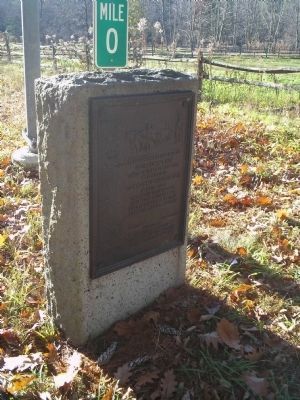
3. Knox Trail Marker NY-30
Photographed by Bill Coughlin, November 2, 2009
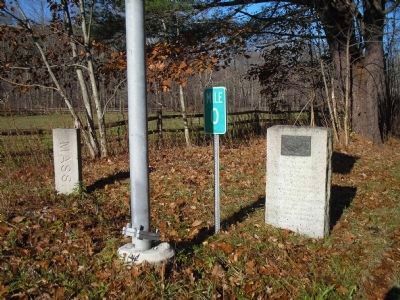
4. Knox Trail Marker MA-1
The Massachusetts section of the Gen. Henry Knox Trail begins here.
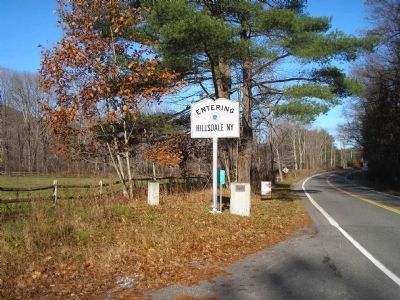
Photographed by Bill Coughlin, November 2, 2009
5. Massachusetts Knox Trail Marker
This photo shows the monument as viewed from Massachusetts.
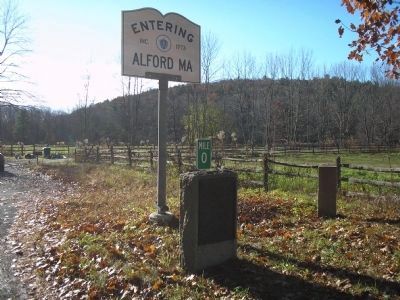
Photographed by Bill Coughlin, November 2, 2009
6. New York Knox Trail Marker
A view of the monument from New York is shown here.
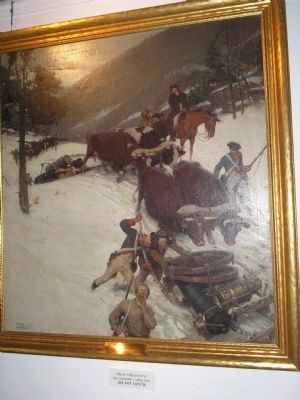
Photographed by Bill Coughlin, July 11, 2008
7. The Noble Train of Artillery
This painting of Knox transporting the cannons is on display at Fort Ticonderoga. It was painted by Tom Lovell.
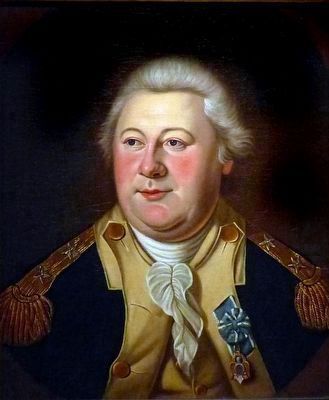
Photographed by Allen C. Browne, August 9, 2015
8. Henry Knox
This portrait of Henry Knox by Charles Peale Polk after the c.1783 original by Charles Willson Peale hangs in the National Portrait Gallery in Washington, DC.
“Henry Knox 1750-1806 . Born Boston, Massachusetts An overweight twenty-five-year old Boston bookseller who had taught himself military engineering and artillery out of books, Henry Knox was chief of artillery for the Continental army. In 1775, with Boston under British control, Knox commanded the 300-mile trek to Fort Ticonderoga to bring back by ox sleds the fifty-nine cannons mounted on Dorchester Heights that forced the British to evacuate the city. Throughout the seven years of battle, Knox would be by General Washington's side, his close friend and indispensable colleague and later the man the president would pick to be his secretary of war.
Knox is painted here in the uniform of a major general. He wears the badge of the Order of the Society of the Cincinnati, the fraternity of Continental army officers that he envisioned in 1783.” — National Portrait Gallery
“Henry Knox 1750-1806 . Born Boston, Massachusetts An overweight twenty-five-year old Boston bookseller who had taught himself military engineering and artillery out of books, Henry Knox was chief of artillery for the Continental army. In 1775, with Boston under British control, Knox commanded the 300-mile trek to Fort Ticonderoga to bring back by ox sleds the fifty-nine cannons mounted on Dorchester Heights that forced the British to evacuate the city. Throughout the seven years of battle, Knox would be by General Washington's side, his close friend and indispensable colleague and later the man the president would pick to be his secretary of war.
Knox is painted here in the uniform of a major general. He wears the badge of the Order of the Society of the Cincinnati, the fraternity of Continental army officers that he envisioned in 1783.” — National Portrait Gallery
Photographed by Bill Coughlin, November 2, 2009
9. Massachusetts Plaque
The Massachusetts side of the marker contains this bas relief bronze plaque depicting Gen. Knox overseeing a train of ox-drawn sleds.

Photographed by Lea Bishop, May 23, 2026
10. NY Side of Knox Marker NY30 May 23,2026

Photographed by Lea Bishop, May 23, 2026
11. Mass. Side of Knox Marker NY30 05/23/26

Photographed by Lea Bishop, May 23, 2026
12. Site of Marker NY30
Credits. This page was last revised on May 31, 2026. It was originally submitted on November 2, 2009, by Bill Coughlin of Woodland Park, New Jersey. This page has been viewed 3,061 times since then and 107 times this year. Photos: 1, 2, 3, 4, 5, 6, 7. submitted on November 2, 2009, by Bill Coughlin of Woodland Park, New Jersey. 8. submitted on August 26, 2015, by Allen C. Browne of Silver Spring, Maryland. 9. submitted on November 2, 2009, by Bill Coughlin of Woodland Park, New Jersey. 10, 11, 12. submitted on May 31, 2026, by Lea Bishop of Hopewell Junction, New York.
