Fairmount Park in Philadelphia in Philadelphia County, Pennsylvania — The American Northeast (Mid-Atlantic)
Columbia Bridge

Built in 1834, the first of three bridges to span the Schuylkill River at this crossing formed an important link in Philadelphia's effort to compete with the Erie Canal. The opening of the Erie Canal in 1825 created an all water route from the mouth of the Hudson River to Lake Superior and enabled New York City to dominate trade with the rapidly growing West. In 1825, Pennsylvania responded to this commercial threat to the Commonwealth and Philadelphia by establishing the "State Works". The State constructed over 700 miles of canals and railroads. The Main Line consisted of a railroad from Philadelphia to Columbia on the Susquehanna River, a canal from Columbia to Hollidaysburg, the 37-mile long Allegheny Portage Railroad which included a 900 feet long tunnel to traverse the mountains to Johnstown and a canal to complete the 394-mile route into Pittsburgh. The system used specifically designed canal boats that flatcars could haul over the railroad. The Main Line began operation in 1834.
The State erected the original Columbia Bridge, a seven span, white pine, covered bridge for the Philadelphia & Columbia Railroad
this page online
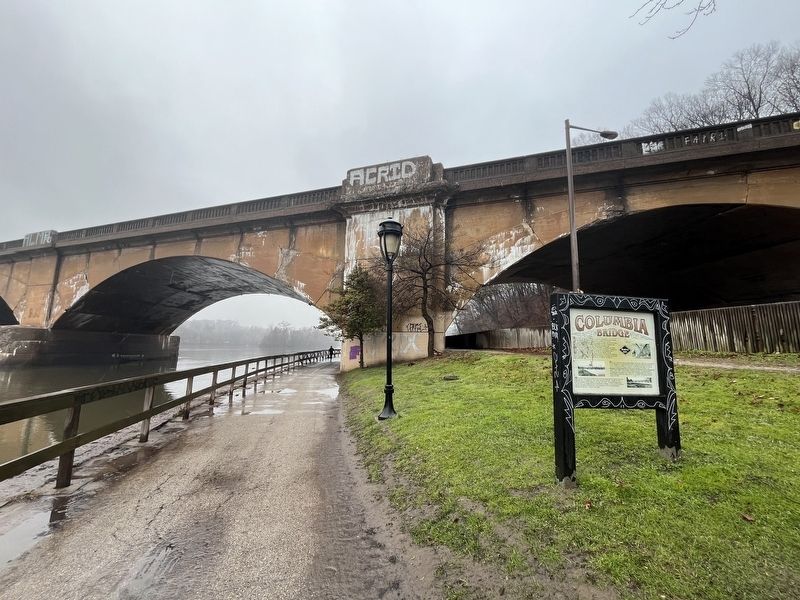
The current bridge consists of eight concrete arch spans supporting four railroad tracks and a pedestrian walk. It measures 755 feet in length and 56 feet in width. Two sets of tracks went into operation in 1920 followed by the other two in 1921. The Columbia Bridge carried the main line of the Reading Railroad from Philadelphia to Reading. It also served the industries along the Schuylkill and Delaware River and the passenger trains of the Reading and of the Baltimore and Ohio. It remains in use today.
Topics and series. This historical marker is listed in
Photographed by Devry Becker Jones (CC0), January 26, 2024
2. Columbia Bridge Marker with the bridge visible in the background
Location. 39° 59.078′ N, 75° 12.2′ W. Marker is in Philadelphia, Pennsylvania, in Philadelphia County. It is in Fairmount Park. It is on Schuylkill River Trail 0.4 miles north of Fountain Green Drive, on the right when traveling north. Touch for map. Marker is at or near this postal address: 30 Schuylkill River Trail, Philadelphia PA 19131, United States of America. Touch for directions.

Regionally, this marker is in Southeast Pennsylvania. It is also in the American Northeast and in the Mid-Atlantic. Globally, it is in North America, the Western Hemisphere, the Western World, and the Anglosphere. Historically, it finds itself in what was once the Haudenosaunee (Iroquois) Confederacy, New Netherland, and one of the original Thirteen Colonies.
Other nearby markers. At least 8 other markers are within walking distance of this marker: Rockland (approx. 0.2 miles away); A Pirate's Plantation / Beer, Milk, Autos, Museum (approx. 0.2 miles away); Mount Pleasant (approx. 0.2 miles away); Rebecca at the Well (approx. 0.3 miles away); a different marker also named Rebecca at the Well (approx. 0.3 miles away); Haydn (approx. 0.3 miles away); Rev. Dr. John Witherspoon (approx. 0.3 miles away); John Witherspoon D.D.L.L.D. (approx. 0.3 miles away). Touch for a list and map of all markers in Philadelphia.
Credits. This page was last revised on January 31, 2024. It was originally submitted on January 31, 2024, by Devry Becker Jones of Washington, District of Columbia. This page has been viewed 639 times since then and 106 times this year. Photos: 1, 2. submitted on January 31, 2024, by Devry Becker Jones of Washington, District of Columbia.
