
Indian Creek, Toledo, Belize — Central America
Ball Court
Structures 18 & 19
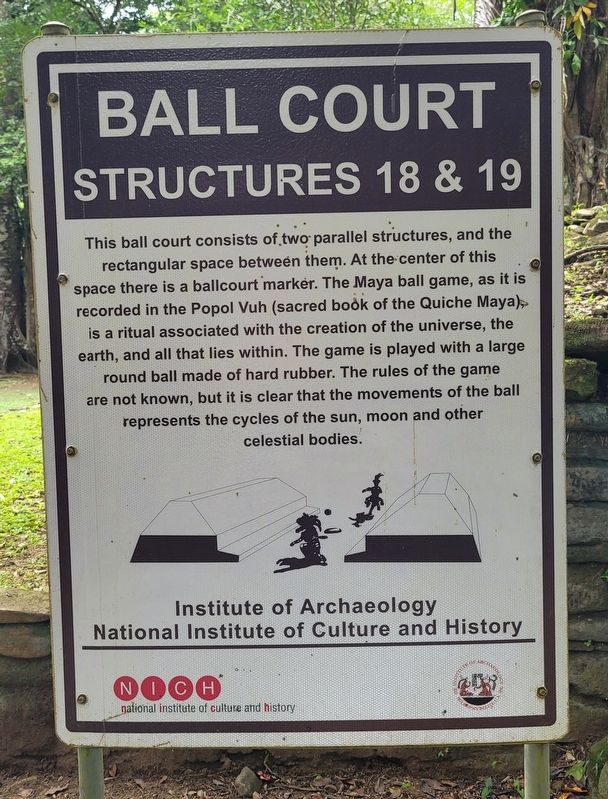
Photographed by James Hulse, January 29, 2024
1. Ball Court Marker
Erected by Institute of Archaeology National Institute of Culture and History.
Topics. This historical marker is listed in these topic lists: Anthropology & Archaeology • Indigenous Peoples and Communities • Sports.
Location. 16° 19.297′ N, 88° 49.469′ W. Marker is in Indian Creek, Toledo. It is on Nim Li Punit Mayan Ruins Road 0.4 kilometers north of Southern Highway. The marker is located in the Nim Li Punit Mayan Ruins and there is a small fee to visit. Touch for map. Touch for directions.

Regionally, it is in North
this page online
Other nearby markers. At least 4 other markers are within 16 kilometers of this marker, measured as the crow flies: E-Group (about 90 meters away, measured in a direct line); The Royal Residence (about 120 meters away); Tomb #1 (about 150 meters away); a different marker also named Ball Court (approx. 15 kilometers away).
Also see . . .
1. Nim Li Punit. The Mayan Ruins Website
Nim Li Punit is a small, yet important archaeological zone located in the south of Belize. It is a modern name meaning “Big Hat” in Kekchi Maya after an image of a ruler depicted on a stela recovered from the site. Its original name has yet to be deciphered.(Submitted on February 3, 2024, by James Hulse of Medina, Texas.)
The site is centered upon the leveled summits of small hills within a richly diverse tropical forest situated in the foothills of the Maya Mountains. It was established to exploit the areas natural resources and to take advantage of the extensive trade network that existed in the region. Itis situated 9 miles/15 kms northeast of, and was contemporaneous with, the Maya site of Lubaantun which was the main political/economic center in the region. The population has been estimated between 5,000 to 7,000 individuals.Photographed by James Hulse, January 29, 20242. The view of the Ball Court and Marker
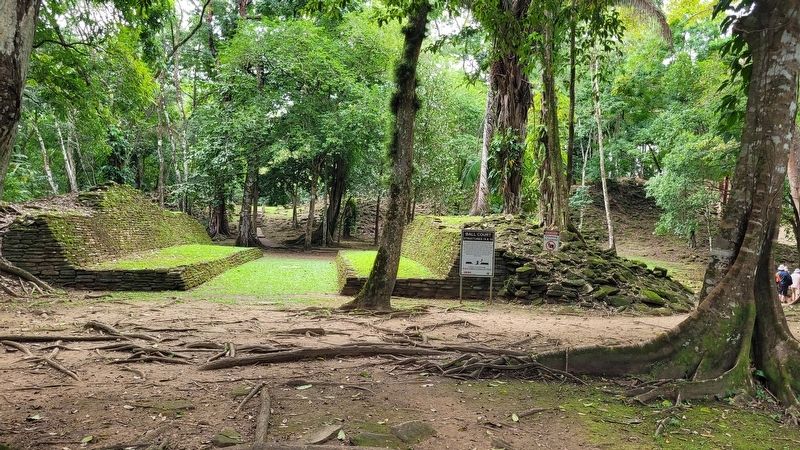
2. Maya Ballgame. Wikipedia
The ball was put in motion by action of the right hip, the right elbow, and the right knee, and was not permitted to touch the ground. It could be passed between players in each team by propulsion by those body parts. The aim was to move the ball back to the opposite team, preferably through the ring. The goal of the opposition (what today might be termed ‘the defense’) was to force the offense to lose control and to allow the ball to touch the ground. The stone ring was an innovation of the late-classic and early post-classic periods, as seen in Chi.(Submitted on February 3, 2024, by James Hulse of Medina, Texas.)
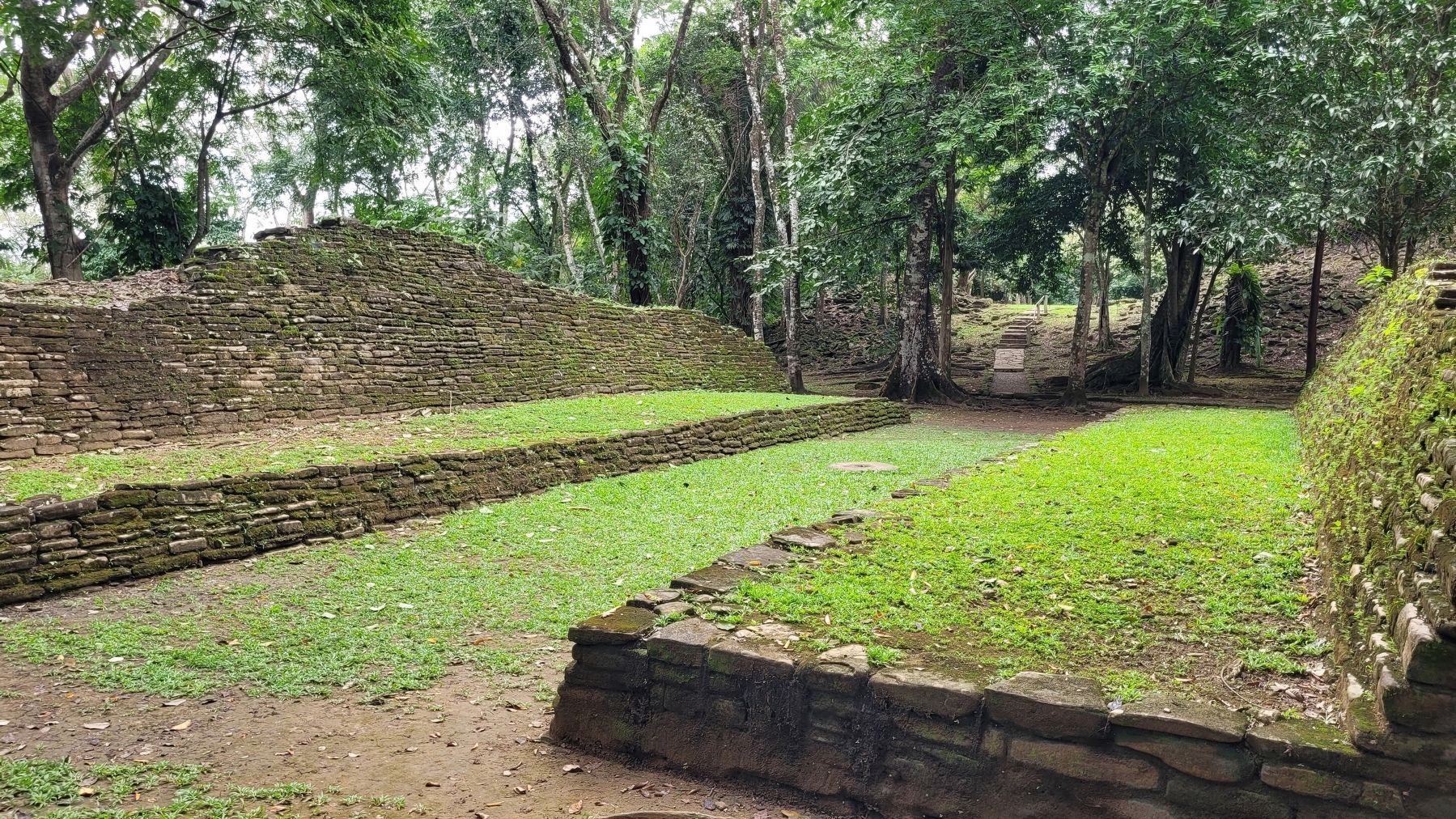
Photographed by James Hulse, January 29, 2024
3. Closeup of the Ball Court Marker
Credits. This page was last revised on February 5, 2024. It was originally submitted on February 2, 2024, by James Hulse of Medina, Texas. This page has been viewed 182 times since then and 24 times this year. Photos: 1, 2, 3. submitted on February 2, 2024, by James Hulse of Medina, Texas.
