Vicksburg National Military Park in Warren County, Mississippi — The American South (East South Central)
Major General John S. Bowen
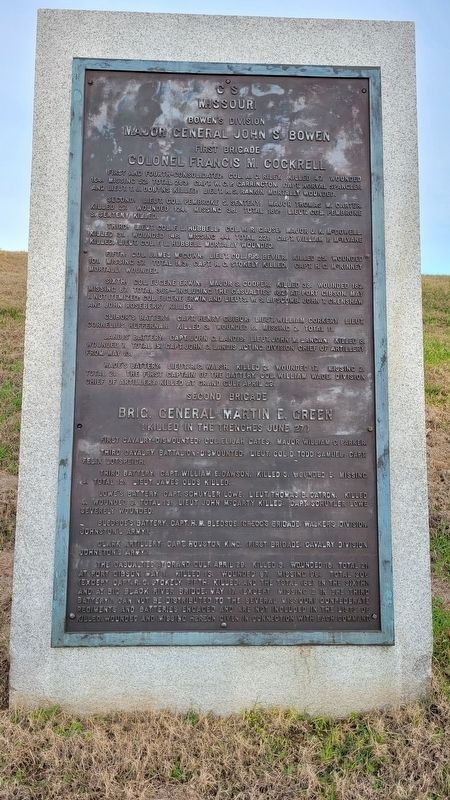
C.S. Missouri
| — | Bowens Division | — |
Photographed by James Hulse, January 14, 2023
1. Major General John S. Bowen Marker
Colonel Francis M. Cockrell
First and Fourth - Consolidated: Col. A.C. Riley, Killed 47. Wounded 164, Missing 52, Total 263; Capt. W.C.P. Carrington, Capt. Norval Spangler and Lieutenant T.J. Dobyns Killed; Lieut. R.S. Rankin Mortally Wounded.
Second: Lieut. Col. Pembroke S. Senteny; Major Thomas M. Carter, Killed 27, Wounded 124, Missing 38, Total 189; Lieut. Col. Pembroke S. Senteny Killed.
Third: Lieut. Col. F.L. Hubbel; Col. W.R. Gause; Major J.K. McDowell, Killed 31; Wounded 146, Missing 44, Total 221; Capt. William P. McIlvane Killed, Lieut. Col. F.L. Hubbel Mortally Wounded.
Fifth: Col. James McGowan; Lieut. Col. R.S. Bevier, Killed 25, Wounded 101, Missing 37, Total 163; Capt. R.G. Stonely Killed, Capt. H.G. McKinney Mortally Wounded.
Sixth: Col. Eugene Erwin; Major S. Cooper. Killed 38, Wounded 182, Missing 67, Total 369 - Including the Casualties (82) at Port Gibson, May 1, Not itemized; Col. Eugene Erwin and Lieuts. W.S. Lipscomb, John T. Crenshaw and Jonn Roseberry Killed.
Guibor's Battery: Capt. Henry Guibor; Lieut. William Corkery, Lieut. Cornelius Heffernan, Killed 3, Wounded 6, Missing 2, Total 11.
Landis' Battery: Capt. John C. Landis; Lieut. John M. Langan. Killed 8, Wounded 7, Total 15. Capt John C. Landis acting Division Chief of Artillery from May 13.
Wade's Battery: Lieut. R.C. Walsh. Killed 2, Wounded 17, Missing 2, Total 21. The First Captain of the Battery, Col. William Wade, Division Chief of Artillery. Killed at Grand Gulf, April 29.
Second Brigade
Brig. General Martin E. Green
(Killed in the Trenches June 27)
First Cavalry-Dismounted: Col. Elijah Gates; Major William C. Parker.
Third Cavalry Battalion-Dismounted: Lieut. Col. D. Todd Samuel; Capt. Felix Lotspeich.
Third Battery: Capt. William E. Dawson, Killed 3, Wounded 5, Missing 4, Total 12; Lieut. James Olds Killed.
Lowe's Battery: Capt. Schuyler Lowe; Lieut. Thomas B. Catron. Killed 4, Wounded 9, Total 13; Lieut. John McCarty Killed, Capt. Schuyler Lowe Severely Wounded.
Bledsoe's Battery: Capt. H.M. Bledsoe. (Gregg's Brigade, Walker's Division, Johnston's Army).
Clark Artillery: Capt. Houston King. (First Brigade, Cavalry Division, Johnston's Army).
The Casualties at Grand Gulf, April 29, Killed 3, Wounded 18, Total 21; At Port Gibson, May 1, Killed 13, Wounded 97, Missing 96, Total 206 (Except Capt. R.G. Stokely, Fifth, Killed, and the Total (82) in the Sixth); and at Big Black River Bridge, May 17, (Except Missing 2 in the Third Battery). Can not be distributed to the several Missouri Confederate Regiments and Batteries engaged and are not included in the lists of Killed, Wounded and Missing hereon given in connection with each command.
Topics.
this page online
Location. 32° 22.199′ N, 90° 50.685′ W. Marker is in Vicksburg National Military Park, Mississippi, in Warren County. It is at the intersection of Confederate Avenue and Old Graveyard Road, on the left when traveling south on Confederate Avenue. The marker is located in the north central section of the Vicksburg National Military Park. Touch for map. Marker is in this post office area: Vicksburg MS 39183, United States of America. Touch for directions.

Regionally, this marker is in Natchez Trace Corridor and in Greater Jackson. It is also in the American South, specifically in the Deep South, in the Mississippi Delta, and in the Great River Road Region. Globally, it is in North America, a Gulf of Mexico state, the Western Hemisphere, the Western World, and the Anglosphere. Historically, it finds itself in what was once New Spain, the territory of the Mississippian Culture, one of the Confederate States of America, and the Antebellum South.
Other nearby markers. At least 8 other markers are within walking
Photographed by James Hulse, January 14, 2023
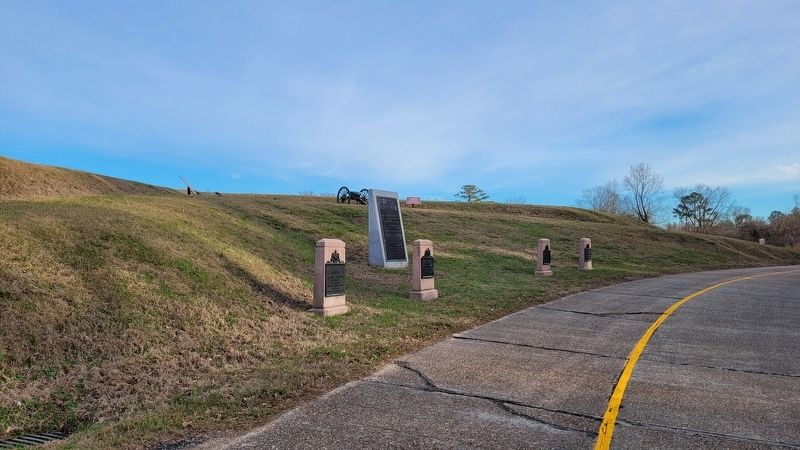
2. The Major General John S. Bowen Marker is the larger white marker behind the red markers
Also see . . .
1. John S. Bowen. Wikipedia
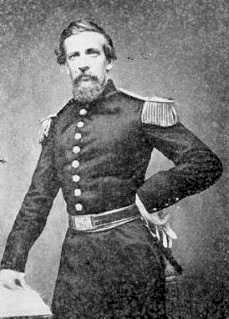
He subsequently was commissioned a brevet second lieutenant in the U.S. Regiment of Mounted Rifles. He was first assigned to the army cavalry school at Carlisle, Pennsylvania until 1855, when he was transferred to the Jefferson Barracks in St. Louis, Missouri; while in St. Louis, he met and married Mary Kennerly. He eventually became acting adjutant of the U.S. 2nd Cavalry Regiment; then in early 1855, he was reassigned to Fort McIntosh, Texas. While there,(Submitted on February 7, 2024, by James Hulse of Medina, Texas.)he decided to resign from the army due to loneliness and moved to Georgia, becoming an architect. He designed and built his family's home on Michigan Avenue in St. Louis. Bowen was an acquaintance of Ulysses S. Grant before the war as Grant used to deliver firewood in Bowen's neighborhood.[3] Bowen became a lieutenant colonel in the Georgia militia, but then moved to Missouri in 1857. There he became active in the Missouri Volunteer Militia (MVM). In 1861 he was appointed as lieutenant colonel commanding the MVM's Southwest Battalion, patrolling Missouri's western border against raids by bands of Kansas Jayhawkers.Public Domain - United States Library of Congress, circa 1860s3. Major General John S. Bowen
2. “To save the further effusion of blood”: Major General John S. Bowen and the Surrender of Vicksburg. Emerging Civil War - Kristen M. Trout
On July 3, 1863, Major General John S. Bowen and Lieutenant Colonel Louis Montgomery entered the Union siege lines surrounding Vicksburg to deliver a message from Army of Mississippi Lieutenant General John Pemberton and discuss the upcoming surrender of the Army of Mississippi. Himself stricken with dysentery, Bowen commanded a division of Missourians and Arkansans who were slowly dying of starvation and disease within the blockaded river town. Bowen hoped that through his personal connections with Army of the Tennessee commander Major General Ulysses Grant, he could somehow negotiate reasonable terms of surrender to save the army – and his own men.(Submitted on February 7, 2024, by James Hulse of Medina, Texas.)
Credits. This page was last revised on February 7, 2024. It was originally submitted on February 5, 2024, by James Hulse of Medina, Texas. This page has been viewed 211 times since then and 35 times this year. Photos: 1, 2. submitted on February 6, 2024, by James Hulse of Medina, Texas. 3. submitted on February 7, 2024, by James Hulse of Medina, Texas.
