Redondela in Pontevedra, Galicia, Spain — Southwestern Europe (Iberian Peninsula)
O Convento de Vilavella (Sèculos XVI-XX)
⎯⎯⎯
The Convent of Vilavella (16th-20th Centuries)

Photographed by Andrew Ruppenstein, September 8, 2023
1. O Convento de Vilavella (Sèculos XVI-XX) / The Convent of Vilavella (16th-20th Centuries) Marker

O Convento de Vilavella
Foi fundado en 1501 polo crego García Prego de Montaos, arcediago de Cerveira. O convento estivo ocupado polas monxas de clausura da orde de San Lourenzo Xustiniano e construíuse arredor do templo parroquial de Vilavella.
Este relixioso decidiu investir os seus aforros na construción deste edificio na antiga freguesía de Vilavella "por ser camino público y estrada real y porque Garcia Prego de Montaos quiere y es su voluntad por hacer gracia e obra buena a dicha villa e porque los Santos Sacramentos e Oficios Divinos sean aumentados e eso mesmo por causa de traer a camino a muchas donzellas de género que en la dicha villa y alrededor ay quiere y es su voluntad ha puesto por obra de fazer a su propia costa e espesa un Monesterio de Monjas e Religiosas junto e alderredor de la dicha yglessia y gastar en el tres o cuatro mil ducados e que la dicha iglesia de Santiago sea el propio cuerpo de dicho Monesterio"
As obras rematáronse en 1554. acollendo a vintecatro monxas. Estivo dedicado nun principio ao apóstolo Santiago, aínda que máis tarde acabaría sendo a súa patroa a Nosa
this page online
O edificio actual é o resultado dunha profunda reforma do proxecto orixinal realizada a mediados do século XX polos arquitectos Jenaro de la Fuente Álvarez e Manuel Gómez Román.
Renda e foros
Cando unha monxa tomaba os hábitos o seu pai debia entregar á orde unha dote, xa fora diñeiro ou bens, O convento tamén recibia propiedades mediante cesións ou herdanzas de persoas devotas. As relixiosas cobraban foros polo arrendamento das súas propiedades en forma de millo, trigo, centeo, viño, galiñas, etc. A administración dos seus bens, o rezo e a elaboración de bordados e de doces ocupaban as súas horas.
Anegamentos
No ano 1933 un total de seis relixiosas abandonaron Redondela para trasladarse ao convento das Franciscanas de Tui por causa das enfermidades provocadas polo exceso de humidade e dos continuos asolagamentos que sufria a planta baixa do convento e tamén a horta, provocados polo río Maceiras.
José Otero González
En 1942 o convento e a súa horta, viñas e froiteiras, que se abastecia de tres fontes de auga procedentes do exterior, foron vendidos
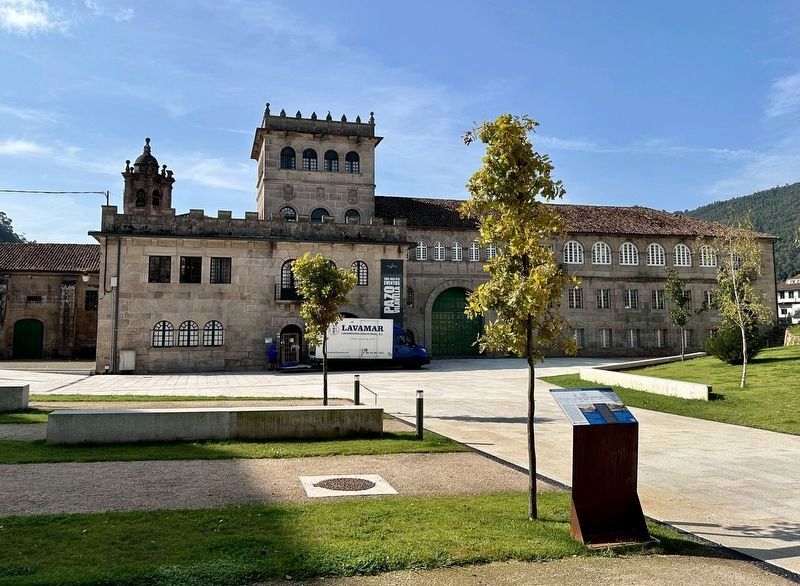
Photographed by Andrew Ruppenstein, September 8, 2023
2. The Convent of Vilavella and marker
Como consecuencia daquelas obras, as inic de José Otero González (JOG) e da súa fábrica de conservas JOB (iniciais do seu pai José Otero Bilbao), aparecen nos escudos da fachada principal do convento xunto co do fundador.
A súa morte, Otero González deixoulle en usufruto o convento á Orde de Xustinianas 'coa obriga de dedicarse ao ensino, para o que se disporá miña herencia da cantidade de cen mil pesetas para a súa instalación no mosteiro Otero González deixou aos veciños de Redondela o coro baixo do convento, e pretendía ceder o superior e o campanario ás monxas.
Doces e lambonadas
O convento foi célebre polos doces que elaboraban as relixiosas. Asi, en 1603 o Concello de Pontevedra encarga a Inés
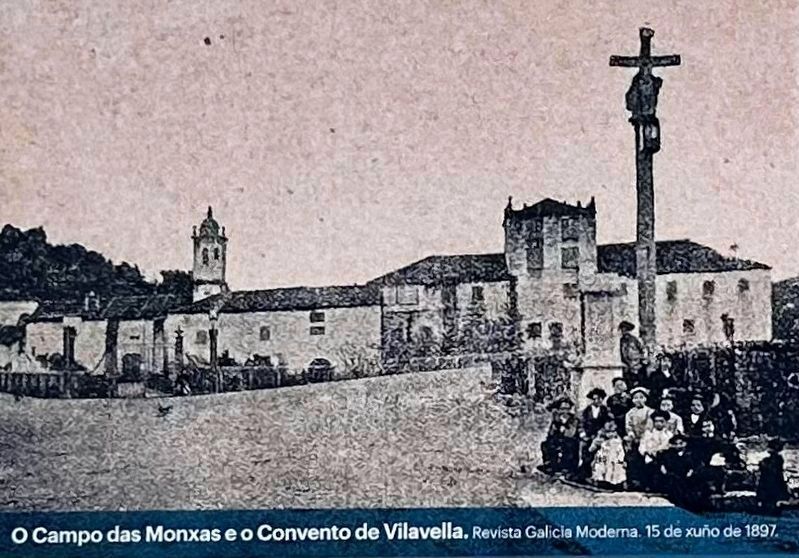
Photographed by Revista Galicia Moderna, June 15, 1897
3. Marker photo: The Campo das Monxas and Convent of Vilavella
The Convent of Vilavella
It was founded in 1501 by the priest García Prego de Montaos, archdeacon of Cerveira. The convent was occupied by the cloistered nuns of the order of San Lorenzo Justiniano and was built around the parish church of Vilavella:
This religious man decided to invest his savings in the construction of this building in the old parish of Vilavella "because it is a public road and royal road and because García Prego de Montaos wants and it is his will to do grace and good works to the said town and because the Holy Sacraments or Divine Offices are increased and because of bringing to
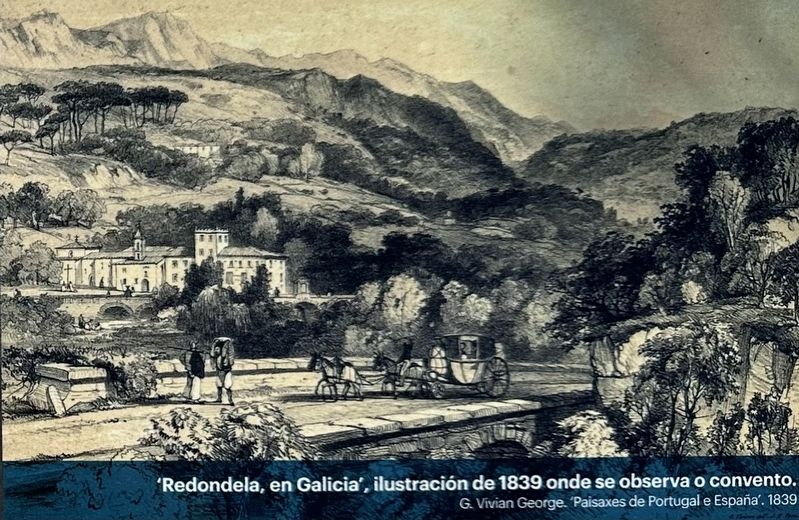
G. Vivian George, from Landscapes of Portugal and Spain, 1839
4. Marker illustration: Redondela, in Galicia
The work was completed in 1554, housing twenty-four nuns. It was initially dedicated to the apostle St. James, although later its patron saint would become Our Lady of the Purification. The convent eventually housed sixty nuns.
The current building is the result of a thorough renovation of the original project carried out in the mid-20th century by the architects Jenaro de la Fuente Álvarez and Manuel Gómez Román.
Rent and forums
When a nun took the habit her father had to give the order a dowry, either money or property. The convent also received property through transfers or inheritances from devout individuals. The nuns were paid for the lease of their property in the form of corn, wheat, rye, wine, chickens, etc. In addition to the administration of their property, prayer and the production of embroidery and sweets occupied their time.
Floods
In 1933, a total of six nuns left Redondela to move to the convent of the Franciscan nuns in Tui because of the illnesses caused by the excessive humidity and the continuous flooding of the ground floor of the convent and the vegetable garden, caused by the river Maceiras.
José Otero González
In 1942 the convent and its vegetable garden, vineyards and fruit trees, which were supplied by three water sources from outside, were sold to the businessman José Otero González (1899-1968) for 110,000 pesetas. This local canner decided to buy this building in memory of his grandmother Rita Bilbao, who was widowed with six young children and worked as an errand girl for the nuns for several decades. In 1951, Otero González established his home, the offices of his company, a warehouse and workshops in the convent, carrying out different reforms.
As a result of those works, the initials of José Otero González (JOG) and of his canning factory JOB (initials of his father José Otero Bilbao), appear on the coats of arms on the main façade of the convent together with that of the founder. On his death, Otero González left the convent in usufruct to the Justinian Order "with the duty to dedicate itself to teaching, for which purpose the sum of one hundred thousand pesetas will be provided from my inheritance for its installation in the monastery". Otero González left the lower choir of the convent to the residents of Redondela, and intended to cede the upper choir and the bell tower to the nuns.
Sweets and cakes
The convent was famous for the sweets made by the nuns. Thus, in 1603 the Pontevedra City Council commissioned Inés Avalle Marino, the mother superior of the convent, to bake cakes to entertain Archbishop Maximilian of Austria, who was visiting the city. In 1857 his twelve fruit cakes in syrup were awarded a prize at the Agricultural Products Exhibition in Madrid and Pontevedra. In 1867 the nuns' sweets represented Spain at the Universal Exhibition in Paris with sweets in syrup, orange blossom, orange, naranjillo, angel hair and walnuts.
Erected by Concello de Redondela, Deputación Pontevedra.
Topics. This historical marker is listed in these topic lists: Industry & Commerce • Religion & Religious Structures • Women. A significant historical year for this entry is 1501.
Location. 42° 16.738′ N, 8° 36.617′ W. Marker is in Redondela, Galicia, in Pontevedra. It is on Praza de Monteareas. Touch for map. Marker is in this post office area: Redondela, Galicia 36800, Spain. Touch for directions.

Regionally, it is in the North Atlantic Region, on the Atlantic Arc, in Europe, in the European Union, in Atlantic Europe, on the Iberian Peninsula, in the Schengen Area, in a coastal Mediterranean country, and in the Western World. Historically, it finds itself in what was once the Roman Empire.
Other nearby markers. At least 8 other markers are within walking distance of this marker: Don Jose Regojo (approx. 0.2 kilometers away); Dona Rita Otero Fernández (approx. 0.2 kilometers away); A Casa Da Torre / The Tower House (approx. 0.4 kilometers away); Reveriano Soutullo (approx. 0.4 kilometers away); Casa da Alfóndega (approx. 0.4 kilometers away); Diego San José de la Torre (approx. 0.4 kilometers away); Xosé L. Franco Grande (approx. half a kilometer away); Igrexa de Santiago (Século XV) / Church of Santiago (15th Century) (approx. half a kilometer away). Touch for a list and map of all markers in Redondela.
Also see . . . Vilavella Convent. Redondela Council Tourism website entry (Submitted on May 22, 2024, by Larry Gertner of New York, New York.)
Credits. This page was last revised on May 23, 2024. It was originally submitted on February 5, 2024, by Andrew Ruppenstein of Lamorinda, California. This page has been viewed 279 times since then and 49 times this year. Photos: 1, 2, 3, 4. submitted on February 5, 2024, by Andrew Ruppenstein of Lamorinda, California.
