
New Bern in Craven County, North Carolina — The American South (South Atlantic)
William Henry Singleton
From Slavery to Freedom
Photographed by Kevin W., October 21, 2009
1. William Henry Singleton Marker
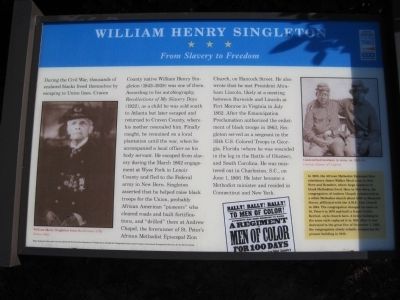
During the Civil War, thousands of enslaved blacks freed themselves by escaping to Union lines. Craven County native William Henry Singleton (1843-1938) was one of them. According to his biography, Recollections of My Slavery Days (1922), as a child he was sold south to Atlanta but later escaped and returned to Craven County, where his mother concealed him. Finally caught, he remained on a local plantation until the war, when he accompanied a local officer as his body servant. He escaped from slavery during the March 1862 engagement at Wyse Fork in Lenoir County and fled to the Federal army in New Bern. Singleton asserted that he helped raise black troops for the Union, probably African-American “pioneers” who cleared roads and built fortifications, and “drilled” them at Andrew Chapel, the forerunner of St. Peter’s African Methodist Episcopal Zion Church, on Hancock Street. He also wrote that he met President Abraham Lincoln, likely at a meeting between Burnside and Lincoln at Fort Monroe in Virginia in July 1862. After the Emancipation Proclamation authorized the enlistment of black troops in 1863, Singleton served as
this page online
Photographed by Kevin W., October 21, 2009
2. William Henry Singleton Marker
[Sidebar:]
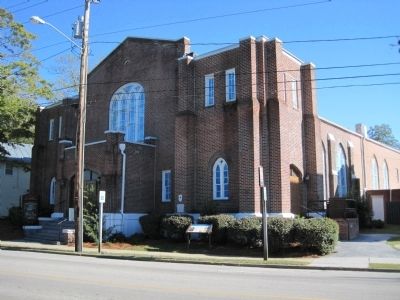
In 1863, the African Methodist Episcopal Zion missionary James Walker Hood came to New Bern and Beaufort, where large numbers of black Methodists lived. Here in New Bern, the congregation of Andrew Chapel, constructed as a white Methodist church about 1802 on Hancock Street, affiliated with the A.M.E. Zion Church in 1864. The congregation changed its name to St. Peter’s in 1879 and built a frame Gothic Revival-style church here. A brick building in the same style replaced it in 1914. After it was destroyed in the great fire of December 1, 1922, the congregation slowly rebuilt, completing the present building in 1942.
Erected by North Carolina Civil War Trails.
Topics and series. This historical marker is listed in these topic lists: African Americans • Religion & Religious Structures • War, US Civil. In addition, it is included in the African Methodist Episcopal Zion (AME Zion) Church, the Former U.S. Presidents: #16 Abraham Lincoln, and the North Carolina Civil War Trails series lists. A significant historical month for this entry is March 1862.
Location. 35° 6.647′ N, 77° 2.621′ W. Marker is in New Bern, North Carolina, in Craven County. It is on Queen Street near Johnson Street. Touch for map. Marker is at or near this postal address: 617 Queen St, New Bern NC 28560, United States of America. Touch for directions.

Regionally, this marker is in North Carolina’s Coastal Plain. It is also in the American South, specifically in the Upper South, in the Tidewater, and on the Eastern Seaboard. Globally, it is in the North Atlantic Region, North America, the Western Hemisphere, the Western World, and the Anglosphere. Historically, it finds itself in what was once the territory of the Mississippian Culture, one of the original Thirteen Colonies, one of the Confederate States of America, and the Antebellum South.
Other nearby markers. At least 8 other markers are within walking distance of this marker: St. Peter's A.M.E. Zion Church (here, next to this marker); Cedar Grove Cemetery (within shouting distance of this marker); King Solomon Lodge (about 700 feet away, measured in a direct line); New Bern Academy (about 700 feet away); a different marker also named New Bern Academy (approx. 0.2 miles away); James Walker Hood (approx. 0.2 miles away); George H. White (approx. 0.2 miles away); Tryon Palace (approx. 0.2 miles away). Touch for a list and map of all markers in New Bern.
Also see . . . Recollections of My Slavery Days. Online digital copy of Singleton's autobiography. (Submitted on November 9, 2009, by Craig Swain of Leesburg, Virginia.)
Credits. This page was last revised on November 7, 2024. It was originally submitted on November 3, 2009, by Kevin W. of Stafford, Virginia. This page has been viewed 3,052 times since then and 176 times this year. Photos: 1, 2. submitted on November 3, 2009, by Kevin W. of Stafford, Virginia. • Craig Swain was the editor who published this page.
