Leça da Palmeira in Matosinhos, Porto, Portugal — Southwestern Europe (Iberian Peninsula)
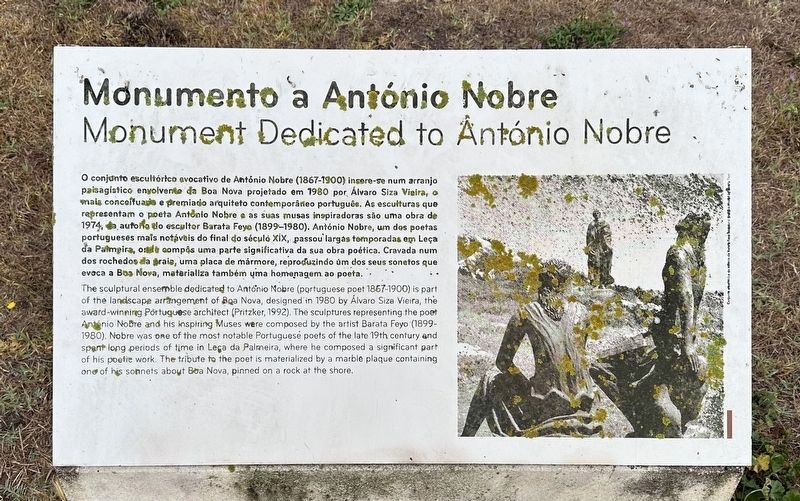
Monumento a António Nobre
⎯⎯⎯
Monument Dedicated to António Nobre
| — | Matosinhos Mar | — |
Photographed by Andrew Ruppenstein, September 2, 2023
1. Monumento a António Nobre / Monument Dedicated to António Nobre Marker

this page online
Topics. This historical marker is listed in this topic list: Arts, Letters, Music. A significant historical date for this entry is March 18, 1900.
Location. 41° 12.125′ N, 8° 42.79′ W. Marker is in Leça da Palmeira, Porto, in Matosinhos. It can be reached from Avenida Liberdade. The marker is on the pedestrian path between Avenida Liberdade and the ocean. Touch for map. Marker is in this post office area: Leça da Palmeira, Porto 4450, Portugal. Touch for directions.

Regionally, it is in the North Atlantic Region, in Europe, in the European Union, in Atlantic Europe, on the Iberian Peninsula, in the Schengen Area, and in the Western World. Historically, it finds itself in what was once Portuguese colonies and also the Roman Empire.
Other nearby markers. At least 8 other markers are within 3 kilometers of this marker, measured as the crow flies: Farol da Boa Nova / The Boa Nova Lighthouse (about 180 meters away, measured in a direct line); Marginal de Leça da Palmeira / The Leça da Palmeira Waterfront (about 180 meters away); A origem da Vieira de Santiago / The Origin of the Scallop Shell of Santiago
Photographed by Andrew Ruppenstein, September 2, 2023
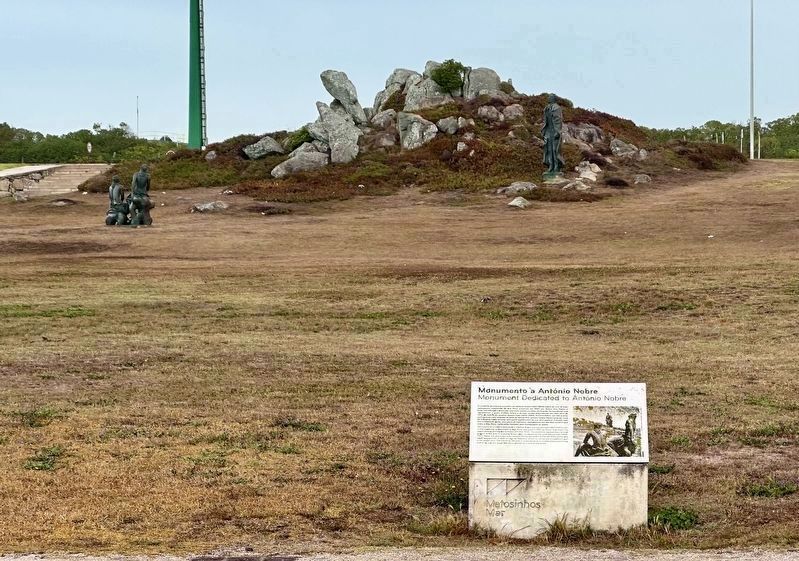
2. Monumento a António Nobre / Monument Dedicated to António Nobre Marker - wide view
Besides the marker itself, also visible here is the sculptural ensemble dedicated to Nobre, with the statue depicting Nobre visible directly above the marker, and the statues of his muses to the left.
Also see . . .
1. António Nobre (Wikipedia).
Overview: António Pereira Nobre (16 August 1867 – 18 March 1900) was a Portuguese poet. His masterpiece, Só (Paris, 1892), was the only book he published.(Submitted on February 7, 2024.)
2. António Nobre, Portuguese poet (Britannica).
Excerpt: … in Paris, where he was influenced by the French Symbolist poets. There he wrote the greater part of the only book he published in his lifetime, Só (1892; “Alone”), inspired by nostalgic memories of a childhood spent in the company of peasants and sailors in northern Portugal. Só combines the simple lyricism of Portuguese traditional poetry with the more refined perceptiveness of Symbolism.(Submitted on February 7, 2024.)
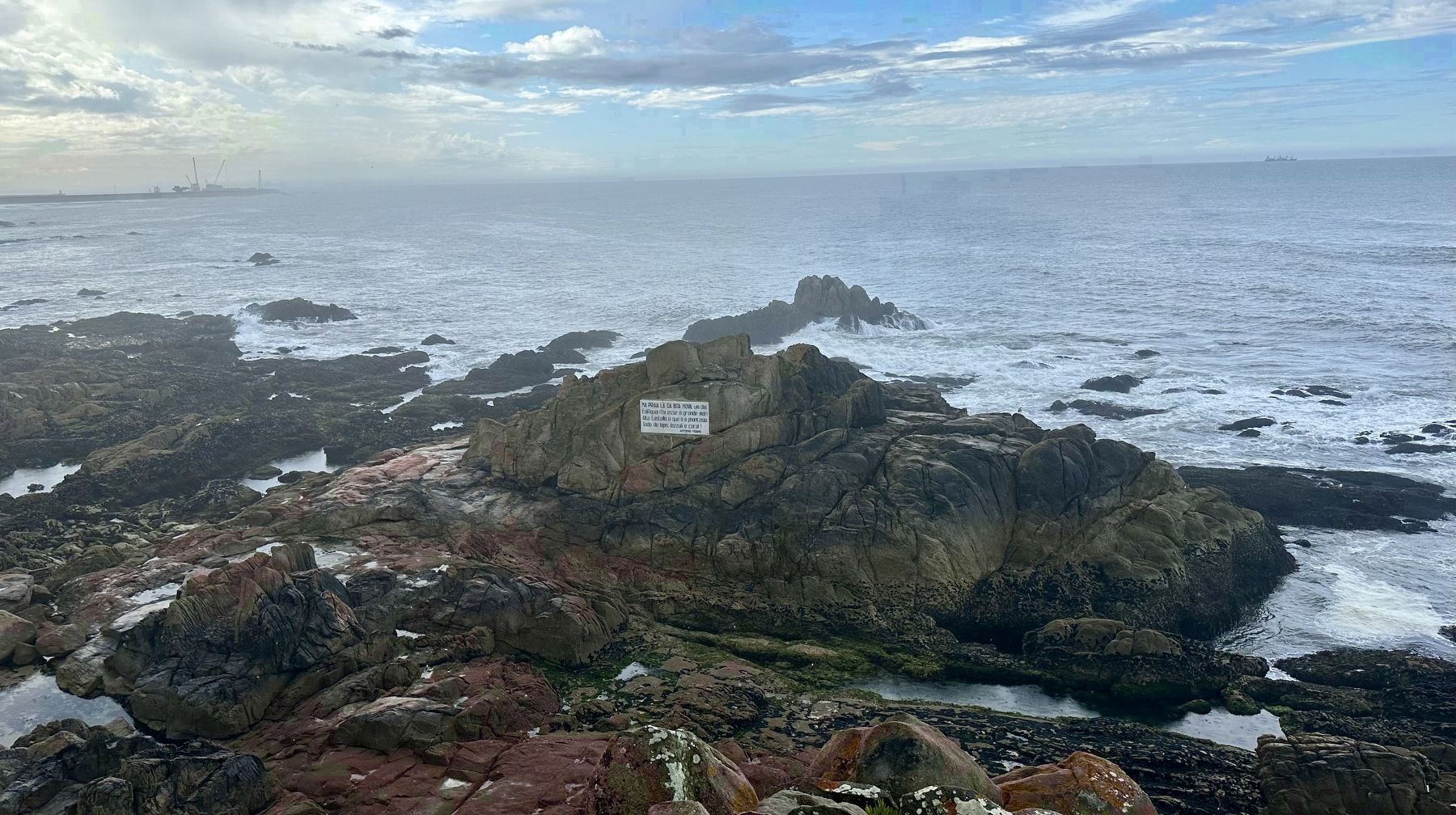
At first Só met with a mixed reception, but it became one of the most popular and most imitatedworks of poetry in Portugal. A final version appeared in 1898. A generation of poets who followed and imitated him was called the Sósino Generation.Photographed by Andrew Ruppenstein, September 2, 20233. António Nobre - sonnet segment (as mentioned on the marker)Rough 150 meters to the northwest of the marker, on the shoreline behind the Capela da Boa Nova, is a bit of Nobre’s sonnet “Lá na Praia da Boa Nova” (written 1887), inscribed on a marble plaque mounted to the rocks. It reads:
Na praia lá da Boa Nova, um dia,
Edifiquei (foi esse o grande mal)
Alto Castelo, o que é a fantasia,
Todo de lápis-lazúli e coral!
Loosely translated: On the beach there at Boa Nova, one day, I built (that was the great evil) - a tall castle - such was the fantasy, all of lapis lazuli and coral!
The plaque was installed in the 1940s and is scheduled to be restored at some point in 2024.
3. [Na praia lá da Boa Nova, um dia], António Nobre - Carla Bolito (YouTube, 1:44). In 2011 RTP had a sort of short poem-of-the-week series, where various persons, some of note, gave readings of poems, with each poem receiving multiple readings, to illustrate the ways of a poem. Here actress Carla Bolito reads Na praia lá da Boa Nova, um dia - the poem on the rock in Photo 3. (Submitted on February 7, 2024.)
Credits. This page was last revised on February 7, 2024. It was originally submitted on February 7, 2024, by Andrew Ruppenstein of Lamorinda, California. This page has been viewed 375 times since then and 60 times this year. Photos: 1, 2, 3. submitted on February 7, 2024, by Andrew Ruppenstein of Lamorinda, California.
