Plain Township near Wooster in Wayne County, Ohio — The American Midwest (Great Lakes)
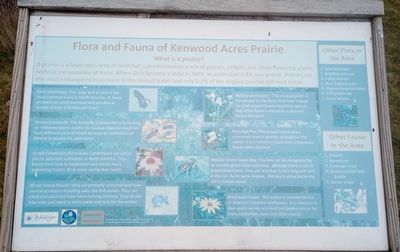
Flora and Fauna of Kenwood Acres Prairie
What is a prairie?
Photographed by Craig Doda, January 27, 2024
1. Flora and Fauna of Kenwood Acres Prairie Marker
A prairie is a large open area of land that is predominantly a mix of grasses, sedges, and other flowering plants without the presence of trees. When Ohio became a state in 1803, an estimated 2-4% was prairie. Prairies are the most endangered ecosystem in the United States and only 1-2% of the original prairies still exist today.
Red-tailed Hawk: This large bird of prey is the most common hawk in North America. It feeds primarily on small mammals and can dive at speeds of over 120 miles per hour!
Monarch butterfly: This butterfly is known for only feeding on milkweed plants and for its massive migration each fall from different parts of North America to California and Mexico to escape the cold winter.
Purple Coneflower/Echinacea: Coneflowers are native plants, popularly cultivated in North America. They bloom from June to September and attract many pollinating insects. Birds enjoy eating their seeds.
White footed Mouse: Mice are primarily nocturnal and have several predators including owls, fox and snakes. They can climb and swim and have keen homing instincts. They do not hibernate and need to store seedsand nuts for the winter.
Click or scan to see
this page online
Rattlesnake Master: This unusual plant in the parsley family has a thick stalk topped by a ball shaped flower head that sprouts tiny white flowers and emits a pleasant, honey-like scent.
Partridge Pea: This annual native pea is commonly seen in prairies throughout the nation. It is a 'sensitive' plant and collapses its leaves when touched.
Metallic Green Sweat Bee: This bee can be recognized by its metallic green head and body, although there is also a brown/black form. They are less than 1⁄2 Inch long and nest in the soil. As its name implies, this bee is attracted to the salt in human sweat.
Black-eyed Susan: This native is considered one of America's favorite wildflowers. It is resistant to deer and it serves as a food and pollen source for many butterflies, bees and other insects.
Other Flora in the Area
1. Little bluestem
2. Nodding wild rye
3. Indian blanket
4. New England aster
5. Virginia mountain mint
6. Stiff goldenrod
7. Great lobelia
Other Fauna in the Area
1. Katydid
2. Barred owl
3. American crow
4. Seven-spotted lady beetle
5. Garter snake
Topics. This historical marker
Photographed by Craig Doda, January 27, 2024
2. Kenwood Acres Prairie & Marker
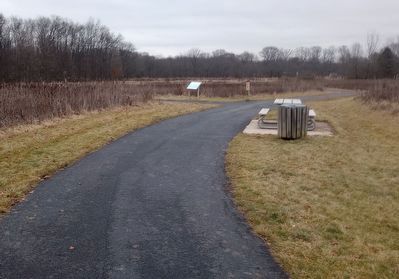
Location. 40° 48.689′ N, 82° 1.208′ W. Marker is near Wooster, Ohio, in Wayne County. It is in Plain Township. It is on Silver Road (County Road 4) west of North Smyser Road (County Road 35), on the right when traveling west. Touch for map. Marker is at or near this postal address: 4696 Silver Rd, Wooster OH 44691, United States of America. Touch for directions.

Regionally, this marker is in Amish Country and in Greater Cleveland. It is also in the American Midwest and in the Corn Belt. Globally, it is in North America, the Western Hemisphere, the Western World, and the Anglosphere. Historically, it finds itself in what was once the Haudenosaunee (Iroquois) Confederacy, the territory of the Mississippian Culture, and the Northwest Territory.
Other nearby markers. At least 8 other markers are within 5 miles of this marker, measured as the crow flies: The Monitor Bank Parcel (approx. 0.2 miles away); The James T. and Marilyn N. Strock Preserve (approx. 0.2 miles away); The Origin Of Wooster Memorial Park (approx. 0.2 miles away); Charles W. Follis (approx. 4.1 miles away); Harvey Howard House / Central Christian Church (Disciples of Christ) (approx. 4.2 miles away); General David Wooster (approx. 4.2 miles away); The Second Baptist Church ~ where Charles and his family attended services (approx. 4.2 miles away); Wooster, Ohio ~ The early years (approx. 4.2 miles away). Touch for a list and map of all markers in Wooster.
Credits. This page was last revised on March 4, 2024. It was originally submitted on February 13, 2024, by Craig Doda of Napoleon, Ohio. This page has been viewed 164 times since then and 19 times this year. Photos: 1, 2. submitted on February 13, 2024, by Craig Doda of Napoleon, Ohio. • Devry Becker Jones was the editor who published this page.
