Saint Victor in Paris in Département de Paris, Île-de-France, France — Western Europe
L’Archéologie à Paris
⎯⎯⎯
Archaeology in Paris
Photographed by Andrew Ruppenstein, June 26, 2023
1. L’Archéologie à Paris / Archaeology in Paris Marker

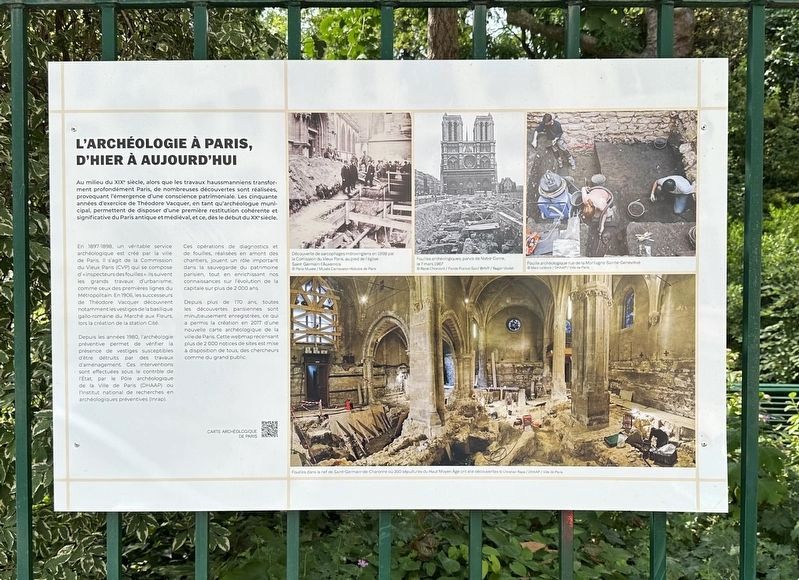
Au milieu du XIXe siècle, alors que les travaux haussmanniens transforment profondément Paris, de nombreuses découvertes sont réalisées, provoquant l'émergence d'une conscience patrimoniale. Les cinquante années d'exercice de Théodore Vacquer, en tant qu'archéologue municipal, permettent de disposer d'une première restitution cohérente et significative du Paris antique et médiéval, et ce, dès le début du XX° siècle.
En 1897-1898, un véritable service archéologique est créé par la ville de Paris. Il s'agit de la Commission du Vieux Paris (CVP) qui se compose d'«inspecteurs des fouilles ». Ils suivent les grands travaux d'urbanisme, comme ceux des premières lignes du Métropolitain. En 1906, les successeurs de Théodore Vacquer découvrent notamment les vestiges de la basilique gallo-romaine du Marché aux Fleurs, lors la création de la station Cité.
Depuis les années 1980, l'archéologie préventive permet de vérifier la présence de vestiges susceptibles d'être détruits par des travaux d'aménagement. Ces interventions sont effectuées sous le contrôle
this page online
Ces opérations de diagnostics et de fouilles, réalisées en amont des chantiers, jouent un rôle important dans la sauvegarde du patrimoine parisien, tout en enrichissant nos connaissances sur l'évolution de la capitale sur plus de 2 000 ans.
Depuis plus de 170 ans, toutes les découvertes parisiennes sont minutieusement enregistrées, ce qui a permis la création en 2017 d'une nouvelle carte archéologique de la ville de Paris. Cette webmap recensant plus de 2 000 notices de sites est mise à disposition de tous, des chercheurs comme du grand public.
Archeology in Paris, from yesterday to today
In the middle of the 19th century, while Haussmann's work profoundly transformed Paris, numerous discoveries were made, causing the emergence of a consciousness of heritage. Théodore Vacquer's fifty years of practice as a municipal archaeologist provide us with a first coherent and significant restitution of ancient and medieval Paris, from the beginning of
Photographed by Andrew Ruppenstein, June 26, 2023
2. L’Archéologie à Paris / Archaeology in Paris Marker
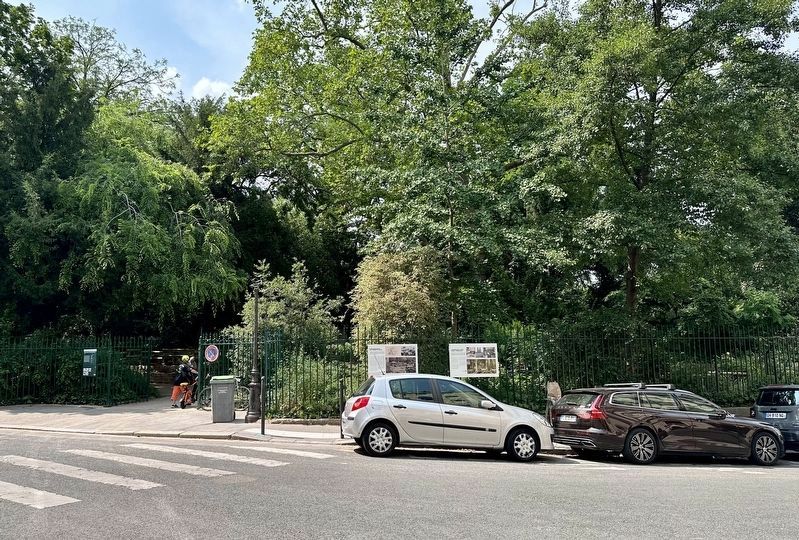
The marker is the rightmost of the two visible here, located outside the Rue de Navarre entrance to the Arènes de Lutèce.
In 1897-1898, a true archaeological service was created by the city of Paris. This was the “Commission of Old Paris” (CVP) which is made up of “excavation inspectors”. They followed major urban planning works, such as those on the first lines of the Metropolitan. In 1906, Théodore Vacquer's successors notably discovered the remains of the Gallo-Roman basilica of the Marché aux Fleurs, during the creation of the Cité station.
Since the 1980s, preventive archeology has made it possible to verify the presence of remains likely to be destroyed by development work. These interventions are carried out under the control of the State, by the Pôle archéologique de la Ville de Paris (“Archaeological Center of the City of Paris”) or DHAAP, or the Institut national de recherches en archéologiques préventives (“National Institute for Preventive Archaeological Research”) or Inrap.
These diagnostic and excavation operations, carried out ahead of the construction sites, play an important role in safeguarding Parisian heritage, while enriching our knowledge of the evolution of the capital over more than 2,000 years.
For more than 170 years, all Parisian discoveries have been carefully recorded, which allowed the creation in 2017 of a new archaeological map of the city of Paris. This webmap listing more than 2,000 site notices is made available to everyone, including researchers and the general public.
Topics. This historical marker is listed in this topic list: Anthropology & Archaeology.
Location. 48° 50.671′ N, 2° 21.206′ E. Marker is in Paris, Île-de-France, in Département de Paris. It is in Saint Victor. It is at the intersection of Rue des Arènes and Rue de Navarre, on the left when traveling south on Rue des Arènes. Touch for map. Marker is in this post office area: Paris, Île-de-France 75005, France. Touch for directions.

Regionally, it is in the North Atlantic Region, Europe, the European Union, Atlantic Europe, the Schengen Area, Western Europe, a coastal Mediterranean country, and the Western World. Historically, it finds itself in what was once a French colony and also the Roman Empire.
Other nearby markers. At least 8 other markers are within walking distance of this marker: 1869, Découverte des Arènes de Lutèce / 1869, Discovery of the Arenas of Lutetia (here, next to this marker); Arenes de Lutece / Arenas of Lutetia (a few steps from this marker); Emile Mâle (within shouting distance of this marker); Les Arènes de Lutèce / The Arenas of Lutetia (about 90 meters away, measured in a direct line); Henri Curiel (about 120 meters away); Benjamin Fondane (about 120 meters away); Ecole Élémentaire Rollin Jewish Students Deportation Memorial (about 180 meters away); Paul de Chomedey (about 210 meters away). Touch for a list and map of all markers in Paris.
Also see . . . Référentiel et Cartographie de l’Archéologie Parisienne (Ville de Paris, in French). The QR code on the marker links to an interactive French-language map of archaeological sites in Paris, with a translation of the introduction presented as follows.
Reference and Cartography of Parisian Archeology: This interactive map presents nearly 2000 archaeological discoveries made in Paris. Numerous data sources were analyzed, ranging from mentions of ancient finds from the 17th and 18th centuries to the most recent reports of preventive archaeological operations.(Submitted on February 16, 2024.)
Credits. This page was last revised on February 16, 2024. It was originally submitted on February 16, 2024, by Andrew Ruppenstein of Lamorinda, California. This page has been viewed 151 times since then and 18 times this year. Photos: 1, 2. submitted on February 16, 2024, by Andrew Ruppenstein of Lamorinda, California.
