Oak Park in Cook County, Illinois — The American Midwest (Great Lakes)
Continental Divide
Photographed by Sean Flynn, February 24, 2024
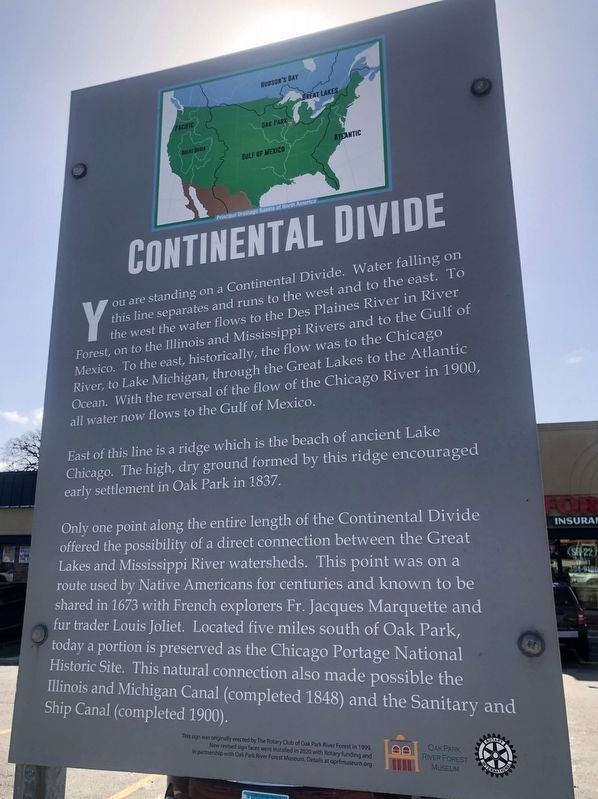
1. Continental Divide Marker, Side One
East of this line is a ridge which is the beach of ancient Lake Chicago. The high, dry ground formed by this ridge encouraged early settlement in Oak Park in 1837.
Only one point along the entire length of the Continental Divide offered the possibility of a direct connection between the Great Lakes and Mississippi River watersheds. This point was on a route used by Native Americans for centuries and known to be shared in 1673 with French explorers Fr. Jacques Marquette and fur trader Louis Joliet. Located five miles south of Oak Park, today a portion is preserved as the Chicago Portage National Historic Site. This natural connection also
this page online
Erected 1999 by Rotary Club of Oak Park; Oak Park River Forest Museum.
Topics and series. This historical marker is listed in these topic lists: Environment • Exploration • Indigenous Peoples and Communities • Settlements & Settlers. In addition, it is included in the Illinois & Michigan Canal, and the Rotary International series lists. A significant historical year for this entry is 1837.
Location. 41° 54.544′ N, 87° 47.074′ W. Marker is in Oak Park, Illinois, in Cook County. It is at the intersection of North Avenue (Illinois Route 64) and Narragansett Avenue, on the right when traveling east on North Avenue. The marker is in front of the North Ridge strip mall, a short distance from the beginning of Ridgeland Avenue. Touch for map. Marker is at or near this postal address: 6325 W North Ave, Oak Park IL 60302, United States of America. Touch for directions.

Regionally, this marker is in Greater Chicago. It is also in the American Midwest. Globally, it is in North America, on the Great Lakes, in
Photographed by Sean Flynn, February 24, 2024
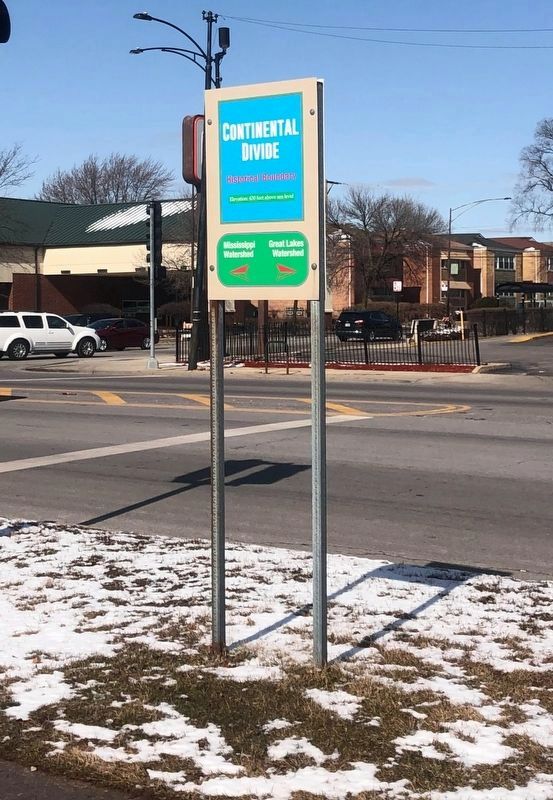
2. Continental Divide Marker, Side Two
The beginning of Chicago's Narragansett Drive is in the background.
Other nearby markers. At least 8 other markers are within walking distance of this marker: Galewood Community War Memorial (about 800 feet away, measured in a direct line); a different marker also named Continental Divide (approx. 0.4 miles away); Henry A. Taylor (approx. half a mile away); Taylor Park (approx. half a mile away); Gold Star Men of the World War (approx. 0.6 miles away); Origins of the Literary Fairy Tale (approx. 0.6 miles away); a different marker also named Fairy Tales of Hans Christian Andersen (approx. 0.6 miles away); The Life of Hans Christian Andersen (approx. 0.6 miles away). Touch for a list and map of all markers in Oak Park.
Other markers no longer nearby. The Fairy Tales of Hans Christian Andersen (was approx. 0.6 miles away but has been permanently removed); a different marker also named The Fairy Tales of Hans Christian Andersen (was approx. 0.6 miles away but has been permanently
Photographed by Sean Flynn, February 24, 2024
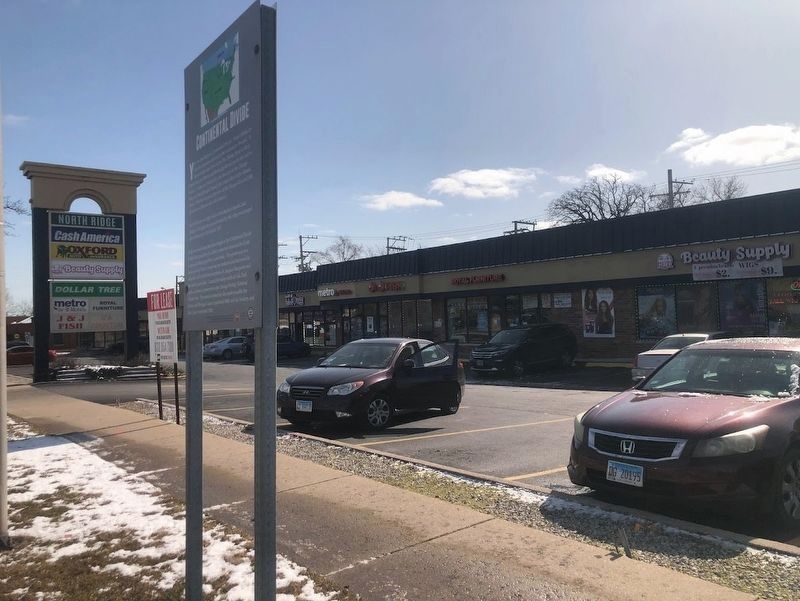
3. Continental Divide Marker
The North Ridge strip mall is in the rear.
More about this marker. The marker is one of at least five in Oak Park that line the approximate path of the continental divide through Oak Park. The back of the marker points to the two watersheds (the Great Lakes and the Mississippi) and notes that it is 630 feet above sea level.
Related markers. Click here for a list of markers that are related to this marker. Continental Divide Markers in Oak Park
Also see . . . The Continental Divide in Oak Park. From the Historical Society of Oak Park & River Forest (Submitted on February 24, 2024, by Sean P. Flynn of Oak Park, Illinois.)
Photographed by Sean Flynn, February 24, 2024
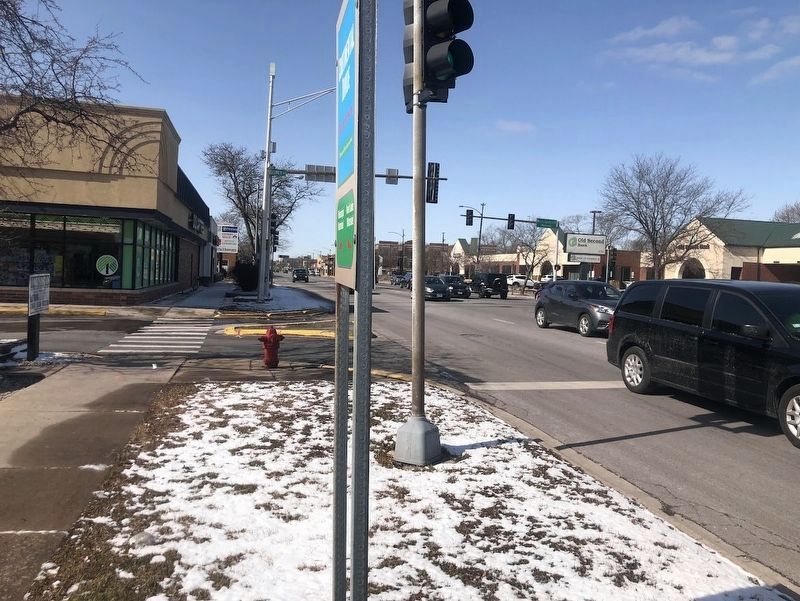
4. Continental Divide Marker
This west-facing view shows North Avenue in the background; the road at this spot is the border between Oak Park and Chicago.
Credits. This page was last revised on February 24, 2024. It was originally submitted on February 24, 2024, by Sean P. Flynn of Oak Park, Illinois. This page has been viewed 288 times since then and 57 times this year. Photos: 1, 2, 3, 4. submitted on February 24, 2024, by Sean P. Flynn of Oak Park, Illinois.
