Oakville in Halton Region, Ontario — Central Canada (North America)
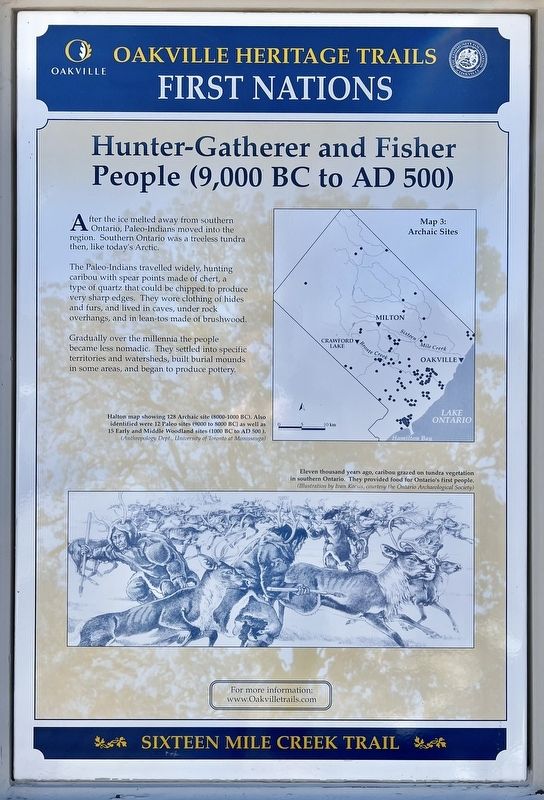
Hunter-Gatherer and Fisher People (9,000 BC to AD 500)
First Nations
| — | Sixteen Mile Creek Trail | — |
Photographed by Tim Boyd, February 20, 2024
1. Hunter-Gatherer and Fisher People (9,000 BC to AD 500) Marker
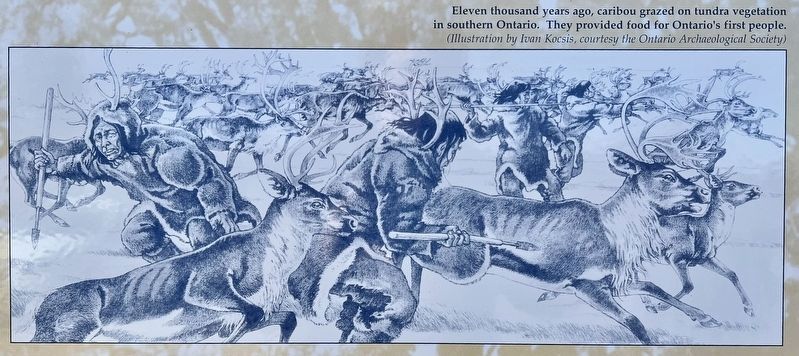
The Paleo-Indians travelled widely, hunting caribou with spear points made of chert, a type of quartz that could be chipped to produce very sharp edges. They wore clothing of hides and furs, and lived in caves, under rock overhangs, and in lean-tos made of brushwood.
Gradually over the millennia the people became less nomadic. They settled into specific territories and watersheds, built burial mounds in some areas, and began to produce pottery.
Erected by Town of Oakville.
Topics. This historical marker is listed in these topic lists: Indigenous Peoples and Communities • Paleontology.
Location. 43° 26.759′ N, 79° 40.243′ W. Marker is in Oakville, Ontario, in Halton Region. It is at the intersection of Randall Street and Thomas Street, on the right when traveling west on Randall Street. Touch for map. Marker is at or near this postal address: 165 Randall Street, Oakville ON L6J 1P5, Canada. Touch for directions.

Regionally, this marker is in Greater Toronto, specifically on the Golden Horseshoe, in the Hamilton-Halton-Brant Area, and specifically in the Toronto Metropolitan Area. It is also in Central Canada. Globally, it is in North America, on the Great Lakes, in the Western Hemisphere, in the Western World, and in the Anglosphere. Historically, it finds itself in what was once a British colony, the Viceroyalty of New France, the Haudenosaunee (Iroquois) Confederacy, and Rupert’s Land.
Other nearby markers. At least 8 other markers are within walking distance of this marker: The First Horticultural People (AD 500 to 1610) (here, next to this marker); The Treaty Period (1801-1847)
this page online
Photographed by Tim Boyd, February 20, 2024
2. Hunter-Gatherer and Fisher People (9,000 BC to AD 500) Marker
Photographed by Anthropology Department, University of Toronto at Mississauga
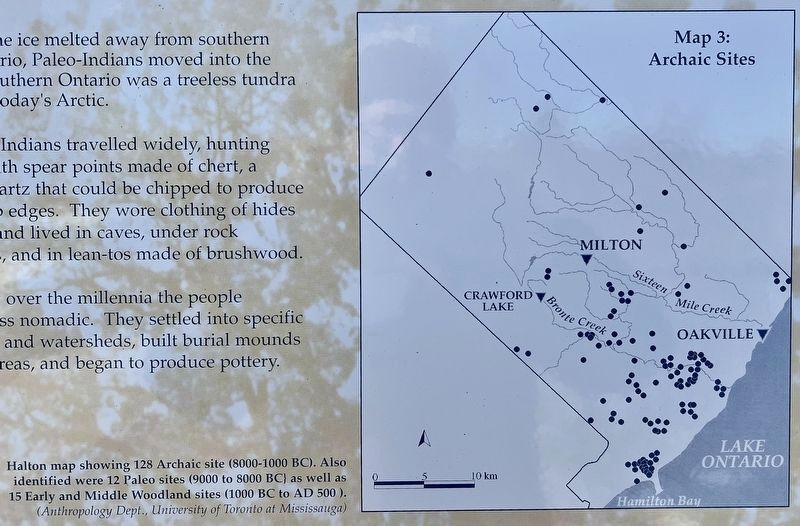
3. Hunter-Gatherer and Fisher People (9,000 BC to AD 500) marker detail
Ivan Kocsis (courtesy of the Ontario Archaeological Society)
4. Hunter-Gatherer and Fisher People (9,000 BC to AD 500) marker detail
Credits. This page was last revised on February 28, 2024. It was originally submitted on February 26, 2024, by Tim Boyd of Hamilton, Ontario. This page has been viewed 144 times since then and 29 times this year. Photos: 1, 2, 3, 4. submitted on February 26, 2024, by Tim Boyd of Hamilton, Ontario. • Andrew Ruppenstein was the editor who published this page.
