Lithonia in DeKalb County, Georgia — The American South (South Atlantic)
MISSING
SEE LOCATION SECTION
Lynching in America / Mob Violence in Lithonia
Community Remembrance Project
Photographed By Mark Hilton, April 25, 2021
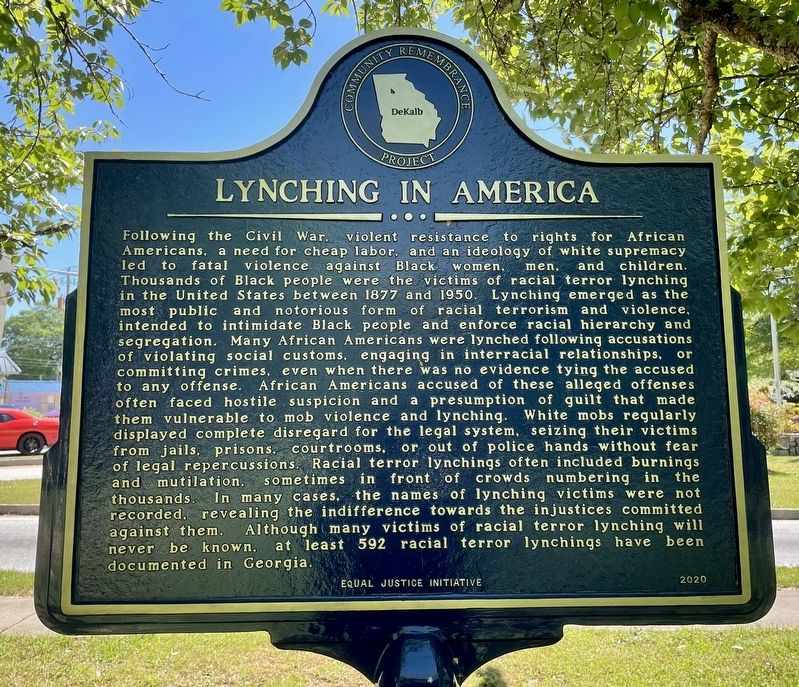
1. Lynching in America Marker
Inscription.
Lynching in America, also, Mob Violence in Lithonia. Community Remembrance Project.
Lynching in America. Following the Civil War, violent resistance to rights for African Americans, a need for cheap labor, and an ideology of white supremacy led to fatal violence against Black women, men, and children. Thousands of Black people were the victims of racial terror lynching in the United States between 1877 and 1950. Lynching emerged as the most public and notorious form of racial terrorism and violence, intended to intimidate Black people and enforce racial hierarchy and segregation. Many African Americans were lynched following accusations of violating social customs, engaging in interracial relationships, committing crimes, even when there was no evidence tying the accused to any offense. African Americans accused of these alleged offenses often faced hostile suspicion and a presumption of guilt that made them vulnerable to mob violence and lynching. White mobs regularly displayed complete disregard for the legal system, seizing their victims from jails, prisons, courtrooms, or out of police hands without fear of legal repercussions. Racial terror lynchings often included burnings and mutilation, sometimes in front of crowds numbering in the thousands In many cases, the names of lynching victims were not recorded, revealing the indifference towards the injustices committed against them. Although many victims of racial terror lynching will never be known, at least 592 racial terror lynchings have been documented in Georgia.,
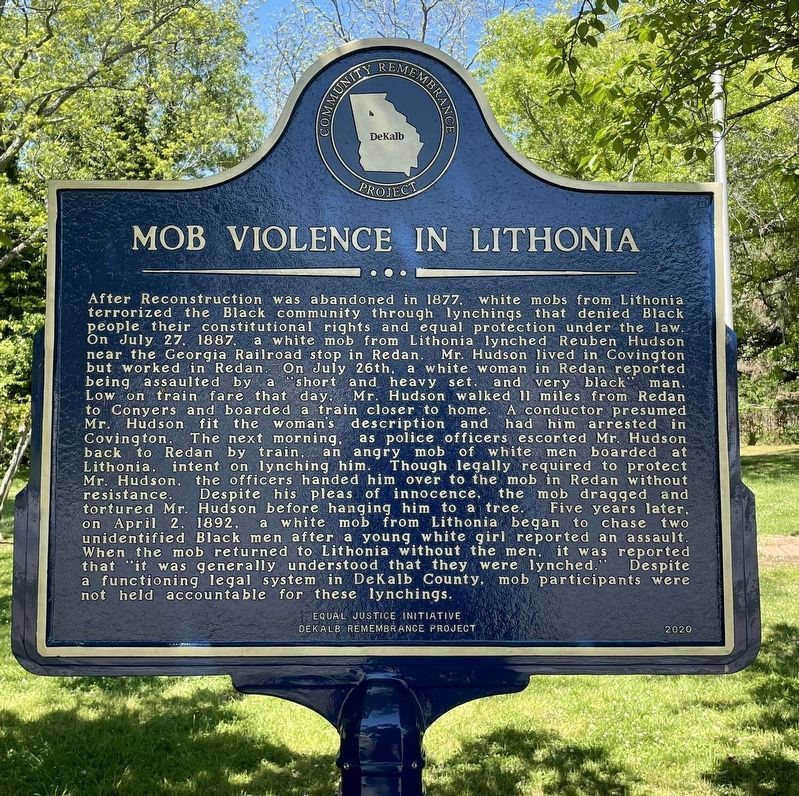
Mob Violence in Lithonia. After Reconstruction was abandoned in 1877, white mobs from Lithonia terrorized the Black community through lynchings that denied Black people their constitutional rights and equal protection under the law. On July 27, 1887, a white mob from Lithonia lynched Reuben Hudson near the Georgia Railroad stop in Redan. Mr. Hudson lived in Covington but worked in Redan. On July 26th, a white woman in Redan reported being assaulted by a "short and heavy set, and very black" man. Low on train fare that day, Mr. Hudson walked 11 miles from Redan to Conyers and boarded a train closer to home. A conductor presumed Mr. Hudson fit the woman's description and had him arrested in Covington. The next morning, as police officers escorted Mr. Hudson back to Redan by train, an angry mob of white men boarded at Lithonia, intent on lynching him. Though legally required to protect Mr. Hudson, the officers handed him over to the mob in Redan without resistance. Despite his pleas of innocence, the mob dragged and tortured Mr. Hudson before hanging him to a tree. Five years later, on April 2, 1892, a white mob from Lithonia began to chase two unidentified Black men after a young white girl reported an assault. When the mob returned to Lithonia without the men, it was reported that "it was generally understood that they were lynched." Despite a functioning legal system in DeKalb County, mob participants were not held accountable for these lynchings.
Lynching in America
Following the Civil War, violent resistance to rights for African
Americans, a need for cheap labor, and an ideology of white supremacy
led to fatal violence against Black women, men, and children.
Thousands of Black people were the victims of racial terror lynching
in the United States between 1877 and 1950. Lynching emerged as the
most public and notorious form of racial terrorism and violence,
intended to intimidate Black people and enforce racial hierarchy and
segregation. Many African Americans were lynched following accusations
of violating social customs, engaging in interracial relationships,
committing crimes, even when there was no evidence tying the accused
to any offense. African Americans accused of these alleged offenses
often faced hostile suspicion and a presumption of guilt that made
them vulnerable to mob violence and lynching. White mobs regularly
displayed complete disregard for the legal system, seizing their victims
from jails, prisons, courtrooms, or out of police hands without fear
of legal repercussions. Racial terror lynchings often included burnings
and mutilation, sometimes in front of crowds numbering in the
thousands In many cases, the names of lynching victims were not
recorded, revealing the indifference towards the injustices committed
against
Click or scan to see this page online
them. Although many victims of racial terror lynching will
never be known, at least 592 racial terror lynchings have been
documented in Georgia.
Mob Violence in Lithonia
After Reconstruction was abandoned in 1877, white mobs from Lithonia
terrorized the Black community through lynchings that denied Black
people their constitutional rights and equal protection under the law.
On July 27, 1887, a white mob from Lithonia lynched Reuben Hudson
near the Georgia Railroad stop in Redan. Mr. Hudson lived in Covington
but worked in Redan. On July 26th, a white woman in Redan reported
being assaulted by a "short and heavy set, and very black" man.
Low on train fare that day, Mr. Hudson walked 11 miles from Redan
to Conyers and boarded a train closer to home. A conductor presumed
Mr. Hudson fit the woman's description and had him arrested in
Covington. The next morning, as police officers escorted Mr. Hudson
back to Redan by train, an angry mob of white men boarded at
Lithonia, intent on lynching him. Though legally required to protect
Mr. Hudson, the officers handed him over to the mob in Redan without
resistance. Despite his pleas of innocence, the mob dragged and
tortured Mr. Hudson before hanging him to a tree. Five years later,
on April 2, 1892, a white mob from Lithonia began to chase two
unidentified Black men after a young
Photographed By Mark Hilton, April 25, 2021
2. Mob Violence in Lithonia Marker
white girl reported an assault.
When the mob returned to Lithonia without the men, it was reported
that "it was generally understood that they were lynched." Despite
a functioning legal system in DeKalb County, mob participants were
not held accountable for these lynchings.
Erected 2021 by Equal Justice Initiative, Dekalb Remembrance Project.
Topics and series. This historical marker is listed in these topic lists: African Americans • Civil Rights. In addition, it is included in the Lynching in America series list. A significant historical date for this entry is April 2, 1892.
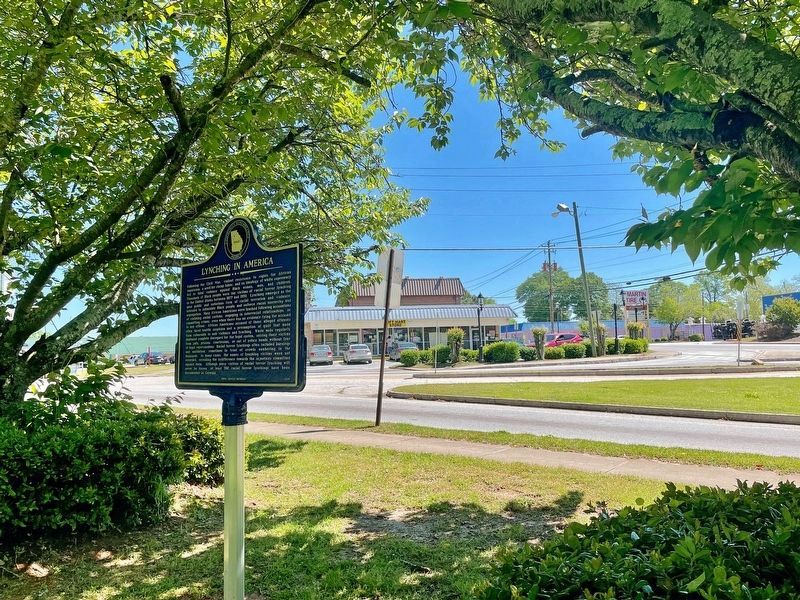
Location. Marker is missing. It was located near 33° 42.623′ N, 84° 6.535′ W. Marker was in Lithonia, Georgia, in DeKalb County. Marker was on Max Cleland Boulevard south of Bond Street, on the right when traveling south. Located in William A. Kelly Park. Touch for map. Marker was in this post office area: Lithonia GA 30058, United States of America. Touch for directions.
More about this marker. Originally the marker unveiling ceremony was scheduled for April 4, 2020, but the ceremony was postponed due to Covid-19 until February 23rd, 2021.
Related marker. Click here for another marker that is related to this marker. Leo Frank Lynching
Also see . . . 1. EJI article on the dedication of the marker.(Submitted on April 25, 2021, by Mark Hilton of Montgomery, Alabama.) 2. Lynching in the United States. According to the Tuskegee Institute, 4,743 people were lynched between 1882 and 1968 in the United States, including 3,446 African Americans and 1,297 whites. (Submitted on May 8, 2021, by Byron Hooks of Sandy Springs, Georgia.)
4. Lynching in America Marker along Max Cleland Blvd.
Credits. This page was last revised on February 29, 2024. It was originally submitted on April 25, 2021, by Mark Hilton of Montgomery, Alabama. This page has been viewed 683 times since then and 178 times this year. Last updated on February 28, 2024, by Gianluca De Fazio of Harrisonburg, Virginia. Photos:1, 2, 3, 4. submitted on April 25, 2021, by Mark Hilton of Montgomery, Alabama. • Bernard Fisher was the editor who published this page.