Rotterdam-West , South Holland, Netherlands — Northwestern Europe
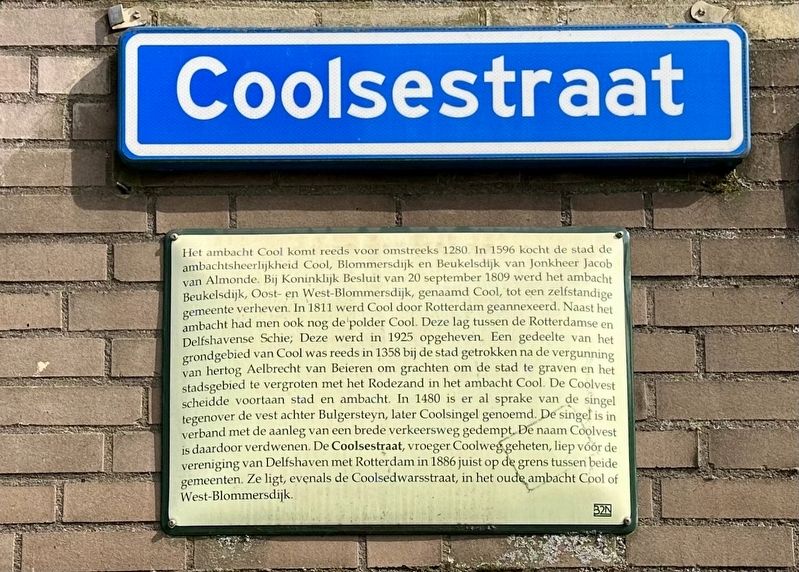
Coolsestraat
Photographed by Andrew Ruppenstein, March 20, 2024
1. Coolsestraat Marker

this page online
The Cool holding dates back to around 1280. In 1596 the city bought the Cool, Blommersdijk and Beukelsdijk holdings from Lord Jacob van Almonde. By Royal Decree of September 20, 1809, the holdings of Beukelsdijk, Oost- and West-Blommersdijk, called Cool, was elevated to an independent municipality. In 1811, Cool was annexed by Rotterdam. Next to this holding, they also had the Cool polder (diked off drained lands). This was located between the Rotterdam and Delfshaven Schie; This was abolished in 1925. Some of Cool's territory had already been added to the city in 1358 after the Duke Aelbrecht of Bavaria was permitted to dig canals around the city and to enlarge the city’s holdings with the Rodezand in the Cool area. The Cool moat henceforth separated city and estate. The canal was already mentioned in 1480 opposite the moat behind Bulgersteyn, later called the Cool moat. The canal has been filled in due to the construction of a wide traffic road. The name Cool moat has therefore disappeared.
Photographed by Andrew Ruppenstein, March 20, 2024
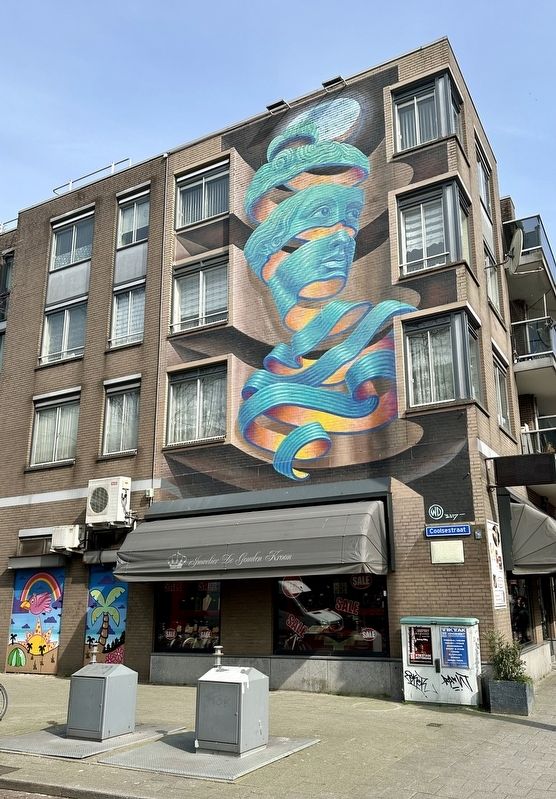
2. Coolsestraat Marker - wide view
Topics. This historical marker is listed in these topic lists: Roads & Vehicles • Settlements & Settlers. A significant historical date for this entry is September 20, 1809.
Location. 51° 55.207′ N, 4° 27.988′ E. Marker is in Rotterdam, Zuid-Holland (South Holland). It is in Rotterdam-West. It is on Coolsestraat near West-Kruiskade, on the right when traveling north. Touch for map. Marker is at or near this postal address: West-Kruiskade 89, Rotterdam, Zuid-Holland 3014 JT, Netherlands. Touch for directions.

Regionally, it is in Europe, the European Union, Atlantic Europe, the Benelux Low Countries, the Schengen Area, Western Europe, and the Western World. Historically, it finds itself in what was once the Roman Empire and specifically also the Holy Roman Empire.
Other nearby markers. At least 8 other markers are within walking distance of this marker: Van Speijkstraat - Jan van Speyk (within shouting distance of this marker); West-Kruiskade (within shouting distance of this marker); Drievriendenstraat / “Three Friends” Street (within shouting distance of this marker); Josephlaan / Joseph Lane (within shouting distance of this marker); Palmdwarsstraat (within shouting distance of this marker); Tiendplein (within shouting distance of this marker); Josephstraat (within shouting distance of this marker); Zijdewindeplein (about 90 meters away, measured in a direct line). Touch for a list and map of all markers in Rotterdam.
Credits. This page was last revised on March 20, 2024. It was originally submitted on March 20, 2024, by Andrew Ruppenstein of Lamorinda, California. This page has been viewed 177 times since then and 28 times this year. Photos: 1, 2. submitted on March 20, 2024, by Andrew Ruppenstein of Lamorinda, California.
