Saint Anthony Main in Minneapolis in Hennepin County, Minnesota — The American Midwest (Upper Plains)
Follow the Water: Part 1 - Intake and Tunnel
The Anatomy of the Pillsbury Waterpower System

Photographed by McGhiever, August 4, 2023
1. Follow the Water: Part 1 - Intake and Tunnel Marker
1882
Tunnel finished; 2 Victor turbines power the Pillsbury A Mill. Low water levels soon raise concerns about the reliability of waterpower
1884
Steam engine installed to supplement waterpower—a move towards less dependence on the Mississippi
1893
Steam plant added at 2nd Street and 3rd Avenue SE
1901
Downstream Victor turbine replaced with larger, more powerful Samson twin-turbine unit
1903
New Main Street steam plant built, followed by a larger steam plant in 1910, further reducing reliance on waterpower
1955
Mill stops using waterpower; intake sealed
1960s
Main Street steam plant demolished
1992
Turbines removed
2003
Mill produces flour for the last time
2015
Pillsbury complex reopens as housing; the waterpower system is reactivated to provide electricity for residents
Originally, there was a large gatehouse above the intake that housed the hoists for the gates that controlled the flow of water into the tunnel
Riverfront, 1926 Minnesota Historical Society
To your right is the "intake" for the Pillsbury A Mill waterpower system. A gate controls the flow of water through
this page online
When the system was developed in the early 1880s, the Saint Anthony Falls Water Power Company needed a permit from the Minneapolis City Council to tear up Main Street and put the tunnel beneath it. The city required that the tunnel "be covered by an arch of masonry of such material as to be permanent, and such strength as to support the travel and all use of roadway above said canal." The builders complied—the tunnel remains in excellent condition and has supported Main Street since the project was completed.
Detail from Map of Minneapolis, Minnesota, 1885 Minneapolis Public Library, Special Collections
Local newspapers reported on the waterpower system's development. The Minneapolis Tribune described the "small army" of workers at the chilly construction site in February 1881: "Over 100 men and
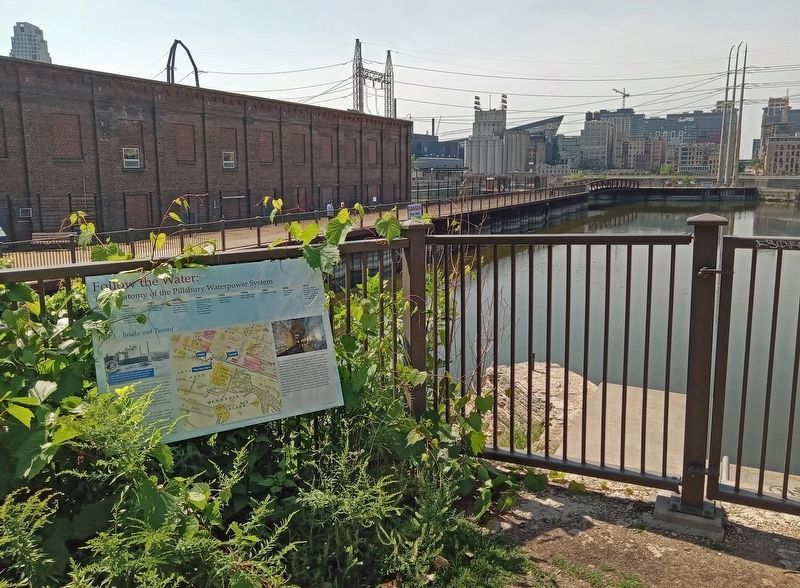
Photographed by McGhiever, August 4, 2023
2. Follow the Water: Part 1 Marker at a small overlook off SE Main Street
Daniel Life, photographer, 2014
Topics. This historical marker is listed in these topic lists: Bridges & Viaducts • Industry & Commerce • Waterways & Vessels. A significant historical year for this entry is 1881.
Location. 44° 59.048′ N, 93° 15.297′ W. Marker is in Minneapolis, Minnesota, in Hennepin County. It is in Saint Anthony Main. It is on SE Main Street west of SE 3rd Avenue, on the left when traveling west. Touch for map. Marker is at or near this postal address: 219 SE Main Street, Minneapolis MN 55414, United States of America. Touch for directions.

Regionally, this marker is in the Twin Cities Metropolitan Area. It is also in the American Midwest, in the Corn Belt, and in the Great River Road Region. Globally, it is in North America, the Western Hemisphere, the Western World, and the Anglosphere. Historically, it finds itself in what was once Rupert’s Land, the territory of the Mississippian Culture, and the Louisiana Purchase.
Other nearby markers. At least 8 other markers are within walking distance of this marker: The Falls That Built the City (here, next to this marker); Electricity and Minneapolis (a few steps from this marker); Harnessing Waterpower (within shouting distance of this marker); Power on the East Side (within shouting distance of this marker); Main Street Builds (within shouting distance of this marker); Hydroelectricity: The Early Years (about 300 feet away, measured in a direct line); Hydroelectricity Comes of Age (about 400 feet away); Franklin Steele (about 400 feet away). Touch for a list and map of all markers in Minneapolis.
Credits. This page was last revised on March 24, 2024. It was originally submitted on March 24, 2024, by McGhiever of Minneapolis, Minnesota. This page has been viewed 393 times since then and 37 times this year. Photos: 1, 2. submitted on March 24, 2024, by McGhiever of Minneapolis, Minnesota.
