Kpalimé in Kloto, Plateaux, Togo — West Africa
The Cathedral of Kpalimé
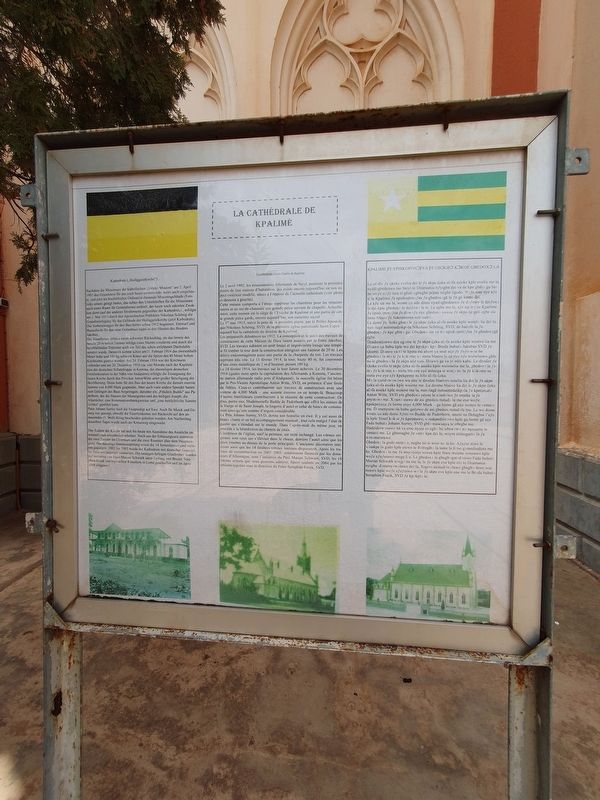
Photographed by J. Makali Bruton, March 12, 2024
1. The Cathedral of Kpalimé Marker

Deutsch
Kathedrale (“Heiliggeistkirche")
Nachdem die Missionare der katholischen “Steyler Mission" am 2. April 1902 den Grundstein für das noch heute existierende, wenn auch umgebaute, und jetzt als bischöfliches Ordinariat dienende Missionsgebäude (Foto links unten) gelegt hatten, das neben den Unterkünften für die Missionare auch einen Raum für Gottesdienste enthielt, der heute noch sakralen Zwekken dient (auf der anderen Straßenseite gegenüber der Kathedrale), erfolgte am 1. Mai 1913 durch den Apostolischen Präfekten Nikolaus Schönig die Grundsteinlegung für das Gebäude der Heiliggeistkirche (jetzt Kathedrale). Die Vorbereitungen für den Bau hatten schon 1912 begonnen. Entwurf und Bauaufsicht für das neue Gotteshaus lagen in den Händen des Bruders Jakobus.
Die Bauarbeiten erlitten einen schweren Rückschlag, als das Innere des bereits 20 m hohen Turmes infolge eines Sturms einstürzte und durch die herabfallenden Trümmer auch ein Teil des schon errichteten Dachstuhls zerstört wurde. Dennoch konnte schon am11. Februar 1914 das zweieinhalb Meter hohe und 100 kg schwere Kreuz auf die Spitze des 40 Meter
this page online
Pater Johann Surrey hielt die Festpredigt auf Ewe. Auch für Musik und Gesang war gesorgt, obwohl die Feierlichkeiten mit Rücksicht auf den andauernden (1. Welt) Krieg bescheiden gehalten wurden. Am Nachmittag desselben Tages wurde auch der Kreuzweg eingeweiht.
Das Äußere der Kirche hat sich bis heute mit Ausnahme des Anstrichs im wesentlichen unverändert erhalten. Noch aus der Erbauungszeit stammen die zwei Fenster

Photographed by J. Makali Bruton, March 12, 2024
2. The Cathedral of Kpalimé Marker
The marker is to the left of the cathedral's main entrance.
La cathédrale Saint-Esprite de Kpalimé
Le 2 avril 1902, les missionnaires Allemands de Steyl, posèrent la première pierre de leur maison d'habitation, qui existe encore aujourd'hui en son as- pect extérieur modifié, située à l'opposé de l'actuelle cathédrale (voir photo ci-dessous à gauche).
Cette maison comporta à l'étage supérieur les chambres pour les missionnaires et au rez-de-chaussée une grande pièce servant de chapelle. Actuellement, cette maison est le siège de l'Evêché de Kpalimé et une partie de cette grande pièce garde, encore aujourd'hui, son caractère sacral.
Le 1 mai 1913, suivit la pose de la première pierre, par le Préfet Apostolique Nikolaus Schönig, SVD, de la première église paroissiale
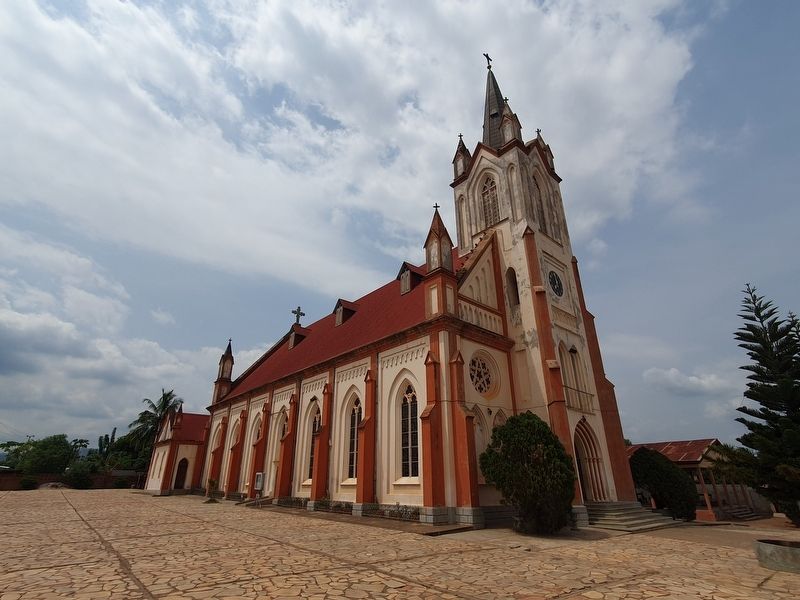
Photographed by J. Makali Bruton, March 12, 2024
3. The Cathedral of Kpalimé
Les préparatifs débutèrent en 1912. La conception et le suivi des travaux de construction de cette Maison de Dieu furent assurés par le Frère Jakobus, SVD. Les travaux subirent un arrêt brutal et imprévisible lorsqu'une tempête fit tomber la tour dont la construction atteignait une hauteur de 20 m. Les débris endommagèrent aussi une partie de la charpente du toit. Les travaux reprirent très vite. Le 11 février 1914, la tour, haute 40 m, fut couronnée d'une croix métallique de 2 m d'hauteur, pesant 100 kg.
Le 24 février 1914, les travaux sur la tour furent achevés. Le 20 décembre 1914 (quatre mois après la capitulation des Allemands à Kamina, l'ancienne station allemande radio près d'Atakpamé), la nouvelle église fut bénie par le Pro-Vicaire Apostolique Anton Witte, SVD, en présence d'une foule de fidèles. Ceux-ci contribuèrent aux travaux de construction avec une somme de 4,000 Mark une somme énorme en ce temps-là. Beaucoup d'autres bienfaiteurs contribuèrent à la réussite de cette construction. De plus, parmi eux, Mademoiselle Budde de Paderborn qui offrit les statues

Photographed by J. Makali Bruton, March 12, 2024
4. An interior view of the Cathedral of Kpalimé
Le Père Johann Surrey, SVD, donna son homélie en éwé. Il y cut aussi de beaux chants et un bel accompagnement musical; tout cela malgré l'état de guerre qui s'étendait sur le monde. Dans l'après-midi du même jour, on procéda à la bénédiction du chemin de croix.
L'extérieur de l'église, sauf la peinture, est resté inchangé. Les vitraux originaux sont ceux qui s'élèvent dans le choeur, derrière l'autel ainsi que les deux rosettes au-dessus de la porte principale. L'ancienne décoration intéricure ainsi que les 14 fenêtres-vitraux latéraux-disparurent. Après les travaux de reconstruction en 2002-2003, entièrement financés par les donateurs d'Allemagne, sous l'initiative du Père Marian Schwark, SVD, les 14 vitraux actuels que nous pouvons admirer, furent réalisés en 2004 par les artisans togolais sous la direction du Frère Seraphim Frunk, SVD.
Kpalime fe episkoponofea fe gbogbo kɔkoe gbedoxo la
Le afofic fe nkeke evelia dzi le fe akpe deka alofa asieke kple evelia me la, nyadǝgbedeawo tso Steyl
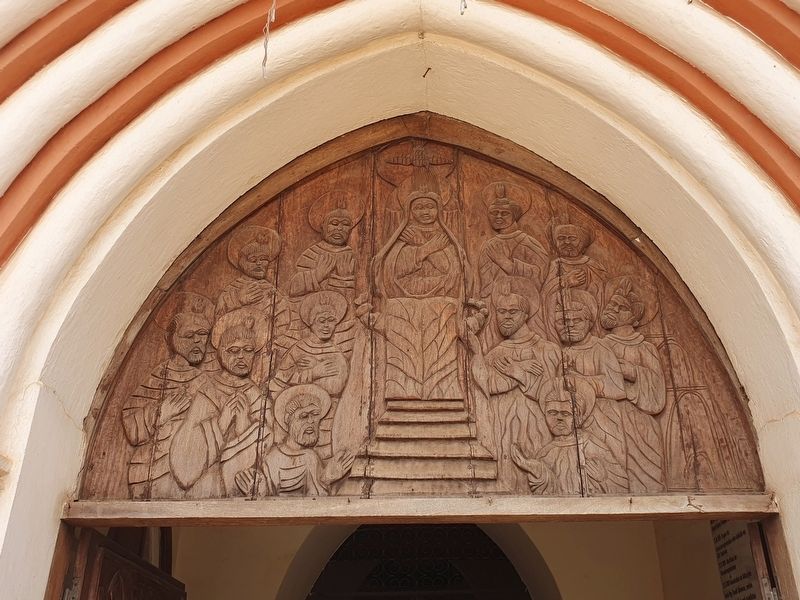
Photographed by J. Makali Bruton, March 12, 2024
5. Wood engraving over the main entrance to the Cathedral of Kpalimé
Le afe sia me la, woate nu ade dzesi nyadǝgbedeawo fe dǝfewo le dzifoxo la dzi kple gbedoxo le dzifoxɔ la te. Le egbe me la, afe sia trɔ zu Kpalime fe episkoponǝfea fe dɔwɔfe eye gbedoxo xoxoa fe akpa de gali egbe sia hena Altaro fe Sakramento subǝsubɔ.
Le dame fe 'keke gbato le fe akpe deka alɔfa asieke kple wuieto lia dzi la, nunǝlaga nutomedzikpǝla Nikolaus Schönig, SVD, de hanǝfe la fe gbedoxo fe kpe gbãto gu. Gbedoxo sia va tro episkoponofea fe gbedoxɔgā egbe.
Dzadzraɖoawo dze egǝme le fe akpe deka alofa asieke kple wuieve lia me. Doawo nu bubu kple wo dzi kpɔkpɔ kpɔ Broda bubutɔ Jakobus SVD fe kume. Dǝawo va to te kpata esi ahom ya sese ade fe fofo wae be gbedoxǝ la mɔ si fe kǝkǝme xɔ meta blaeve le ne eye efe wuiwluiwo gble nu le gbedoxɔ la fe akpa ade nuti. Doawo ga va yi edzi

Photographed by J. Makali Bruton, March 12, 2024
6. The "missionaries' dwelling house" mentioned in the marker
This building is just south across from the cathedral.
Mǝ la nutidɔwɔwɔwo wu enu le dzodze blaevevsenelia lia dzi le fe akpe deka alǝfa asieke kple wuiene me. Le dzome blaeve lia dzi le fe akpe deka alofa asieke kple wuiene me la, nunǝlagă nutoamedzikpola ƒe kpeɖenuto Anton Witte, SVD yra gbedoxo yeyea le xosetowo fe ameha la fe anyinənɔ me. Xosetɔ siawo de asi gbedoxǝtutudo la me eye wofe kpekpeɖenu fe home enye 4,000 Mark - ga home ga ade wonye le vemavi me. Domenyuiwǝla bubu geɖewo de asi gbedoxotutudǝla me. Le wo dome woate nu ade dzesi Afenovi Budde de Paderborn, amesi na Detugbui l'afe la kple Yosef kǝkǝe fe kpetatawo, vasakpedzivǝwo kple ga home gå aɖe. Fada bubuto Johann Surrey, SVD gblo mawunya le edegbe me. Hadzidziwonawo ha va eme nyuie to egbo be adawɔwɔ nɔ xexeame le vemavi me. Le gbemagbe fe vetro kpa dzi la, woyra atitsogamo la fe nonometatawo.
Gbedoxo la godo metro o, negbe tsi si wosi nɛ la ko. Afufui siwo le vosakpe la godo kple esiwo le 9otrogato la tame la li tso gomedzedzea me ke. Gbedoxɔ la me fe atsyɔɖoɖo xoxoa kple fesre wuiene xoxoawo kple wofe afufuiawo mega li o. Le gbedoxo la gbugbogatodosiwo Fada bubut Marian Schwark nongo na me la, le fe akpe eve kple èto to Dzamania- nyigba domenyɔwɔlawo dzi la, Togovi asinudowolawo gbugbo fesre wui- neawo kple wofe afufuiwo wo le fe akpe eve kple ene me le Broda bubuto Seraphim Frunk, SVD fe kpǝkplo te.
On April 2, 1902, the German missionaries of Steyl laid the first stone of their dwelling house, which still exists today in its modified exterior form, located opposite the current cathedral (see photo below left).
This house had on the upper floor the rooms for the missionaries and on the ground floor a large room used as a chapel. Today, this house is the seat of the Bishopric of Kpalimé and part of this large room still retains its sacred character today.
On May 1, 1913, the foundation stone was laid by the Apostolic Prefect Nikolaus Schönig, SVD, of the first parish church of the Holy Spirit, now the cathedral of the Diocese of Kpalimé.
Preparations began in 1912. The design and follow-up of the construction of this House of God was carried out by Brother Jakobus, SVD. The work came to an abrupt and unpredictable halt when a storm brought down the tower, which was built to a height of 20 m. The debris also damaged part of the roof structure. Work resumed very quickly. On February 11, 1914, the tower, 40 m high, was crowned with a metal cross 2 m high, weighing 100 kg.
On February 24, 1914, work on the tower was completed. December 20, 1914 (four months after the Germans surrendered at Kamina, the former German radio station near Atakpamé), the new church was blessed by the Apostolic Pro-Vicar Anton Witte, SVD, in the presence of a crowd of faithful. They contributed to the construction work with the sum of 4,000 Marks, an enormous sum at that time. Many other benefactors contributed to the success of this construction. Among them was Miss Budde of Paderborn, who offered the statues of the Virgin and St. Joseph, the altar linen, communion benches, as well as a considerable sum of money.
Fr. Johann Surrey, SVD, gave his homily in Ewe. There were also many beautiful songs and a beautiful musical accompaniment; all this despite the state of war that stretched over the world. In the afternoon of the same day, the blessings of the Stations of the Cross were given.
The exterior of the church, except for the paint, has remained unchanged. The original stained glass windows are those that rise in the choir behind the altar, as well as the two rosettes above the main door. The old interior decoration and the 14 side stained-glass windows disappeared. After the reconstruction work in 2002-2003, entirely financed by donors from Germany, under the initiative of Father Marian Schwark, SVD, the 14 current stained glass windows that we can admire were made in 2004 by Togolese craftsmen under the direction of Brother Seraphim Frunk, SVD.
Topics. This historical marker is listed in these topic lists: Colonial Era • Religion & Religious Structures. A significant historical date for this entry is February 11, 1914.
Location. 6° 54.501′ N, 0° 37.85′ E. Marker is in Kpalimé, Plateaux, in Kloto. It is on an unnamed street, on the right when traveling south. Touch for map. Touch for directions.

Regionally, it is in Africa, Sub-Saharan Africa, and specifically West Africa. Historically, it finds itself in what was once a French colony and also a British Mandate.
Credits. This page was last revised on June 18, 2026. It was originally submitted on March 24, 2024, by J. Makali Bruton of Washington, District of Columbia. This page has been viewed 313 times since then and 58 times this year. Photos: 1, 2, 3, 4, 5, 6. submitted on March 24, 2024, by J. Makali Bruton of Washington, District of Columbia.
