East Frederick in Frederick County, Maryland — The American Northeast (Mid-Atlantic)
Jug Bridge
An engineering marvel for early America
| — | The Road That Built The Nation | — |
Photographed by Adam Margolis, September 20, 2025
1. Jug Bridge Marker
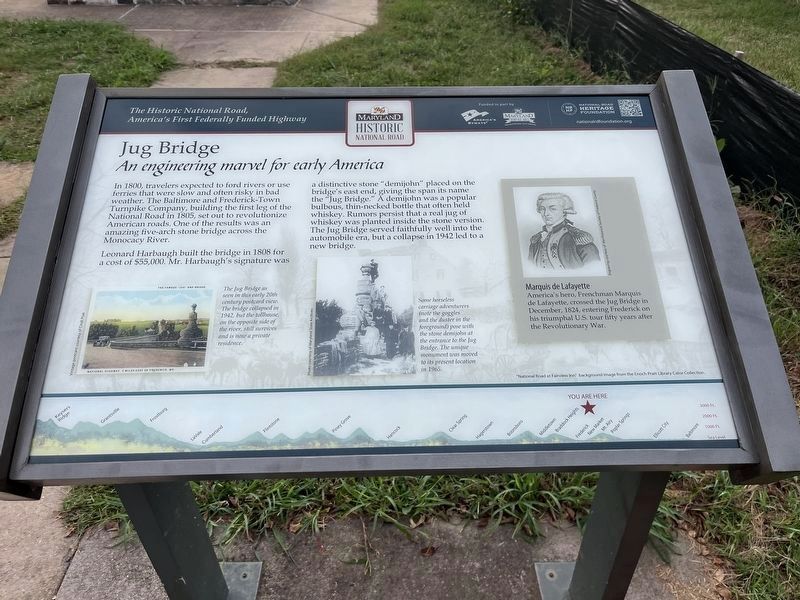
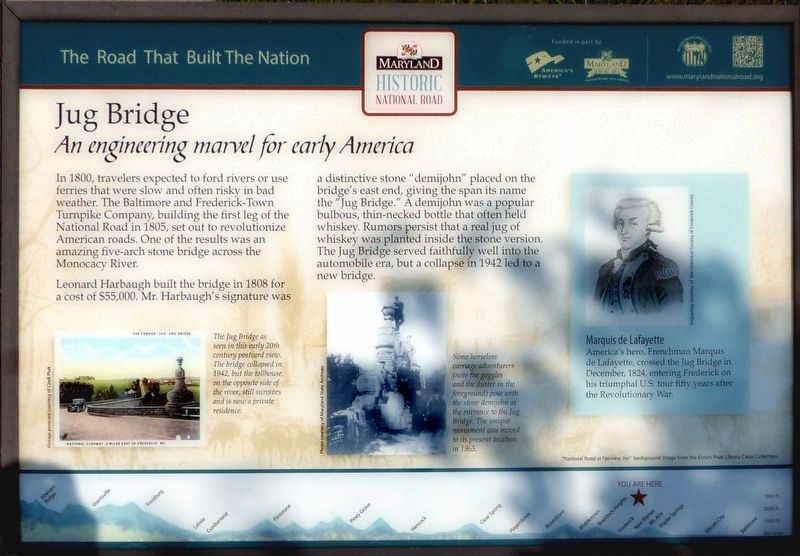
In 1800, travelers expected to ford rivers or use ferries that were slow and often risky in bad weather. The Baltimore and Frederick-Town Turnpike Company, building the first leg of the National Road in 1805, set out to revolutionize American roads. One of the results was an amazing five-arch stone bridge across the Monocacy River.
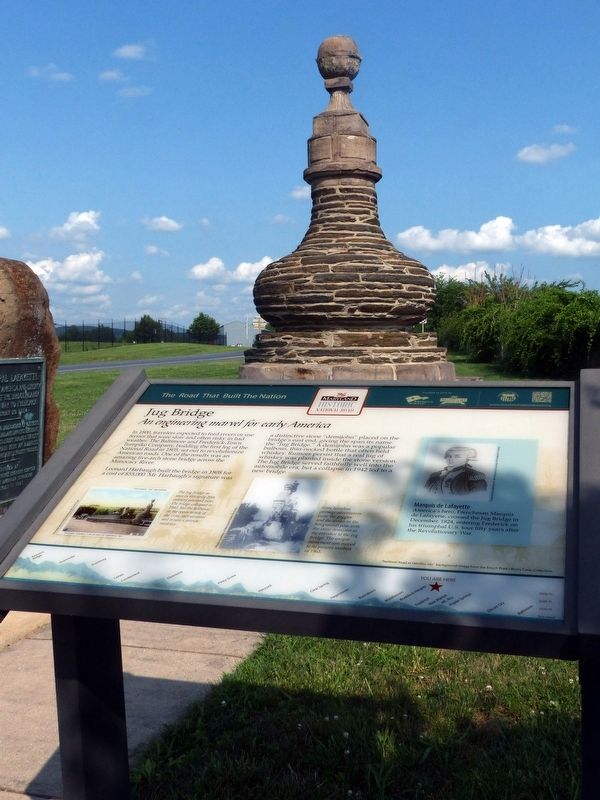
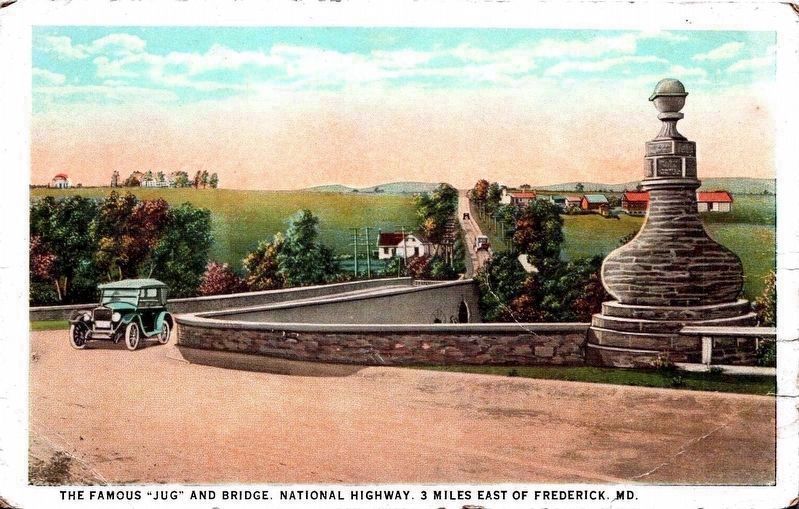
Leonard Harbaugh built the bridge in 1808 for a cost of $55,000. Mr. Harbaugh's signature was a distinctive stone "demijohn" placed on the bridge's east end, giving the span its name the "Jug Bridge." A demijohn was a popular bulbous, thin-necked bottle that often held whiskey. Rumors persist that a real jug of whiskey was planted inside the stone version. The Jug Bridge served faithfully well into the automobile era, but a collapse in 1942 led to a new bridge.
(Sidebar):
Marquis de Lafayette
America's hero, Frenchman Marquis de Lafayette, crossed the Jug Bridge in December, 1824, entering Frederick on his triumphal U.S. tour fifty years after the Revolutionary War.
Erected by America's Byways; Maryland Heritage Areas Authority; Maryland National Road Association.
Topics and series.
this page online
Location. 39° 24.305′ N, 77° 23.019′ W. Marker is near Frederick, Maryland, in Frederick County. It is in East Frederick. It is on East Patrick Street east of Maryland Route 144, on the right when traveling east. Touch for map. Marker is at or near this postal address: 1501 E Patrick St, Frederick MD 21701, United States of America. Touch for directions.

Regionally, this marker is in the Washington Metropolitan Area and in Central Maryland. It is also in the American Mid-Atlantic. Globally, it is in North America, the Western Hemisphere, the Western World, and the Anglosphere. Historically, it finds itself in what was once one of the original Thirteen Colonies and also the Antebellum South.
Other nearby markers. At least 8 other markers are within 2 miles of this marker, measured as the crow flies: General LaFayette (within shouting distance of this marker); Defense Of Jug Bridge (approx. ¾ mile away);
Photographed by Allen C. Browne, July 9, 2019
2. Jug Bridge Marker
Other markers no longer nearby. Jug Bridge (has been replaced with this marker); Jug Bridge Monument (was here, next to this marker but has been confirmed missing).
Related marker. Click here for another marker that is related to this marker. This marker has been replaced with the linked marker, which has subtle differences in subtitles and credited erecting organizations.
Photographed by Allen C. Browne, July 9, 2019
3. Jug Bridge Marker
The C.T. American Art Co.
4. Famous “Jug” and Bridge,
National Highway,
3 Miles East of Frederick, MD.
National Highway,
3 Miles East of Frederick, MD.
The Jug Bridge as seen in this early 20th century postcard view. The bridge collapsed in 1942, but the tollhouse, on the opposite side of the river, still survives and is now a private residence.
Postcard Published by Neff Novelty Co., Cumberland Maryland, C.T. American Art Chicago.
Postcard Published by Neff Novelty Co., Cumberland Maryland, C.T. American Art Chicago.
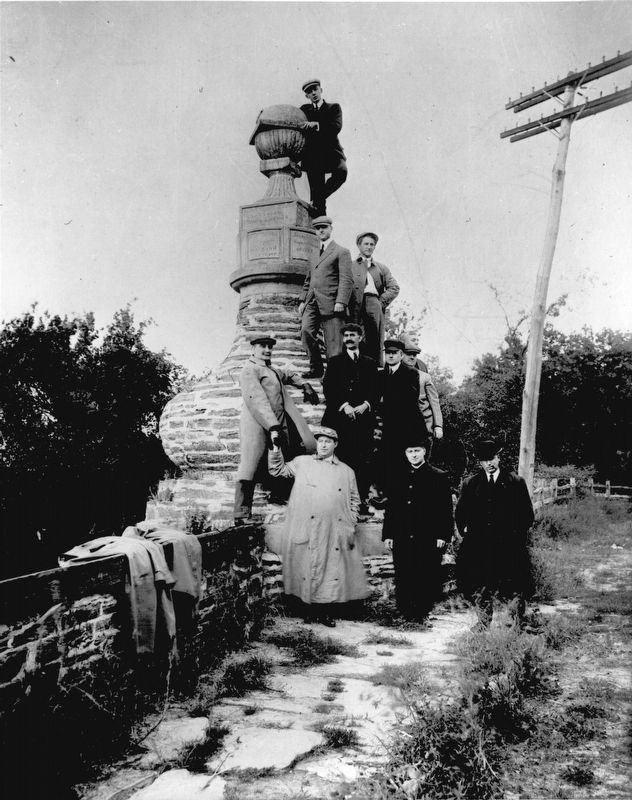
The Maryland State Archives
5. Men climbing on Jug Bridge over the Monocacy River
Some horseless carriage adventurers (note the goggles and the duster in the foreground) pose with the stone demijohn at the entrance to the Jug Bridge. The unique monument was moved to its present location in 1965.
Reproduction of photo by unknown photographer (1920s). MSA SC 1477-1-5435 — MD State Archives.
Reproduction of photo by unknown photographer (1920s). MSA SC 1477-1-5435 — MD State Archives.
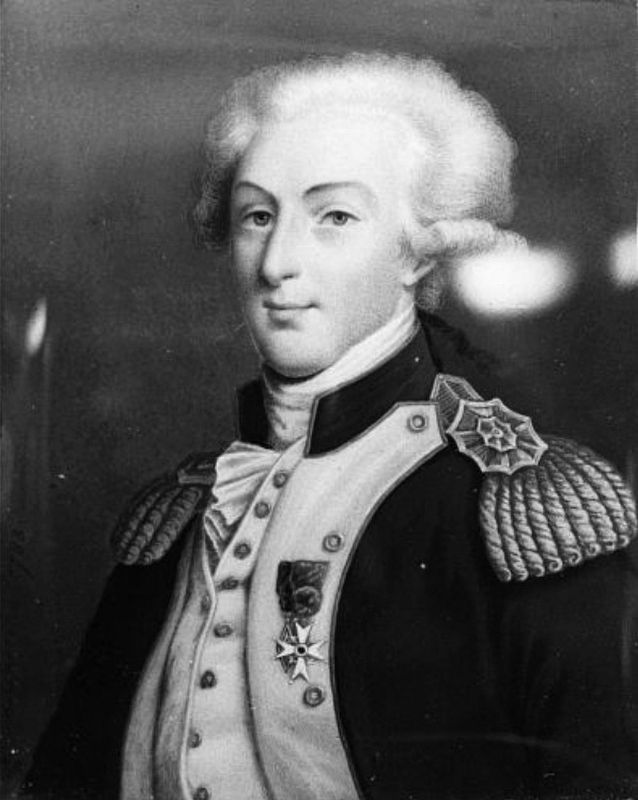
The National Portrait Gallery
6. Marquis de Lafayette
America's hero, Frenchman Marquis de Lafayette, crossed the bridge in December, 1824, entering Frederick on his triumphal U.S. tour fifty years after the Revolutionary War.
Watercolor on Ivory by Laperche, Museum of Fine Arts, Boston, National Gallery Catalog of American Portraits.
Watercolor on Ivory by Laperche, Museum of Fine Arts, Boston, National Gallery Catalog of American Portraits.
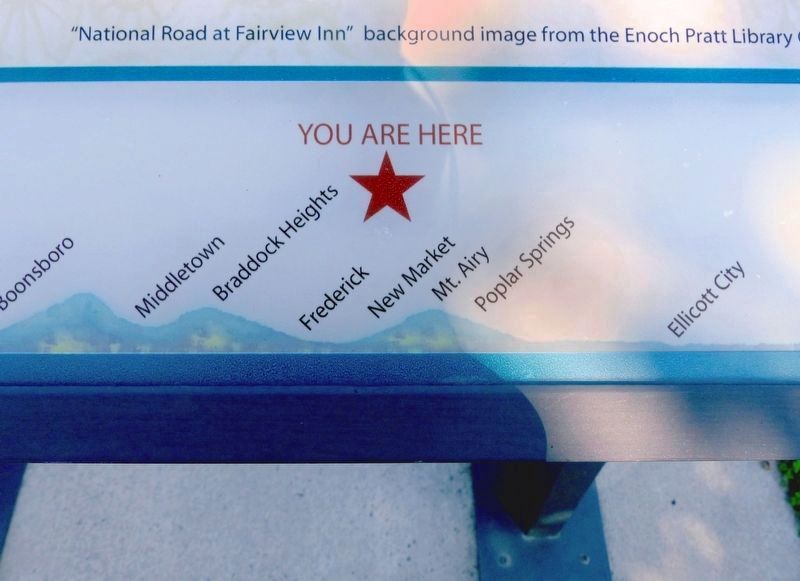
Photographed by Allen C. Browne, July 9, 2019
7. You Are Here
Credits. This page was last revised on September 22, 2025. It was originally submitted on March 24, 2024, by Allen C. Browne of Silver Spring, Maryland. This page has been viewed 747 times since then and 127 times this year. Photos: 1. submitted on September 21, 2025, by Adam Margolis of Mission Viejo, California. 2. submitted on March 30, 2024, by Allen C. Browne of Silver Spring, Maryland. 3. submitted on July 19, 2019, by Allen C. Browne of Silver Spring, Maryland. 4, 5, 6, 7. submitted on March 30, 2024, by Allen C. Browne of Silver Spring, Maryland. • Devry Becker Jones was the editor who published this page.
