Clinton in Lower Connecticut River Valley Region, Connecticut — The American Northeast (New England)
War of 1812 in Clinton
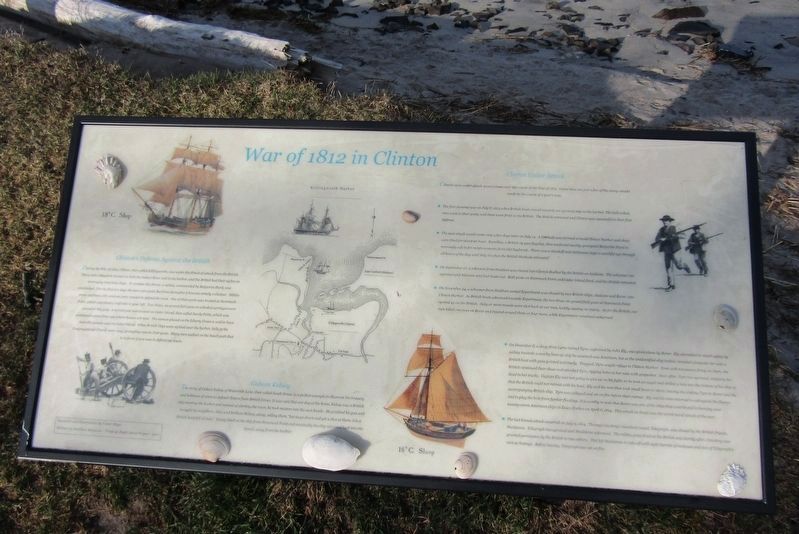
Photographed by Conrad Ward, December 10, 2023
1. War of 1812 in Clinton Marker
Clinton's Defense Against the British
During the War of 1812, Clinton, then called Killingworth, was under the threat of attack from the British. There were shipyards located on both the Indian River and in the harbor, and the British had their sights on destroying American ships. To combat this threat, a militia, commanded by Benjamin Hurd, was established. For the first ten days the men were paid, but from thereafter it became strictly volunteer. Militia posts outfitted with cannons were created to defend the town. One of these posts was located at Hammock Point, which was about a half mile to your left. Two brass, six-pound field guns on wheeled carriages were placed at this post. A second post was located on Cedar Island, then called Sandy Point, which was positioned across from you where houses are now. The cannon placed on the Liberty Green is said to have been the cannon used on Cedar Island. When British ships were sighted near the harbor, bells at the Congregational Church were rung, prompting men to their posts. Many men walked on the beach path that is in front of you now to defend our town.
Gideon Kelsey
The
this page online
Clinton Under Attack
Clinton came under attack several times over the course of the War of 1812. Listed here are just a few of the many attacks made in the course of a year's time.
The first instance was on July 8, 1813 when British boats rowed towards an aground ship in the harbor. The bells tolled, men went to their posts, and shots were fired at the British. The British retreated and Clinton was successful in their first defense.
The next attack would come only a few days later on July 14. A blockade was formed around
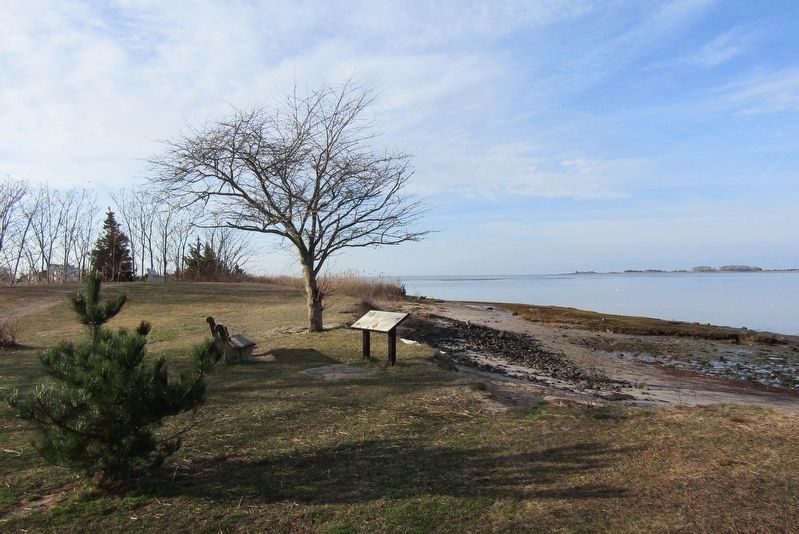
Photographed by Conrad Ward, March 2024
2. War of 1812 Marker next to Clinton Harbor
On September 27, a schooner from Haddam was chased into Clinton Harbor by the British on Atalante. The schooner ran aground and Atalante sent four boats out. Both posts on Hammock Point and Cedar Island fired, and the British retreated.
On November 24, a schooner from Haddam named Experiment was chased by two British ships, Atalante and Borer, into Clinton Harbor. As British boats advanced towards Experiment, the two brass six-pound field guns at Hammock Point opened up on the British. Sixty or more rounds were shot back at our men, luckily causing no injury. As for the British, our men killed one man on Borer and injured around three or four more, while Experiment remained unharmed.
On December 8, a sloop from Lyme named Tyre, captained by John Ely, was given chase by Borer. Ely attempted to reach
Photographed by Conrad Ward, March 2024
3. Sunset, Clinton Harbor
The last known attack occurred on July 9, 1814. Thomas Cowdery's merchant vessel, Telegraph, was chased by the British frigate, Maidstone. Telegraph ran aground and Maidstone advanced. The militia posts fired on the British and shortly after, Cowdery was granted permission by the British to row ashore. This left Maidstone to take off with eight barrels of molasses and two of Telegraph's men as hostage. Before leaving, Telegraph was set on fire.
Research and illustrations by Victor Mays
Written by Matthew Beauvais - Troop 55 Eagle Scout Project - 2017
Erected 2017.
Topics. This historical marker is listed in these topic lists: War of 1812 • Waterways & Vessels. A significant historical date for this entry is July 8, 1813.
Location. 41° 15.971′ N, 72° 31.172′ W. Marker is in Clinton in Lower Connecticut River Valley Region, Connecticut. It can be reached from Waterside Lane south of Old Harbor Village, on the right when traveling south. Located in Clinton Town Beach. Touch for map. Marker is in this post office area: Clinton CT 06413, United States of America. Touch for directions.

Regionally, this marker is in the Connecticut River Valley and on the Connecticut Shoreline. It is also in the American Northeast, in New England, and on the Eastern Seaboard. Globally, it is in the North Atlantic Region, North America, the Western Hemisphere, the Western World, and the Anglosphere. Historically, it finds itself in what was once Middlesex County and also one of the original Thirteen Colonies.
Other nearby markers. At least 8 other markers are within walking distance of this marker: The Coastal Nature Walk (about 500 feet away, measured in a direct line); The Hammock Marshes (approx. half a mile away); William Kelsey (approx. ¾ mile away); Lafayette's Tour (approx. ¾ mile away); This Cannon (approx. ¾ mile away); Clinton Soldiers Monument (approx. ¾ mile away); The Tree of Hope and Peace (approx. 0.8 miles away); Milestone (approx. 0.8 miles away). Touch for a list and map of all markers in Clinton.
Credits. This page was last revised on May 19, 2026. It was originally submitted on March 26, 2024, by Conrad Ward of Guilford, Connecticut. This page has been viewed 633 times since then and 92 times this year. Photos: 1, 2, 3. submitted on March 26, 2024, by Conrad Ward of Guilford, Connecticut. • Michael Herrick was the editor who published this page.
