Chinatown in Rotterdam, South Holland, Netherlands — Northwestern Europe
Anna Paulownastraat (Anna Pavlovna)
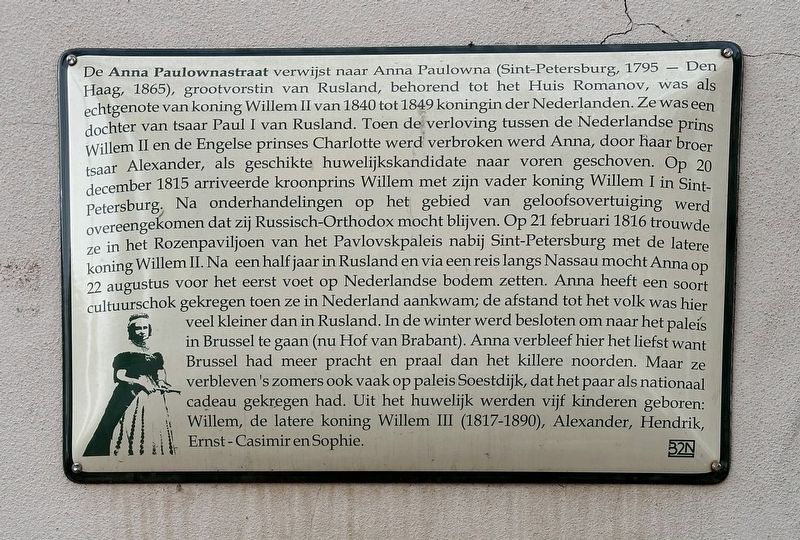
Photographed by Andrew Ruppenstein, March 20, 2024
1. Anna Paulownastraat (Anna Pavlovna) Marker

this page online
The Anna Paulownastraat (“Anna Pavlovna Street”) refers to Anna Pavlovna (St. Petersburg, 1795, The Hague, 1865), Grand Duchess of Russia, a member of the House of Romanov, and as wife of King William II, she was Queen of the Netherlands from 1840 to 1849. She was a daughter of Tsar Paul I of Russia. When the engagement between the Dutch Prince William II and the English Princess Charlotte was broken, Anna was put forward as a suitable marriage candidate by her brother Tsar Alexander. On December 20, 1815, Crown Prince William arrived in Saint Petersburg with his father King William I. After negotiations on religion, it was agreed that she could remain Russian Orthodox. On February 21, 1816, she married the future King
Photographed by Andrew Ruppenstein, March 20, 2024
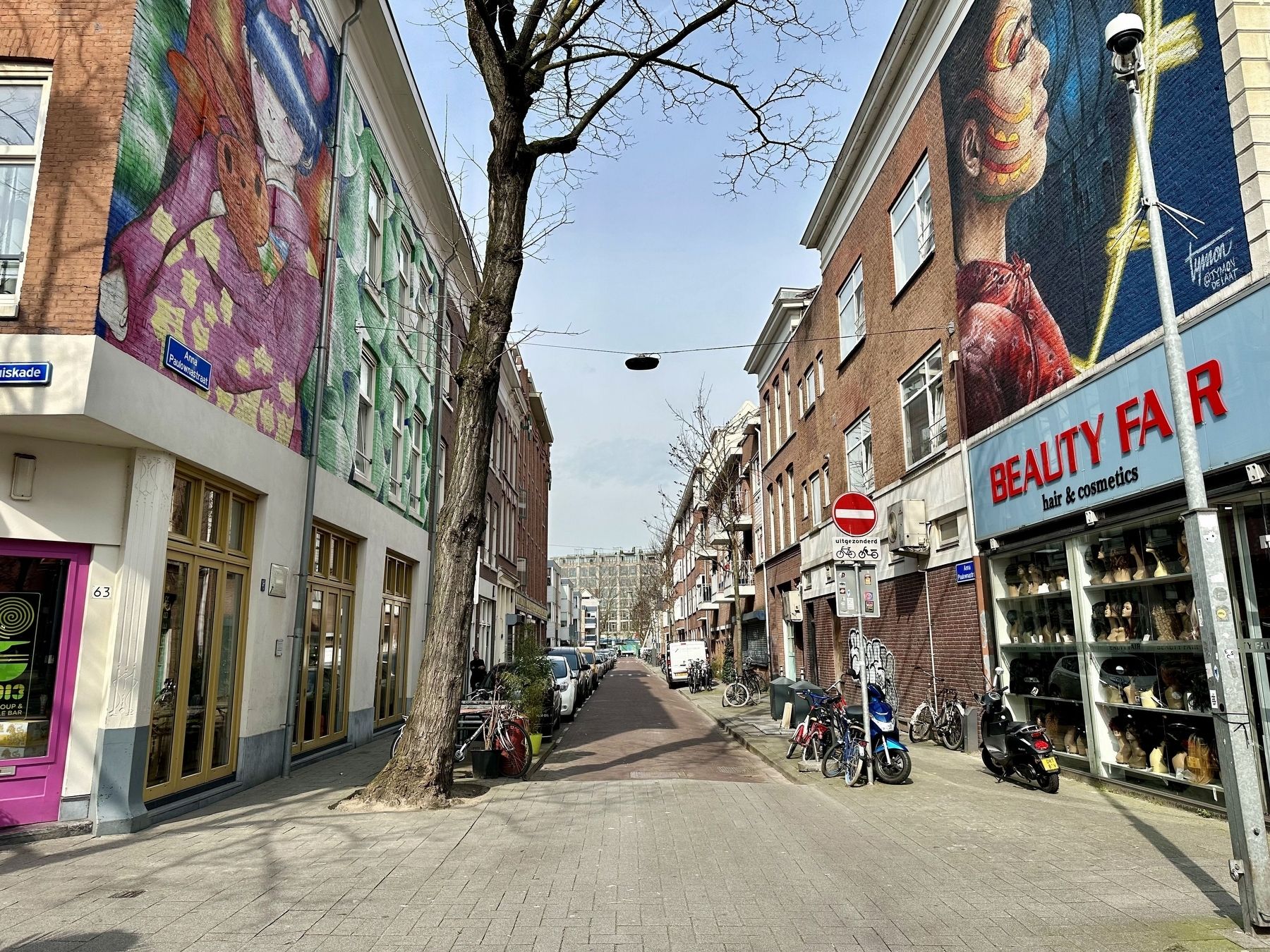
2. Anna Paulownastraat (Anna Pavlovna) Marker - wide view, looking north on Anna Paulownastraat
The marker is visible here on the left.
Topics. This historical marker is listed in these topic lists: Government & Politics • Women. A significant historical date for this entry is February 21, 1816.
Location. 51° 55.222′ N, 4° 28.066′ E. Marker is in Rotterdam, Zuid-Holland (South Holland). It is in Chinatown. It is at the intersection of Anna Paulownastraat and West-Kruiskade, on the left when traveling north on Anna Paulownastraat. Touch for map. Marker is at or near this postal address: Anna Paulownastraat 63, Rotterdam, Zuid-Holland 3014 AM, Netherlands. Touch for directions.

Regionally, it is in Europe, the European Union, Atlantic Europe, the Benelux Low Countries, the Schengen Area, Western Europe, and the Western World. Historically, it finds itself in what was once the Roman Empire and specifically also the Holy Roman Empire.
Other nearby markers. At least 8 other markers are within walking distance of this marker: Josephstraat (within shouting distance of this marker); Drievriendenstraat / “Three Friends” Street (within shouting distance of this marker); West-Kruiskade (within shouting distance of this marker); Josephlaan / Joseph Lane (within shouting distance of this marker); Batavierenstraat (within shouting distance of this marker); Coolsestraat (about 90 meters away, measured in a direct line); Gouvernestraat (about 90 meters away); Van Speijkstraat - Jan van Speyk (about 90 meters away). Touch for a list and map of all markers in Rotterdam.
Also see . . . Anna Pavlovna of Russia (Wikipedia).
Overview: Anna Pavlovna of Russia (Russian: Анна Павловна; Dutch: Anna Paulowna; 18 January [O.S. 7 January] 1795 – 1 March 1865) was Queen of the Netherlands by marriage to King William II of the Netherlands. She was a Russian patriot who upheld a strict royal etiquette in the Netherlands, where she never felt at home, and identified more as an Imperial Russian grand duchess than a Dutch queen. She had no political influence, but was active within charity.(Submitted on March 27, 2024.)
Credits. This page was last revised on March 27, 2024. It was originally submitted on March 27, 2024, by Andrew Ruppenstein of Lamorinda, California. This page has been viewed 135 times since then and 24 times this year. Photos: 1, 2. submitted on March 27, 2024, by Andrew Ruppenstein of Lamorinda, California.
