Hawthorne in Louisville in Jefferson County, Kentucky — The American South (East South Central)
The Cabin at Farmington
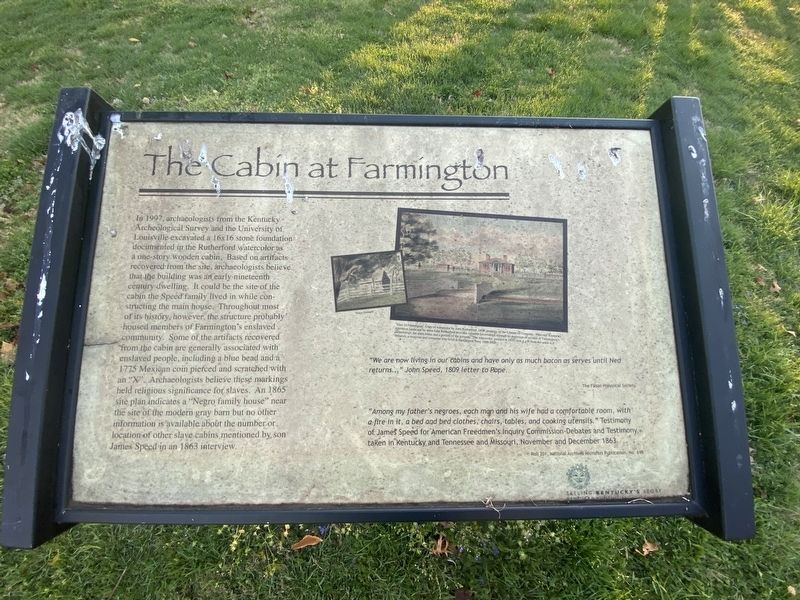
Photographed by Darren Jefferson Clay, April 7, 2024
1. The Cabin at Farmington Marker
"We are now living in our cabins and have only as much bacon as serves until Ned returns..."
John Speed, 1809 letter
this page online
The Filson Historical Society
"Among my father's negroes, each man and his wife had a comfortable room, with a fire in it, a bed and bed clothes, chairs, tables, and cooking utensils." Testimony of James Speed for American Freedmen's Inquiry Commission Debates and Testimony taken in Kentucky and Tennessee and Missouri, November and December 1863.
Roll 201, National Archives Microfilm Publication, No. 619
Erected by Kentucky Humanities Council, Inc.
Topics. This historical marker is listed in these topic lists: African Americans • Anthropology & Archaeology. A significant historical month for this entry is December 1863.
Location. 38° 12.91′ N, 85° 40.099′ W. Marker is in Louisville, Kentucky, in Jefferson County. It is in Hawthorne. It can be reached from Farmington Access Rd. east of Lowell Avenue. Touch for map. Marker is at or near this postal address: Farmington Access Rd, Louisville KY 40205, United States of America. Touch for directions.

Regionally, this marker is in the American South, specifically in the Upper South, and in the Ohio River Valley. Globally, it is in North America, the Western Hemisphere, the
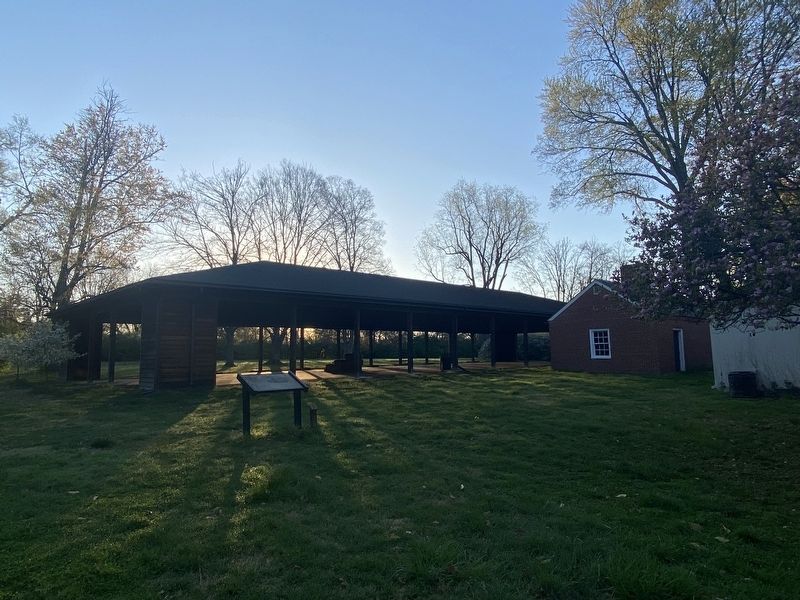
Photographed by Darren Jefferson Clay, April 7, 2024
2. The Cabin at Farmington Marker
Other nearby markers. At least 8 other markers are within walking distance of this marker: Agriculture & Farmington (about 300 feet away, measured in a direct line); The Brothers Speed — Joshua and James (about 400 feet away); Abraham Lincoln & Farmington — 1841 (about 400 feet away); Farmington (approx. ¼ mile away); Bowman Field (approx. 0.6 miles away); Bray Place / Scoggan-Jones Horse Farm (approx. 0.8 miles away); Alonzo "Lonnie" Clayton / African American Jockey (approx. 0.9 miles away); Aero Club of Louisville (approx. one mile away). Touch for a list and map of all markers in Louisville.
Credits. This page was last revised on April 15, 2024. It was originally submitted on April 9, 2024, by Darren Jefferson Clay of Duluth, Georgia. This page has been viewed 335 times since then and 42 times this year. Photos: 1, 2. submitted on April 10, 2024, by Darren Jefferson Clay of Duluth, Georgia. • James Hulse was the editor who published this page.
