Bethesda in Montgomery County, Maryland — The American Northeast (Mid-Atlantic)
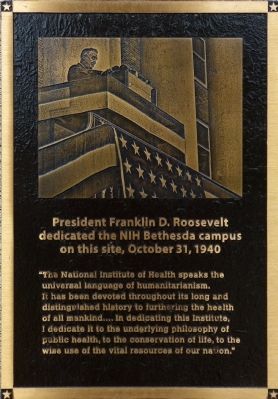
President Franklin D. Roosevelt dedicated the NIH Bethesda campus on this site, October 31, 1940
Photographed by Allen C. Browne, August 14, 2013
1. President Franklin D. Roosevelt Marker
"The National Institute of Health speaks the universal language of humanitarianism. It has been devoted throughout its long and distinguished history to furthering the health of all mankind....In dedicating this Institute, I dedicate it to the underlying philosophy of public health, to the conservation of life, to the wise use of the vital resources of our nation."
Topics and series. This historical marker is listed in this topic list: Science & Medicine. In addition, it is included in the Former U.S. Presidents: #32 Franklin D. Roosevelt series list. A significant historical date for this entry is October 31, 1940.
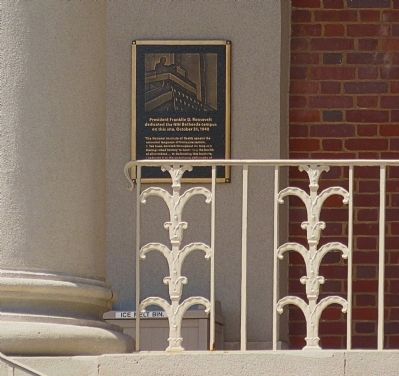
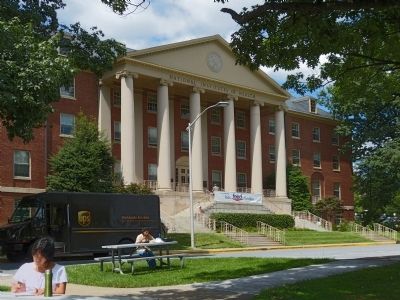
Location. 39° 0.096′ N, 77° 6.08′ W. Marker is in Bethesda, Maryland, in Montgomery County. It is on Center Drive 0.1 miles south of South Drive, on the right when traveling south. The marker is affixed to a pilaster to the right of the front door of Building 1, the James A. Shannon Building on the NIH campus. Touch for map. Marker is at or near this postal address: 100 South Drive, Bethesda MD 20814, United States of America. Touch for directions.

Regionally, this marker is in the Washington Metropolitan Area. It is also
this page online
Other nearby markers. At least 8 other markers are within walking distance of this marker: The Paul G. Rogers Plaza (within shouting distance of this marker); The Centennial Anchor (about 500 feet away, measured in a direct line); The Louis Stokes Laboratories (about 600 feet away); Claude Denson Pepper Building (about 700 feet away); Honoring a Century of Women's Health (approx. 0.2 miles away); At This Location (approx. 0.2 miles away); Tree of Hippocrates (approx. 0.2 miles away); Sky Horizon (approx. ¼ mile away). Touch for a list and map of all markers in Bethesda.
Also see . . . Rare Footage: FDR Addresses NIH,1940. Franklin D. Roosevelt Presidential Library and Museum website entry (Submitted on March 18, 2022, by Larry Gertner of New York, New York.)
Additional commentary.
1. The Dedication
Lyons in her 2006 book Acres of Science describes the dedication
Photographed by Allen C. Browne, August 15, 2013
2. President Franklin D. Roosevelt Marker
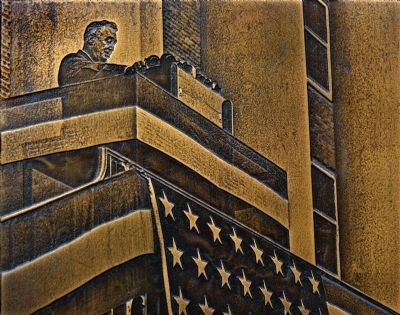
[O]n October 31, 1940, Roosevelt stood between the white columns on the front porch Building 1 to dedicate the campus. An estimated 3,000 public and private doctors, Public Health Service (PHS) employees, and Montgomery County residents attended the ceremony on the warm afternoon. Roosevelt’s brief speech made three points. First, with the United States closely watching the war in Europe, Roosevelt stressed that total defense meant not only guns and airplanes, but mobilization of health and medical resources. He stated that the NIH had been devoted to “furthering the health of all mankind.” Its new mission, he declared, must be to “recruit not only men and materials but also knowledge and science in the service of national strength.”
Second, Roosevelt emphasized that “neither the American people nor their government intend to socialize medical practice any more than they plan to socialize industry.” This was Roosevelt’s strongest statement up until that time trying to calm the organized medical profession. Some feared that Roosevelt would establish a national health
Photographed by Allen C. Browne, August 14, 2013
3. President Franklin D. Roosevelt
And third, Roosevelt lauded the Public Health Service, saying, “it is only recently in the past few years that the Federal Government has indicated that it can do infinitely more–that disease disregards state lines as well as national–that among the States there is inequality of opportunity for health–that in such cases the Public Health Service is helping, and must continue to help, man greatly.” Roosevelt highlighted the establishment of the National Cancer Institute and warned that better transportation around the world meant more exposure to all kinds of disease.
At the end of his speech, Roosevelt turned to Helen Wilson and thanked her family for the donation of their land
Photographed by Allen C. Browne, August 14, 2013
4. Building 1, The James A. Shannon Building
— Submitted August 16, 2013, by Allen C. Browne of Silver Spring, Maryland.
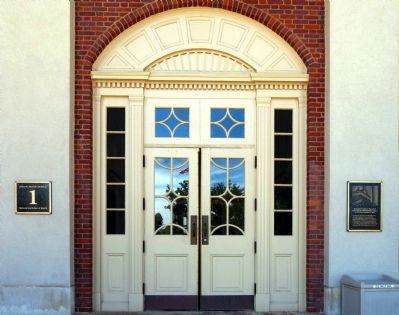
Photographed by Allen C. Browne, August 15, 2013
5. The Front Door of Building 1
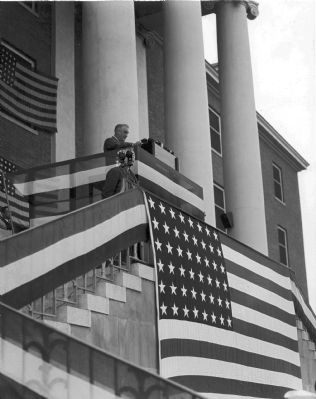
Photographed by NIH Almanac
6. President Franklin D. Roosevelt October 31, 1940
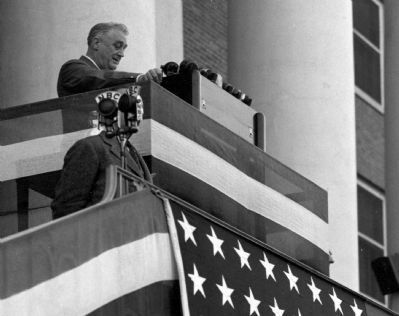
Photographed by NIH Almanac
7. President Franklin D. Roosevelt October 31, 1940
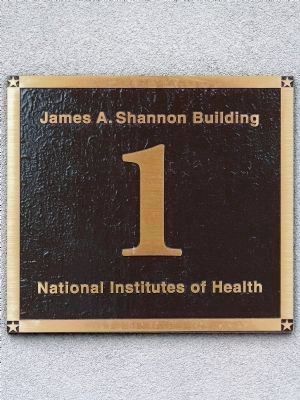
Photographed by Allen C. Browne, August 14, 2013
8. James A. Shannon Building
1
National Institutes of Health
1
National Institutes of Health
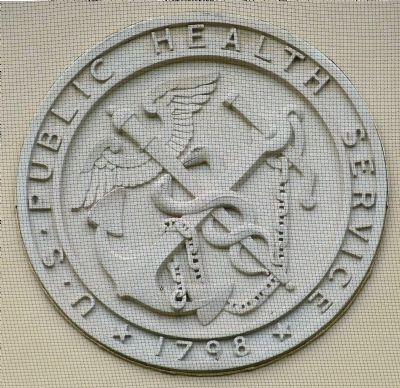
Photographed by Allen C. Browne, August 14, 2013
9. U. S. Public Health Service - 1798
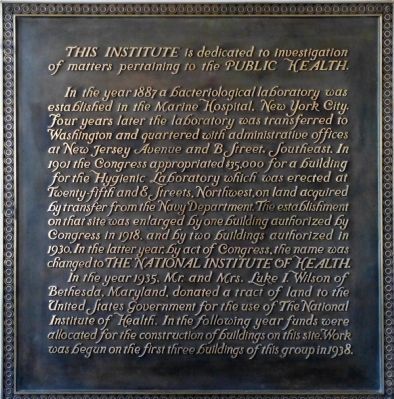
Photographed by Allen C. Browne, August 15, 2013
10. Plaque in the front foyer on Building 1
This Institute is dedicated to the investigation of matters pertaining to the Public Health.
In the year 1887 a bacteriological laboratory was established in the Marine Hospital. New York City. Four years later the laboratory was transferred to Washington and quartered with administrative offices at New Jersey Avenue and B Street, Southeast. In 1901 the Congress appropriated $35,000 for a building for the Hygienic Laboratory which was erected as Twenty-fifth and E Streets, Northwest, on land acquired by transfer from the Navy Department. The establishment on that site was enlarged by on building authorized by Congress in 1918, and two buildings authorized in 1930. In the latter year, by act of Congress, the name was changed to The National Institute of Health.
In the year 1935,Mr. and Mrs. Luke I. Wilson of Bethesda, Maryland. donated a tract of land to the United States Government for the use of the National Institute of Health. In the following year funds were allocated for the construction of buildings on this site. Work was begun on the first three buildings of this group in 1938.
In the year 1887 a bacteriological laboratory was established in the Marine Hospital. New York City. Four years later the laboratory was transferred to Washington and quartered with administrative offices at New Jersey Avenue and B Street, Southeast. In 1901 the Congress appropriated $35,000 for a building for the Hygienic Laboratory which was erected as Twenty-fifth and E Streets, Northwest, on land acquired by transfer from the Navy Department. The establishment on that site was enlarged by on building authorized by Congress in 1918, and two buildings authorized in 1930. In the latter year, by act of Congress, the name was changed to The National Institute of Health.
In the year 1935,Mr. and Mrs. Luke I. Wilson of Bethesda, Maryland. donated a tract of land to the United States Government for the use of the National Institute of Health. In the following year funds were allocated for the construction of buildings on this site. Work was begun on the first three buildings of this group in 1938.
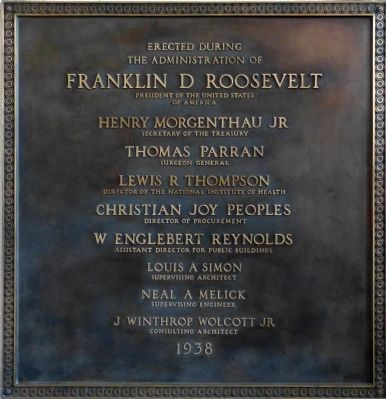
Photographed by Allen C. Browne, August 15, 2013
11. Plaque in the front foyer of Building 1
The Administration of
Franklin D Roosevelt
President of the United States of America
Henry Morgenthau Jr
Secretary of the Treasury
Thomas Parran
Surgeon General
Lewis R Thompson
Director of the National Institute of Health
Christian Joy Peoples
Director of Procurement
W Englebert Reynolds
Assistant Director for Public Buildings
Louis A Simon
Supervising Architect
Neal A Melick
Supervising Engineer
J Winthrop Wolcott Jr
Consulting Architect
1938
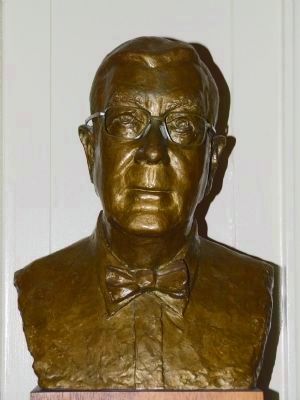
Photographed by Allen C. Browne, August 15, 2013
12. James A.Shannon
James A.Shannon, MD. PhD (1904-1994)
Director NIH, 1955-1968
Sculptor: Elaine Pear Cohen (1920-1995)
James Shannon is remembered as the NIH director under whom there was a rapid expansion in federally funded biomedical research. In 1983, Building 1 itself was renamed in Shannon's honor.Bust inside Building 1
Director NIH, 1955-1968
Sculptor: Elaine Pear Cohen (1920-1995)
James Shannon is remembered as the NIH director under whom there was a rapid expansion in federally funded biomedical research. In 1983, Building 1 itself was renamed in Shannon's honor.
Photographed by Allen C. Browne, August 15, 2013
13. James A. Shannon
James A. Shannon MD, PhD (1904-1994)
Director, NIH, 1955-1968
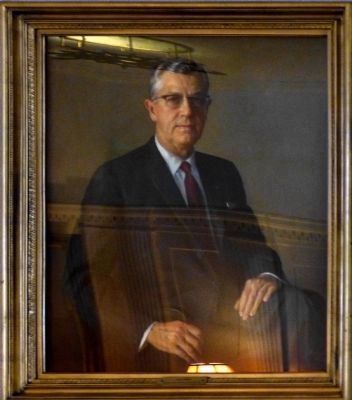
Artist: Bjorn Peter Egeli
Widely recognized for his original research in kidney function, James Shannon led a project during World War II to develop antimalarial drugs at Goldwater Memorial Hospital in New York City. In 1949 he came to NIH as the first intramural director of the National Heart Institute, bringing many future NIH scientific leaders with him. During his NIH directorship, Shannon presided over rapid expansion of the NIH often remembered as "the Golden Years." In 1983, Building 1 was named the James A. Shannon Building to commemorate his many contributions to NIH.Portrait inside Building 1
Director, NIH, 1955-1968
Artist: Bjorn Peter Egeli
Widely recognized for his original research in kidney function, James Shannon led a project during World War II to develop antimalarial drugs at Goldwater Memorial Hospital in New York City. In 1949 he came to NIH as the first intramural director of the National Heart Institute, bringing many future NIH scientific leaders with him. During his NIH directorship, Shannon presided over rapid expansion of the NIH often remembered as "the Golden Years." In 1983, Building 1 was named the James A. Shannon Building to commemorate his many contributions to NIH.
Photographed by Allen C. Browne, August 15, 2013
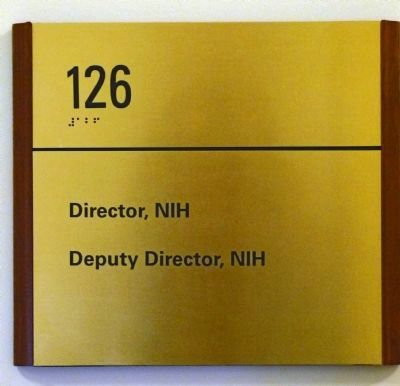
14. Rm. 126, Building 1
Deputy Director, NIH
Photographed by Allen C. Browne, August 14, 2013
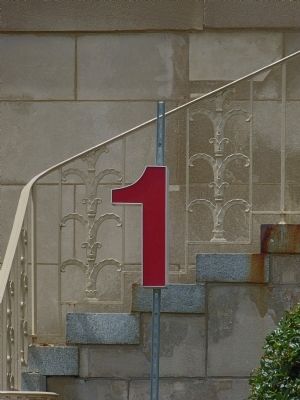
15. Big Red 1
Credits. This page was last revised on April 11, 2024. It was originally submitted on August 16, 2013, by Allen C. Browne of Silver Spring, Maryland. This page has been viewed 1,120 times since then and 47 times this year. Last updated on April 10, 2024, by Laura Edwards of Bethesda, Maryland. Photos: 1, 2, 3, 4, 5, 6, 7, 8, 9, 10, 11, 12, 13, 14, 15. submitted on August 16, 2013, by Allen C. Browne of Silver Spring, Maryland. • Devry Becker Jones was the editor who published this page.
