
Lisboa, Portugal — Southwestern Europe (Iberian Peninsula)
Regicídio de 1908
⎯⎯⎯
The Lisbon Regicide
Photographed by Andrew Ruppenstein, April 20, 2024
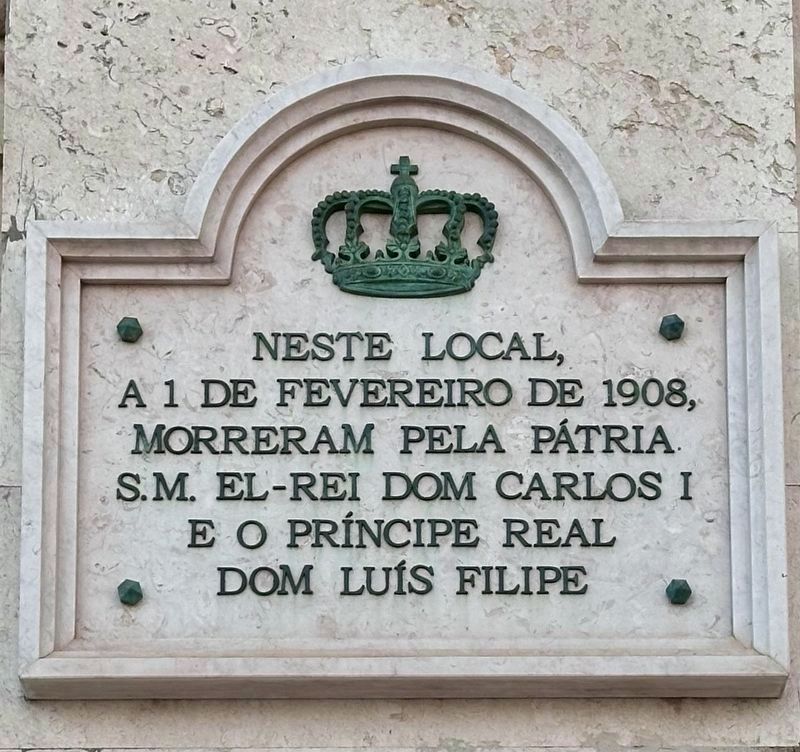
1. The Lisbon Regicide Marker

a 1 de fevereiro de 1908,
morreram pela pátria
S.M. El-Rei Dom Carlos I
e o Príncipe Real
Dom Luís Filipe
In this place, on February 1, 1908, His Majesty the King Dom Carlos I and the Royal Prince Dom Luís Filipe died for the country.
Topics. This historical marker is listed in this topic list: Notable Events. A significant historical date for this entry is February 1, 1908.
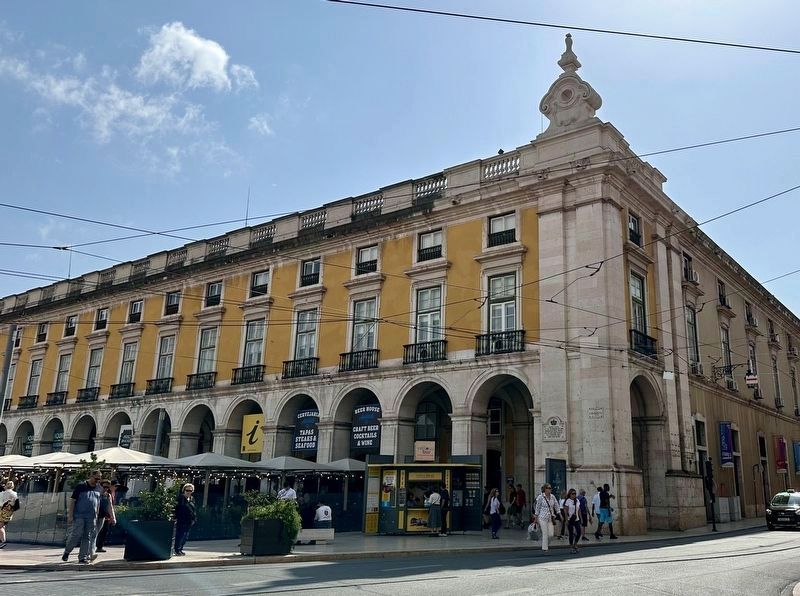
Location. 38° 42.483′ N, 9° 8.266′ W. Marker is in Lisboa. It is on Praça do Comércio. Touch for map. Marker is at or near this postal address: Praça do Comércio 31a, Lisboa 1100-039, Portugal. Touch for directions.

Regionally, it is in the North Atlantic Region, in Europe, in the European Union, in Atlantic Europe, on the Iberian Peninsula, in the Schengen Area, and in the Western World. Historically, it finds itself in what was once the Byzantine Empire, Portuguese colonies, and the Roman Empire.
Other nearby markers. At least 8 other markers are within walking distance of this marker: Arco da Rua Augusta (about 90 meters away, measured in a direct line); Antiga Prisáo Política / Former Political Prison
this page online
Also see . . . Lisbon Regicide (Wikipedia).
Overview: The Lisbon Regicide or Regicide of 1908 (Portuguese: Regicídio de 1908) was the assassination of King Carlos I of Portugal and the Algarves and his heir-apparent, Luís Filipe, Prince Royal of Portugal, by assassins sympathetic to Republican interests and aided by elements within the Portuguese Carbonária, disenchanted politicians and anti-monarchists. The events occurred on 1 February 1908 at the Praça do Comércio along the banks of the Tagus River in Lisbon, commonly referred to by its antiquated name Terreiro do Paço.(Submitted on April 22, 2024.)
Assassinations: …On disembarking at the Estação Fluvial Sul e Sueste atabout five PM, they were met by members of the government including Prime Minister João Franco, Infante Manuel and the King's brother Infante Afonso, Duke of Porto. Even in a climate of tension the monarch opted to travel in an open carriage, wearing his blue service uniform as Generalíssimo of the Army to present an air of normality. The two princes wore civilian clothes. Although there were a few armed police present in the square the carriage was escorted only by a single mounted cavalry officer, Francisco Figueira Freire.Photographed by Andrew Ruppenstein, April 20, 20242. The Lisbon Regicide Marker
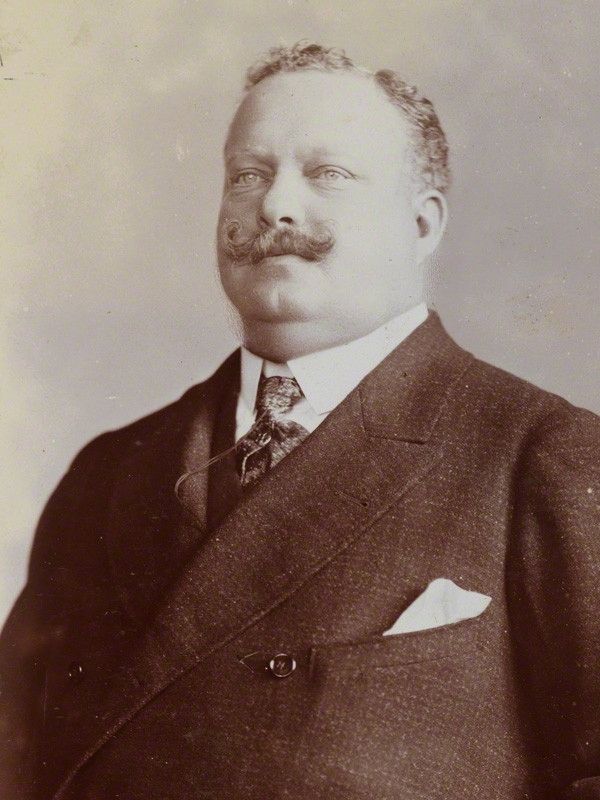
There were only a few people in the Terreiro do Paço as the carriage rounded the eastern part of the square and the first shot rang out. As reported later, a bearded man had walked out into the road after the carriage had passed; he removed a Winchester carbine rifle hidden under his overcoat, knelt on one knee and fired at the King from a distance of about 8 metres (8.7 yd). The shot struck the king's neck, killing him instantly; another gunman in the square opened fire at the carriage while onlookers ran in panic. The first assassin, later identified as Manuel Buíça (a teacher and former sergeant dismissedfrom the army), continued to fire. His second shot clipped the shoulder of the monarch, who slumped to the right with his back lying to the left side of the carriage. Taking advantage of this, the second assassin (Alfredo Luís da Costa, a clerk and editor), jumped onto the carriage step and fired at the slumped body of the King from passenger height. The queen then stood and attempted to strike back at him with the only available weapon (a bouquet of flowers), shouting, "Infames! Infames!" ("Infamous! Infamous!").19073. King Carlos I
The assassins then turned their attention to the Prince Royal, Luís Filipe, who had stood to draw and fire a hidden revolver but was hit in the chest. The bullet (from a small-caliber revolver) did not exit his sternum nor was it fatal; the prince reportedly fired four quick shots at his attacker, who fell from the carriage step. However, when Luís Filipe stood up he became more visible to the attacker with the rifle; the prince was struck by a large-caliber shot which exited from the top of his skull. The young Infante Manuel, protected by his mother during the events, tried to stop the bleeding with a handkerchief but it was quickly soaked with his brother's blood.
As shots continued across the square, Queen Amélia returned to her feet to call for assistance. The Countess of Figueiró, the Viscount of Asseca and the Marquis of Lavradio jumped onto the carriage to support the Prince Royal. Infante Manuel was hit in the arm, and the coachman was hit in the hand. The assassin Buíça then attempted to fire another round, although it is unclear at whom he was aiming. He was stopped by the intervention of Henrique da Silva Valente, a soldier from the 12th Infantry who had appeared in the square during the commotion. During his brief confrontation with Buíça, Silva Valente was shot in the leg, but was able to distract the assassin. The cavalry officer (Francisco Figueira) remounted his horse and fired at Costa, who was then seized by police officers. Buíça managed to shoot Figueira in the leg and attempted to escape but was also captured.
Credits. This page was last revised on April 22, 2024. It was originally submitted on April 21, 2024, by Andrew Ruppenstein of Lamorinda, California. This page has been viewed 611 times since then and 142 times this year. Photos: 1, 2. submitted on April 21, 2024, by Andrew Ruppenstein of Lamorinda, California. 3. submitted on April 22, 2024, by Andrew Ruppenstein of Lamorinda, California.
