
Nottingham in Nottinghamshire, England, United Kingdom — Northwestern Europe (the British Isles)
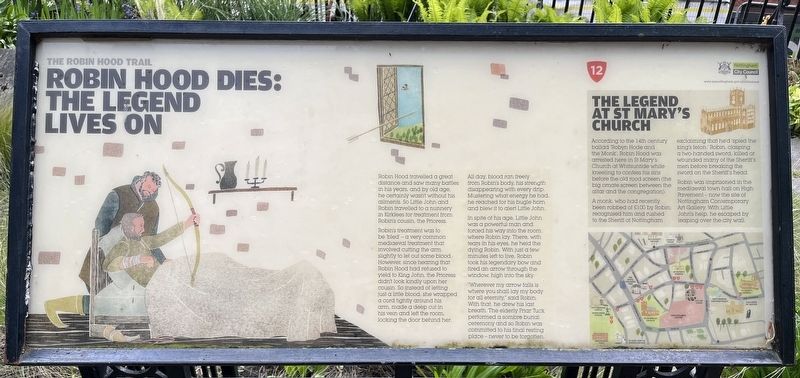
Robin Hood Dies: The Legend Lives On
| — | The Robin Hood Trail | — |
Photographed by Ray Gurganus
1. Robin Hood Dies: The Legend Lives On Marker
Robin's treatment was to be 'bled' - a very common medieval treatment that involved cutting the arm slightly to let out some blood. However, since hearing that Robin Hood had refused to yield to King John, the Prioress didn't look kindly upon her cousin. So instead of letting just a little blood, she wrapped a cord tightly around his arm, made a deep cut in his vein and left the room, locking the door behind her.
All day, blood ran freely from Robin's body, his strength disappearing with every drip. Mustering what energy he had, he reached for his bugle horn and blew it to alert Little John.
In spite of his age, Little John was a powerful man and forced his way into the room where Robin lay. There, with tears in his eyes, he held the dying Robin. With just a few minutes left to live, Robin took his legendary bow and fired an arrow through the window, high into the sky.
"Wherever
this page online
The Legend at St Mary's Church
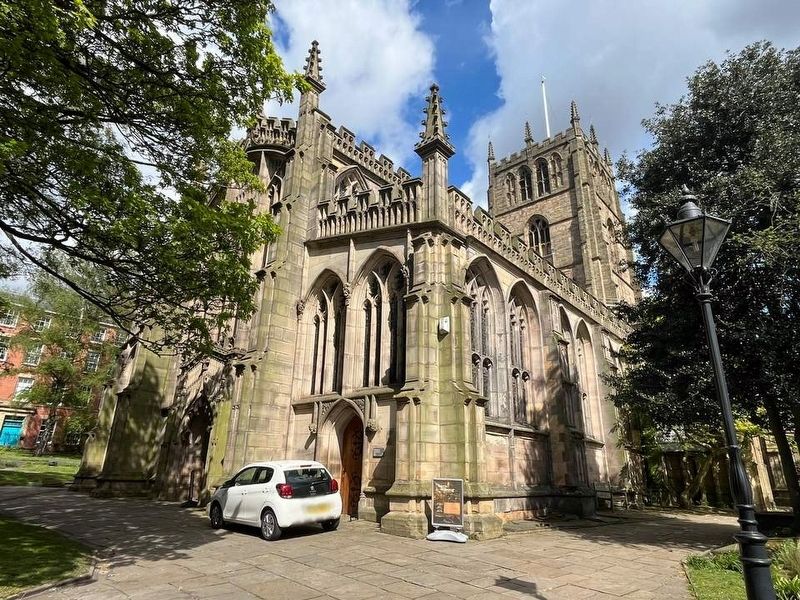
According to the 14th century ballad 'Robyn Hode and the Monk', Robin Hood was arrested here in St Mary's Church at Whitsuntide while kneeling to confess his sins before the old rood screen (the big ornate screen between the altar and the congregation).
A monk, who had recently been robbed of £100 by Robin, recognised him and rushed to the Sheriff of Nottingham exclaiming that he'd 'spied the king's felon' Robin, clasping a two-handed sword; killed or wounded many of the Sheriff's men before breaking the sword on the Sheriff's head.
Robin was imprisoned in the medieval town hall on High Pavement - now the site of Nottingham Contemporary Art Gallery. With Little John's help, he escaped by leaping over the city wall.
Erected by Nottingham City Council. (Marker Number 12.)
Topics. This historical marker is listed in these topic lists: Heroes
Photographed by Ray Gurganus
2. St Mary's Church
Location. 52° 57.061′ N, 1° 8.615′ W. Marker is in Nottingham, England, in Nottinghamshire. It is on High Pavement, on the right. Inside the church gate on the left when facing the church. Touch for map. Marker is in this post office area: Nottingham, England NG1 1HN, United Kingdom. Touch for directions.

Regionally, this marker is in England’s Midlands. Globally, it is on the Atlantic Ocean, in the North Atlantic Region, in Europe, in Atlantic Europe, on one of the British Isles, in the Western World, and in the Anglosphere. Historically, it finds itself in what was once the Roman Empire.
Other nearby markers. At least 8 other markers are within walking distance of this marker: The Lace Market in the 16th, 17th & 18th centuries (within shouting distance of this marker); Lace Market 19th Century (within shouting distance of this marker); Archaeology of the Lace Market (1) (within shouting distance of this marker); Archaeology of the Lace Market (2) (within shouting distance of this marker); The Council House and Exchange Buildings (approx. 0.4 kilometers away); Robin Hood and Friar Tuck (approx. half a kilometer away); Robin Hood Meets His Match (approx. half a kilometer away); Rebel City (approx. 0.6 kilometers away). Touch for a list and map of all markers in Nottingham.
Credits. This page was last revised on April 22, 2024. It was originally submitted on April 22, 2024, by Ray Gurganus of Washington, District of Columbia. This page has been viewed 227 times since then and 114 times this year. Photos: 1, 2. submitted on April 22, 2024, by Ray Gurganus of Washington, District of Columbia. • Andrew Ruppenstein was the editor who published this page.
