
Nottingham in Nottinghamshire, England, United Kingdom — Northwestern Europe (the British Isles)
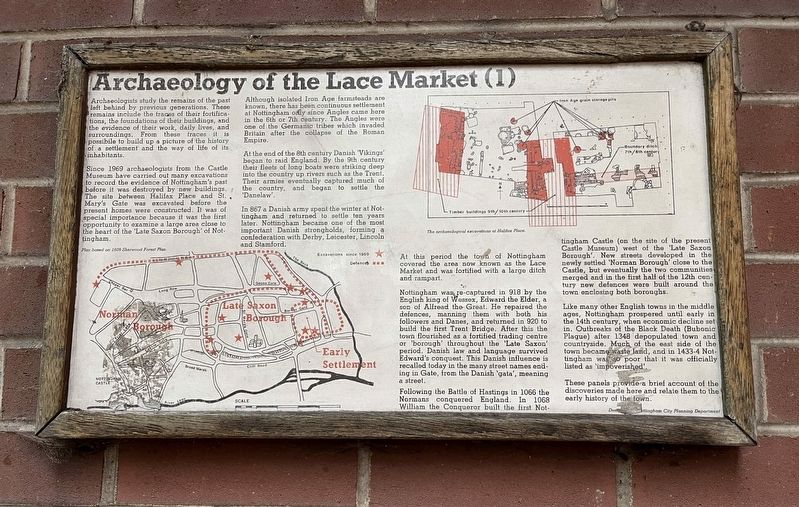
Archaeology of the Lace Market (1)
Photographed by Ray Gurganus
1. Archaeology of the Lace Market Marker
Since 1969 archaeologists from the Castle Museum have carried out many excavations to record the evidence of Nottingham's past before it was destroyed by new buildings. The site between Halifax Place and St. Mary's Gate was excavated before the present homes were constructed. It was of special importance because it was the first opportunity to examine a large area close to the heart of the 'Late Saxon Borough' of Nottingham.
Although isolated Iron Age farmsteads are known, there has been continuous settlement at Nottingham only since Angles came here in the 6th or 7th century. The Angles were one of the Germanic tribes which invaded Britain after the collapse of the Roman Empire.
At the end of the 8th century Danish "Vikings" began to raid England. By the
this page online
In 867 a Danish army spent the winter at Nottingham and returned to settle ten years later. Nottingham became one of the most important Danish strongholds, forming a confederation with Derby, Leicester, Lincoln and Stamford.
At this period the town of Nottingham covered the area now known as the Lace Market and was fortified with a large ditch and rampart.
Nottingham was re-captured in 918 by the English king of Wessex, Edward the Elder, a son of Alfred the Great. He repaired the defences, manning them with both his followers and Danes, and returned in 920 to build the first Trent Bridge, After this the town flourished as a fortified trading centre or 'borough' throughout the 'Late Saxon' period. Danish law and language survived Edward's conquest. This Danish influence is recalled today in the many street names ending in Gate, from the Danish 'gata', meaning a street.
Following the Battle of Hastings in 1066 the Normans conquered England. In 1068 William the Conqueror built the first Nottingham Castle (on the site of the present Castle Museum) west of the 'Late Saxon' Borough New streets developed in the newly settled 'Norman Borough close to the Castle, but eventually the two communities merged and in the first half of the 12th century now defences were built around the town enclosing both boroughs.
Like many other English towns in the middle ages, Nottingham prospered until early in the 14th century, when economic decline set in. Outbreaks of the Black Death (Bubonic Plague) after 1348 depopulated town and countryside. Much of the east side of the town became waste land, and in 1433-4 Nottingham was so poor that it was officially listed as 'impoverished'.
These panels provide a brief account of the discoveries made here and relate them to the early history of the town.
Erected by Nottingham City Planning Department.
Topics. This historical marker is listed in these topic lists: Anthropology & Archaeology • Settlements & Settlers.
Location. 52° 57.086′ N, 1° 8.642′ W. Marker is in Nottingham, England, in Nottinghamshire. It is at the intersection of Saint Mary's Gate and Kayes Walk, on the left when traveling north on Saint Mary's Gate. Touch for map. Marker is at or near this postal address: 44 St Mary's Gate, Nottingham, England NG1 1QN, United Kingdom. Touch for directions.

Regionally, this marker is in England’s Midlands. Globally, it is on the Atlantic Ocean, in the North Atlantic Region, in Europe, in Atlantic Europe, on one of the British Isles, in the Western World, and in the Anglosphere. Historically, it finds itself in what was once the Roman Empire.
Other nearby markers. At least 8 other markers are within walking distance of this marker: Lace Market 19th Century (here, next to this marker); Archaeology of the Lace Market (2) (here, next to this marker); The Lace Market in the 16th, 17th & 18th centuries (here, next to this marker); Robin Hood Dies: The Legend Lives On (within shouting distance of this marker); The Council House and Exchange Buildings (approx. 0.4 kilometers away); Robin Hood and Friar Tuck (approx. half a kilometer away); Robin Hood Meets His Match (approx. half a kilometer away); Rebel City (approx. 0.6 kilometers away). Touch for a list and map of all markers in Nottingham.
Credits. This page was last revised on April 23, 2024. It was originally submitted on April 22, 2024, by Ray Gurganus of Washington, District of Columbia. This page has been viewed 191 times since then and 22 times this year. Photo 1. submitted on April 22, 2024, by Ray Gurganus of Washington, District of Columbia. • Andrew Ruppenstein was the editor who published this page.
