Gettysburg in Adams County, Pennsylvania — The American Northeast (Mid-Atlantic)
Historic Farnsworth House Inn (Circa 1810)

Photographed by Sean Flynn, April 25, 2024
1. Historic Farnsworth House Inn Marker
Confederate sharpshooters occupied the house during the Battle of Gettysburg, one of whom is believed to have killed Mary Virginia "Jennie" Wade, the only civilian killed in the battle, from the garret (attic) window. This window, sharpshooters (sic) nest, and weapon, may be viewed today. The white pock marks seen in the bricks on the south side of the house bear testament to the damage from Union muskets atop Cemetery Hill. An artillery shell lodged near the attic window was removed in the 1950's. Two Union bullets were recovered from the property, one embedded in the brick mortar, the other from the yard. A brick was uncovered in 1972, with the builder of the house, John McFarlane's,
this page online
In an interview with Sara Black-Gideon (from whom the Shultz family purchased the house), she stated that her mother had a collection of one hundred and thirty-five bullets that had been gathered from various areas around the property. Today the attic displays "The Shultz Collection," relics from the Battle of Gettysburg & artifacts from the Civil War.
Mr. Shultz, as a child, resided next door to The Little Round Top one-room schoolhouse, which he attended in 1938 (still remains). Roaming the hills from Little Round Top, he became aware of the brave charge of Gen. Farnsworth. Shultz chose to name the house in honor of Brig. Gen. Elon John Farnsworth and his gallant men.
An ill-fated cavalry charge was ordered by Brig. Gen. Judson Kilpatrick, nicknamed "Kill Cavalry," on the right flank of the Confederate Army (Slyder Farm) on the last day of the battle: July 3rd around 5pm. A heated discussion between Farnsworth and Kilptrick (sic) ensued about the deadly consequences of charging entrenched infantry with cavalry. Finally, Farnsworth retorted, "General, if you order the charge, I will lead it, but you must take responsibility."
Gen.
Photographed by Sean Flynn, April 25, 2024
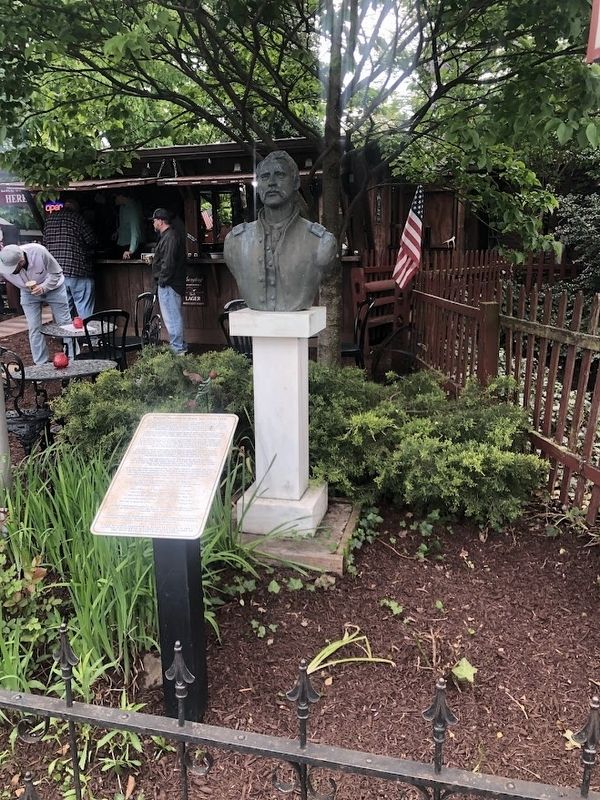
2. Historic Farnsworth House Inn (Circa 1810) Marker and statue of Elon Farnsworth
Other officers voiced their opinions of the ill-fated charge:
"I regret it is simple murder." -Captain William Graham (USA) "I'd rather charge into hell than in there." Major William Wells (USA) "...an inexcusable military blunder." -General Felix Robertson (CSA) "The order to charge was a crime." -Captain Frederick G. Newhall (USA)
General Farnsworth perished on July 3rd, 1863, along with sixty-five of his men. Like the fabled charge of the Light Brigade, Farnsworths' (sic) charge was brave, memorable, and fruitless.
A complete history of the Historic Farnsworth House and its occupants can be found in a book entitled In The Eye of The Storm: The Farnsworth House and The Battle of Gettysburg by Timothy H Smith which can be purchased on site.
The historic Farnsworth House is listed in the National Register of Historic Places and is one of the most recognized inns in America.
Topics and series. This memorial is

Photographed by Sean Flynn, April 25, 2024
3. Historic Farnsworth House Inn
The marker is in front of the inn's outdoor courtyard.
Location. 39° 49.531′ N, 77° 13.873′ W. Memorial is in Gettysburg, Pennsylvania, in Adams County. It is on Baltimore Street (Business U.S. 15) south of South Street, on the right when traveling south. The marker is in front of the outdoor seating section for the Inn's restaurant. Touch for map. Memorial is at or near this postal address: 401 Baltimore Street, Gettysburg PA 17325, United States of America. Touch for directions.

Regionally, this memorial is in South-Central Pennsylvania. It is also in the American Northeast, in the Mid-Atlantic, in Appalachia, and specifically in Northern Appalachia. Globally, it is in North America, the Western Hemisphere, the Western World, and the Anglosphere. Historically, it finds itself in what was once the Haudenosaunee (Iroquois) Confederacy and also one of the original Thirteen Colonies.
Other nearby markers. At least 8 other markers are within walking distance
Whitehurst Gallery, Washington, D.C.; Liljenquist Family collection (Library of Congress)
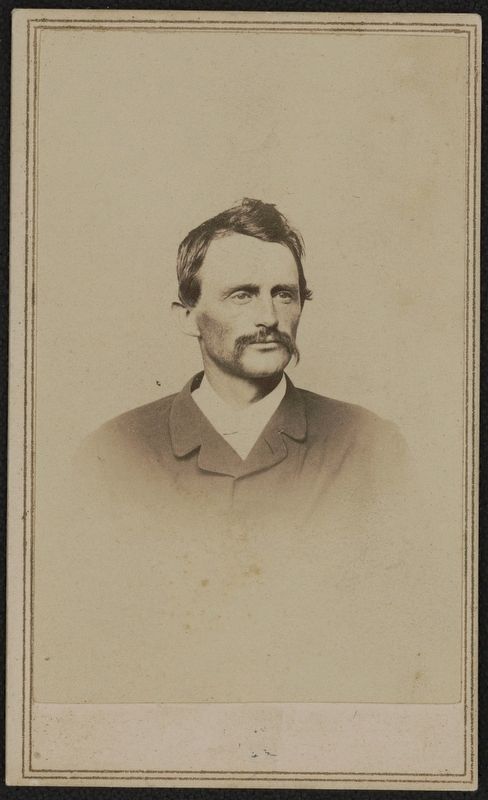
4. Elon Farnsworth
Caption from the Library of Congress: "[Brigadier General Elon John Farnsworth of Co. K, 8th Illinois Cavalry Regiment in uniform] / Whitehurst Gallery, 434 Pennsylvania Avenue, Washington, D.C."
Another marker is no longer nearby. Baltimore Street Facade (was within shouting distance of this marker but has been confirmed missing).
More about this memorial. A statue of Farnsworth is immediately behind the marker.
Regarding Historic Farnsworth House Inn (Circa 1810). The spot where Elon Farnsworth was killed is roughly 3 miles (as the crow flies) south-southwest of the inn that now carries his name. Farnsworth started the war as a lieutenant under his uncle, John Farnsworth, a seven-term Congressman from St. Charles, Illinois, who had donated land for Camp Kane in that city about 40 miles from Chicago and had organized the 8th Illinois Cavalry regiment.
Elon Farnsworth, who is buried in Rockton (Illinois) Cemetery, held the rank of captain at the time of his death. While President Lincoln had nominated him to be a brigadier general on June 29, 1863, the appointment was never confirmed by the Senate.
Also see . . .
1. Farnsworth House Inn official site. (Submitted on April 25, 2024, by Sean P. Flynn of Oak Park, Illinois.)
2. The Death of "Boy General" Elon Farnsworth. From Warfare History Network (Submitted on April 25, 2024, by Sean P. Flynn of Oak Park, Illinois.)
3. Haunted Places Near Me: Farnsworth House Inn. (Submitted on October 15, 2026, by Paul Gordon of Lisbon, Portugal.)
Credits. This page was last revised on October 23, 2026. It was originally submitted on April 25, 2024, by Sean P. Flynn of Oak Park, Illinois. This page has been viewed 947 times since then and 162 times this year. Photos: 1, 2, 3, 4. submitted on April 25, 2024, by Sean P. Flynn of Oak Park, Illinois.
