Galveston in Galveston County, Texas — The American South (West South Central)
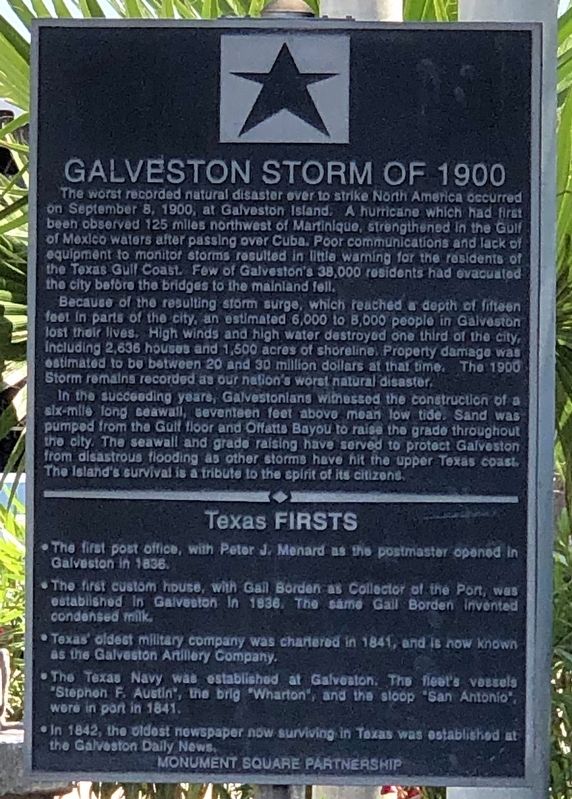
Galveston Storm of 1900
Photographed by Duane and Tracy Marsteller, April 13, 2024
1. Galveston Storm of 1900 Marker
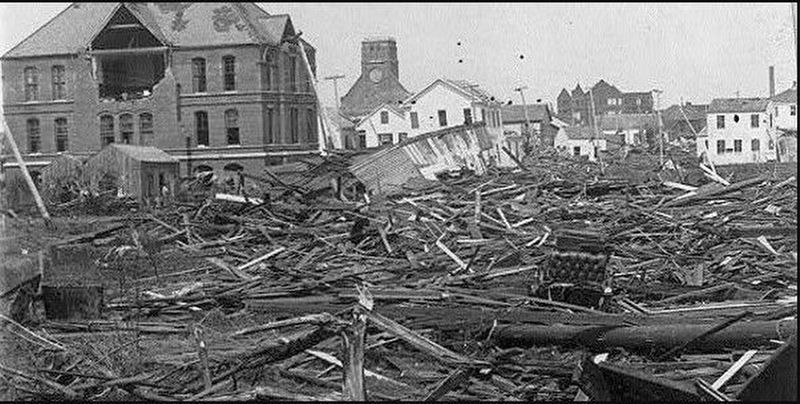
Because of the resulting storm surge, which reached a depth of fifteen feet in parts of the city, an estimated 6,000 to 8,000 people in Galveston lost their lives. High winds and high water destroyed one third of the city, including 2,636 houses and 1,500 acres of shoreline. Property damage was estimated to be between 20 and 30 million dollars at that time. The 1900 Storm remains recorded as our nation's worst natural disaster.
In the succeeding years, Galvestonians witnessed the construction of a six-mile long seawall, seventeen feet above mean low tide. Sand was pumped from the Gulf floor and Offatts Bayou to raise the
this page online
• The first custom house, with Gail Borden as Collector of the Port, was established in Galveston in 1836. The same Gail Borden invented condensed milk.
• Texas' oldest military company was chartered in 1841, and is now known as the Galveston Artillery Company.
• The Texas Navy was established at Galveston. The fleet's vessels “Stephen F. Austin”, the brig “Wharton”, and the stoop “San Antonio”, were in port in 1841.
• In 1842, the oldest newspaper now surviving in Texas was established at the Galveston Daily News.
Erected by Monument Square Partnership.
Topics. This historical marker is listed in these topic lists: Disasters • Waterways & Vessels. A significant historical date for this entry is September 8, 1900.
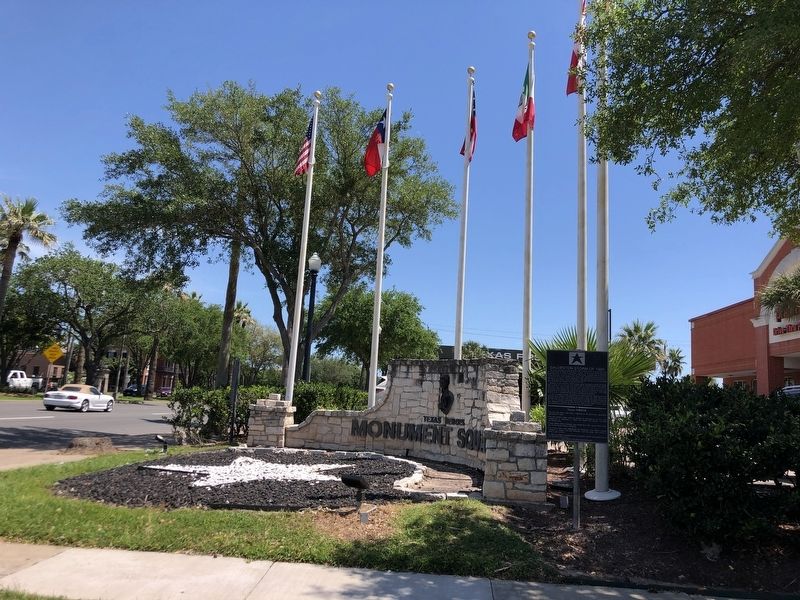
Location. 29° 17.956′ N, 94° 47.646′ W. Marker is in Galveston, Texas, in Galveston
Photographed by Duane and Tracy Marsteller, April 13, 2024
2. Galveston Storm of 1900 Marker

Regionally, this marker is in the Houston Metropolitan Area. It is also in the American South and on the Gulf Coast. Globally, it is in North America, a Gulf of Mexico state, the Western Hemisphere, the Western World, and the Anglosphere. Historically, it finds itself in what was once New Spain, the Republic of Texas, and one of the Confederate States of America.
Other nearby markers. At least 8 other markers are within walking distance of this marker: Texas Heroes Monument (here, next to this marker); Galveston-Port Bolivar Ferry System (within shouting distance of this marker); City of Galveston (within shouting distance of this marker); Texas First Bank (within shouting distance of this marker); Original Oleander Planting in Galveston (about 400 feet away, measured in a direct line); The Eugenia & George Sealy Pavilion
unknown; via National Oceanic and Atmospheric Administration (Public Domain), September 1900
3. 1900 Galveston Hurricane Aftermath
Other markers no longer nearby. Nicholas J. Clayton (was within shouting distance of this marker but has been confirmed missing); Open Gates (was within shouting distance of this marker but has been confirmed missing); Ashton Villa, 1859 (was about 500 feet away but has been confirmed missing).
Also see . . .
1. 1900 Storm. The Rosenberg Library's manuscripts, photographs, and other archival holdings provide graphic evidence of survivors' Storm experiences and the carnage that was left in its wake. (Rosenberg Library) (Submitted on April 25, 2024, by Duane and Tracy Marsteller of Murfreesboro, Tennessee.)
2. The 1900 Storm. Homepage of Galveston County Daily News special report on the Great Storm, with links to stories, photographs and other information. (Submitted on April 25, 2024, by Duane and Tracy Marsteller of Murfreesboro, Tennessee.)
3. The 1900 Storm. The morning of September 8 dawned with little fanfare in Galveston. Families went about their daily business, paying little attention to the downpours falling over the city. The heavy rains were part of a hurricane, but most Galvestonians were not alarmed. Tropical storms struck fairly regularly, although it had been many years since an intense storm had struck the island city. (Galveston Historical Foundation) (Submitted on April 25, 2024, by Duane and Tracy Marsteller of Murfreesboro, Tennessee.)
Credits. This page was last revised on April 25, 2024. It was originally submitted on April 25, 2024, by Duane and Tracy Marsteller of Murfreesboro, Tennessee. This page has been viewed 836 times since then and 250 times this year. Photos: 1, 2, 3. submitted on April 25, 2024, by Duane and Tracy Marsteller of Murfreesboro, Tennessee.
