Evesham in Worcestershire, England, United Kingdom — Northwestern Europe (the British Isles)
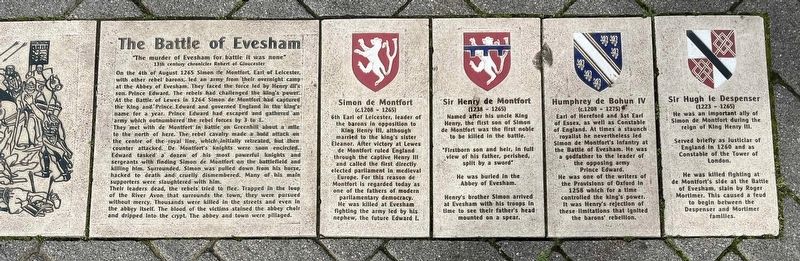
The Battle of Evesham
"The murder of Evesham for battle it was none"
| — | 13th century chronicler Robert of Gloucester | — |
Photographed by Ray Gurganus, April 7, 2024
1. The Battle of Evesham Marker
They met with de Montfort in battle on Greenhill about a mile to the north of here. The rebel cavalry made a bold attack on the centre of the royal line, which initially retreated, but then counter attacked. De Montfort's knights were soon encircled. Edward tasked a dozen of his most powerful knights and sergeants with finding Simon de Montfort on the battlefield and killing him. Surrounded, Simon was pulled down from his horse, hacked to death and cruelly dismembered. Many of his main supporters were slaughtered with him.
Their leaders dead, the rebels tried to flee. Trapped in the loop of the River Avon that surrounds the town, they
this page online
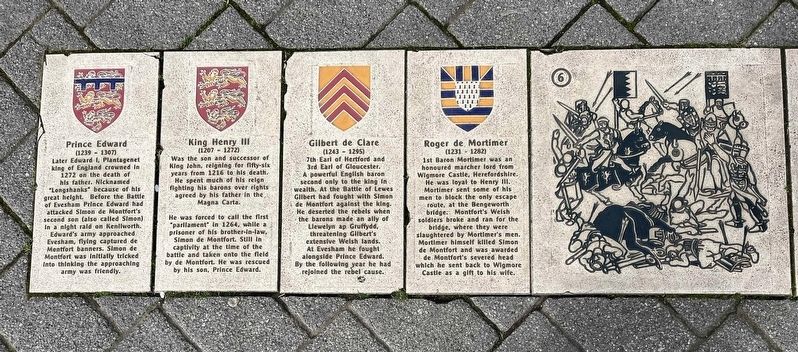
Prince Edward (1239-1307)
Later Edward I, Plantagenet king of England crowned in 1272 on the death of his father. Nicknamed "Longshanks" because of his great height. Before the Battle of Evesham Prince Edward had attacked Simon de Montfort's second son (also called Simon) in a night raid on Kenilworth. Edward's army approached Evesham, flying captured de Montfort banners. Simon de Montfort was initially tricked into thinking the approaching army was friendly.
King Henry II (1207-1272)
Was the son and successor of King John, reigning for fifty-six years from 1216 to his death. He spent much of his reign fighting his barons over rights agreed by his father in the Magna Carta.
He was forced to call the first "parliament" in 1264, while a prisoner of his brother-in-law, Simon de Montfort. Still in captivity at the time of the battle and taken onto the field by de Montfort. He was rescued by his son, Prince Edward.
Gilbert de Clare (1243-1295)
7th
Photographed by Ray Gurganus, April 7, 2024
2. The Battle of Evesham Marker
Roger de Mortimer (1231-1282)
1st Baron Mortimer was an honoured marcher lord from Wigmore Castle. Herefordshire. He was loyal to Henry Ill. Mortimer sent some of his men to block the only escape route, at the Bengeworth bridge. Montfort's Welsh soldiers broke and ran for the bridge, where they were slaughtered by Mortimer's men. Mortimer himself killed Simon de Montfort and was awarded de Montfort's severed head which he sent back to Wigmore Castle as a gift to his wife.
Simon de Montfort (c.1208-1265)
6th Earl of Leicester, leader of the barons in opposition to King Henry III, although married to the king's sister Eleanor. After victory at Lewes de Montfort ruled England through the captive Henry III and called the first directly elected parliament in medieval Europe. For this reason de Montfort is regarded today as one of the fathers of modern parliamentary democracy. He was killed at Evesham fighting the army led by his nephew, the future Edward I.
Sir Henry de Montfort (1238-1265)
Named after his uncle King Henry, the first son of Simon de Montfort was the first noble to be killed in the battle.
‘Firstborn son and heir, in full view of his father, perished, split by a sword'
He was buried in the Abbey of Evesham. Henry's brother Simon arrived at Evesham with his troops in time to see their father's head mounted on a spear.
Humphrey de Bohun IV (c.1208-1275)
Earl of Hereford and 1st Earl of Essex, as well as Constable of England. At times a staunch royalist he nevertheless led Simon de Montfort's infantry at the Battle of Evesham. He was a godfather to the leader of the opposing army Prince Edward. He was one of the writers of the Provisions of Oxford in 1258 which for a time controlled the king's power. It was Henry's rejection of these limitations that ignited the barons' rebellion.
Sir Hugh le Despenser (1223-1265)
He was an important ally of Simon de Montfort during the reign of King Henry III. Served briefly as justiciar of England in 1260 and as Constable of the Tower of London. He was killed fighting at de Montfort's side at the Battle of Evesham, slain by Roger Mortimer. This caused a feud to begin between the Despenser and Mortimer families.
Topics. This historical marker is listed in this topic list: Wars, Non-US. A significant historical date for this entry is August 4, 1265.
Location. 52° 5.595′ N, 1° 56.806′ W. Marker is in Evesham, England, in Worcestershire. It is on High Street, on the right when traveling north. The marker is set in the ground in the median. Touch for map. Marker is at or near this postal address: 34 High St, Evesham, England WR11, United Kingdom. Touch for directions.

Regionally, this marker is in the Midlands. Globally, it is on the Atlantic Ocean, in the North Atlantic Region, in Europe, in Atlantic Europe, on one of the British Isles, in the Western World, and in the Anglosphere. Historically, it finds itself in what was once the Roman Empire.
Other nearby markers. At least 8 other markers are within walking distance of this marker: Evesham's History and Heritage (about 90 meters away, measured in a direct line); Jim Capaldi (1944-2005) (about 120 meters away); a different marker also named Evesham's History and Heritage (about 120 meters away); Norman Gateway (about 150 meters away); Evesham Abbey (about 150 meters away); All Saints, Evesham (about 180 meters away); a different marker also named Evesham Abbey (about 210 meters away); a different marker also named Evesham Abbey (about 210 meters away). Touch for a list and map of all markers in Evesham.
Credits. This page was last revised on May 17, 2024. It was originally submitted on April 28, 2024, by Ray Gurganus of Washington, District of Columbia. This page has been viewed 389 times since then and 84 times this year. Photos: 1, 2. submitted on April 28, 2024, by Ray Gurganus of Washington, District of Columbia. • Andrew Ruppenstein was the editor who published this page.
Editor’s want-list for this marker. photo of the marker within its surroundings • Can you help?
