University in Louisville in Jefferson County, Kentucky — The American South (East South Central)
Freedom Park: A Journey to Freedom
The Civil War
Photographed by Darren Jefferson Clay, April 7, 2024
1. Freedom Park: A Journey to Freedom Marker
Inscription.
Freedom Park: A Journey to Freedom. The Civil War. The American Civil War brought two opposing views of freedom into direct and violent conflict, and nowhere more so than in Kentucky. Kentucky was deeply divided over the issues of slavery and secession. Confederate sentiments were as strong in some regions of the state as were Union sentiments in others, dividing communities and even families. In Louisville, the wealthiest merchants supported the Confederate cause while the professional class, small-business owners, and common laborers tended to support the Union. Still, after flirting with a policy of neutrality, Kentucky ultimately remained in the Union and contributed between 90,000 and 100,000 men to the Union Army, and between 25,000 and 40,000 to the Confederacy., Because of its location on the Ohio River and as the northern terminus of the L&N Railroad, Louisville became a central base of Union operations for the western theater of the war and as many as 100,000 Union troops were stationed in or near the city at one time or another. For the same strategic reasons, the Confederates attempted to invade Kentucky, destroy the railroad and capture Louisville several times in the first year of the war. However, after the Battle of Perryville, fought October 8, 1862 near Danville, the Confederate Army never threatened Kentucky again., As a Union slave state, the Emancipation Proclamation (1863) did not apply to Kentucky. However, the military strategy of ending slavery in the Confederate states became the national policy of abolishing slavery altogether. The steady stream of fugitive slaves flowing into the state became a raging flood-and the authority of the army, when exercised to protect these fugitives, undermined the authority of slave-owners and the institution slowly melted away in Kentucky. For example, in 1860, the value of enslaved African Americans in Kentucky was $107.5 million; by 1865, the value of those who remained enslaved was only $7.2 million., For many white Kentuckians opposed to emancipation, this policy shift regarding slavery created a dilemma without an exit and left great bitterness in its wake which explains the familiar observation that "Kentucky did not join the Confederacy until after the Civil War." , continued..., continued... , Despite divisions among whites, African Americans in Kentucky were clearly not divided in their sympathies during the Civil War. In the early months of the conflict, African Americans In Louisville were treated roughly by the Home Guard and free black schools and churches were closed. Many free people of color fled the city to avoid being pressed into labor gangs building defensive fortifications and performing other menial tasks., As Union troops streamed into Louisville, African Americans found protection under the aegis of an authority higher than that of local leaders. Thereafter, thousands of fugitive slaves fled to the city and, by July 1864, over one hundred blacks were enlisting in the Union Army each day at the Taylor Barracks at 3rd and Oak streets. These men became the backbone of several regiments of U.S. Colored Troops: the 107th, 108th, 109th, 122nd, 123rd and 125th U. S. Colored Infantry. Their families and other freedmen were housed in a ten-acre refugee camp located at 18th and Broadway, then the outskirts of the city, and, beginning in 1864, under the supervision of the Rev. Thomas James, an African American minister from Rochester, New York. In all, roughly 24,000 black Kentuckians served in the Union Army-in harm's way both on the battlefield and from hostile whites and Confederate guerrillas throughout Kentucky., The presence of a large contingent of black soldiers and refugees, and a pre-existing free black community made the Civil War experience in Louisville both complex and unique. In this unusual setting, local black churches organized soldiers aid societies and free blacks in New Albany, Indiana, even established the Hospital d'Afrique to minister to the sick and wounded. As a definitive expression of the sentiments of Louisville African Americans, in January 1865, twenty-two year old Mary Lewis presented a battle flag, sewn by the Louisville Colored Ladies Soldiers Aid Society, to the 123rd United States Colored Infantry, and stated proudly: "Soldiers of the 123rd Regiment, You have enlisted in the service of a cause which is that of freedom, not only in this country, but throughout the world... The freedom of your race no less depends upon the endurance of the Republic than the rights and liberties of other races. Its cause, therefore, is your own."
The American Civil War brought two opposing views of freedom into direct and violent conflict—and nowhere more so than in Kentucky. Kentucky was deeply divided over the issues of slavery and secession. Confederate sentiments were as strong in some regions of the state as were Union sentiments in others, dividing communities and even families. In Louisville, the wealthiest merchants supported the Confederate cause while the professional class, small-business owners, and common laborers tended to support the Union. Still, after flirting with a policy of neutrality, Kentucky ultimately remained in the Union and contributed between 90,000 and 100,000 men to the Union Army, and between 25,000 and 40,000 to the Confederacy.
Because of its location on the Ohio River and as the northern terminus of the L&N Railroad, Louisville became a central base of Union operations for the western theater of the war and as many as 100,000 Union troops were stationed in or near the city at one time or another. For the same strategic reasons, the Confederates attempted to invade Kentucky, destroy the railroad and capture Louisville several
Click or scan to see this page online
times in the first year of the war. However, after the Battle of Perryville, fought October 8, 1862 near Danville, the Confederate Army never threatened Kentucky again.
As a Union slave state, the Emancipation Proclamation (1863) did not apply to Kentucky. However, the military strategy of ending slavery
in the Confederate states became the national policy of abolishing slavery altogether. The steady stream of fugitive slaves flowing into the state became a raging flood-and the authority of the army, when exercised to protect these fugitives, undermined the authority of slave-owners and the institution slowly melted away in Kentucky. For example, in 1860, the value of enslaved African Americans in Kentucky was $107.5 million; by 1865, the value of those who remained enslaved was only $7.2 million.
For many white Kentuckians opposed to emancipation, this policy shift regarding slavery created a dilemma without an exit and left great bitterness in its wake which explains the familiar observation that "Kentucky did not join the Confederacy until after the Civil War."
continued...
continued...
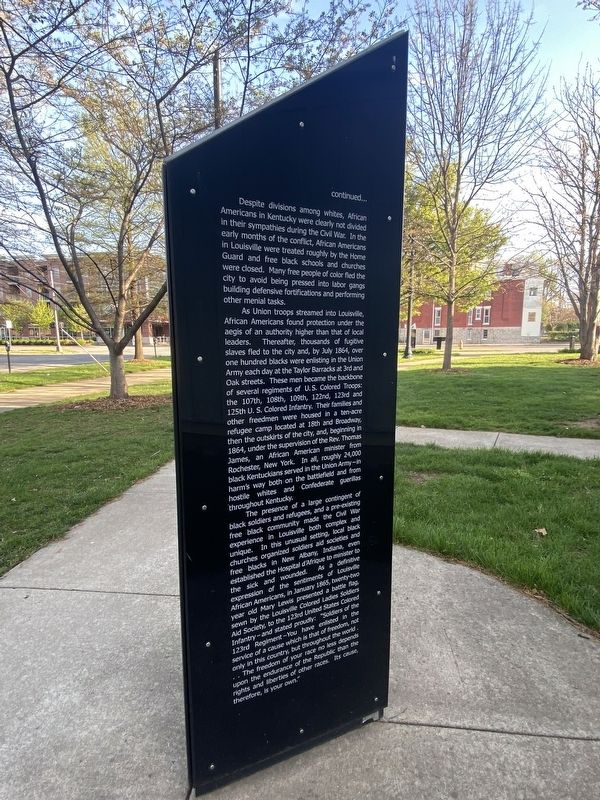
Despite divisions among whites,
Photographed by Darren Jefferson Clay, April 7, 2024
2. Freedom Park: A Journey to Freedom Marker
African Americans in Kentucky were clearly not divided in their sympathies during the Civil War. In the early months of the conflict, African Americans In Louisville were treated roughly by the Home Guard and free black schools and churches were closed. Many free people of color fled the city to avoid being pressed into labor gangs building defensive fortifications and performing other menial tasks.
As Union troops streamed into Louisville, African Americans found protection under the aegis of an authority higher than that of local leaders. Thereafter, thousands of fugitive slaves fled to the city and, by July 1864, over one hundred blacks were enlisting in the Union Army each day at the Taylor Barracks at 3rd and Oak streets. These men became the backbone of several regiments of U.S. Colored Troops: the 107th, 108th, 109th, 122nd, 123rd and 125th U. S. Colored Infantry. Their families and other freedmen were housed in a ten-acre refugee camp located at 18th and Broadway, then the outskirts of the city, and, beginning in 1864, under the supervision of the Rev. Thomas James, an African American minister from Rochester, New York. In
Photographed by Darren Jefferson Clay, April 7, 2024
3. Freedom Park: A Journey to Freedom Marker
all, roughly 24,000 black Kentuckians served in the Union Army-in harm's way both on the battlefield and from hostile whites and Confederate guerrillas throughout Kentucky.
The presence of a large contingent of black soldiers and refugees, and a pre-existing free black community made the Civil War experience in Louisville both complex and unique. In this unusual setting, local black churches organized soldiers aid societies and free blacks in New Albany, Indiana, even established the Hospital d'Afrique to minister to the sick and wounded. As a definitive expression of the sentiments of Louisville African Americans, in January 1865, twenty-two year old Mary Lewis presented a battle flag, sewn by the Louisville Colored Ladies Soldiers Aid Society, to the 123rd United States Colored Infantry—and stated proudly: "Soldiers of the 123rd Regiment—You have enlisted in the service of a cause which is that of freedom, not only in this country, but throughout the world... The freedom of your race no less depends upon the endurance of the Republic than the rights and liberties of other races. Its cause, therefore, is your own."
Topics.
Photographed by Darren Jefferson Clay, April 7, 2024
Location. 38° 13.204′ N, 85° 45.661′ W. Marker is in Louisville, Kentucky, in Jefferson County. It is in University. It is on South 3rd Street (Kentucky Route 1020) south of West Cardinal Boulevard, on the left when traveling south. Touch for map. Marker is at or near this postal address: 1911 S 3rd St, Louisville KY 40208, United States of America. Touch for directions.
Regionally, this marker is in the American South, specifically in the Upper South, and in the Ohio River Valley. Globally, it is in North America, the Western Hemisphere, the Western World, and the Anglosphere. Historically, it finds itself in what was once the territory of the Mississippian Culture and also the Antebellum South.
Credits. This page was last revised on May 1, 2024. It was originally submitted on April 28, 2024, by Darren Jefferson Clay of Duluth, Georgia. This page has been viewed 181 times since then and 12 times this year. Photos:1, 2, 3, 4. submitted on May 1, 2024, by Darren Jefferson Clay of Duluth, Georgia. • Bernard Fisher was the editor who published this page.