
University in Louisville in Jefferson County, Kentucky — The American South (East South Central)
Freedom Park: A Journey to Freedom
The Ongoing Struggle
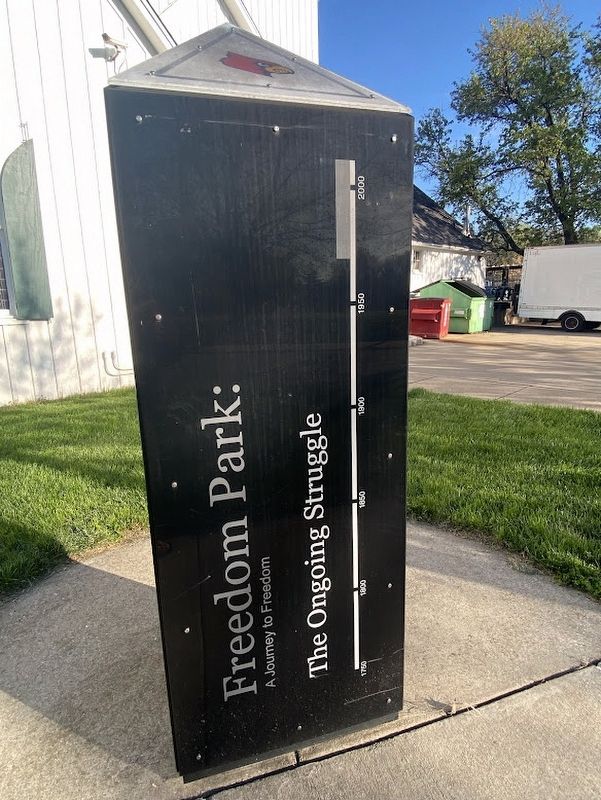
Photographed by Darren Jefferson Clay, April 7, 2024
1. Freedom Park: A Journey to Freedom Marker
After 1970 the freedom struggle operated in a changing and in many ways increasingly hostile environment. White resistance to further government action for racial equality ignited grassroots campaigns against the growing black presence in the work place and schools. The focus of such protest was on court-ordered busing for school integration Conservative politicians tapped into that widespread white discontent to pursue a broader anti-government and anti-reform agenda. Worsening economic times reinforced this conservative trend. At the same time, however, black leaders persevered in their quest for the enforcement of equal opportunity through Affirmative Action, improvement in police-community relations, and the strengthening of black political power. Other groups who had likewise lacked social power-Latinos, women, disabled people, gays and lesbians-adopted the ideas and methods of the civil rights era for their own struggles. The result was, in some respects, a broader freedom movement, but one that was on the defensive in an increasingly conservative political climate-and thus subject to frequent misunderstandings
this page online
By the 1980s, African Americans were visibly integrated into Louisville's public life even as dramatic racial inequities persisted. Campaigns for African American equality continued well after the passage of civil rights laws in the 1960s. Yet when it came to enforcement of those laws, the issues struck uncomfortably close to home for many white Louisvillians. True equity and power in jobs, housing, schools, and electoral politics generated more controversy than had the simple and direct plea for seats at a lunch counter.
When more than a decade of school desegregation failed to achieve equal access for African Americans, Louisville-Jefferson County became in 1975 one of many school districts nationally in which courts ordered widespread busing in search of racial fairness. White mobs and a resurgence of the Ku Klux Klan resulted, but a biracial coalition of activists, moderates, and elected officials steadily built support for busing, and the school plan continued past the expiration of the busing order and into the 21st century with widespread community support. Experts assessed the local

Photographed by Darren Jefferson Clay, April 7, 2024
2. Freedom Park: A Journey to Freedom Marker
The civil rights movement of the post-WWII era gave rise to many other social justice movements in the final third of the twentieth century. New movements adopted its tactics of nonviolent direct action and mass protest, and hundreds of young people who had gained organizing skills while demanding an end to racial segregation then applied their know-how to issues such as gender equality, disability rights and ending many other forms of discrimination. In the 1990s, a local movement called "Fairness" drew together strands of the older civil rights community to end discrimination based on sexuality as part of a wider vision of social and racial freedom. Meanwhile, leaders like Rev. Louis Coleman-an outspoken African American minister - kept racial fairness in the public spotlight into the 21st century, agitating and mobilizing rallies for an end to police violence and environmental racism and for the equitable hiring of minorities by the state.
Topics. This historical marker

Photographed by Darren Jefferson Clay, April 7, 2024
3. Freedom Park: A Journey to Freedom Marker
Location. 38° 13.194′ N, 85° 45.636′ W. Marker is in Louisville, Kentucky, in Jefferson County. It is in University. It is on South 2nd Street (Route 1020) just south of West Cardinal Boulevard, on the left when traveling north. Touch for map. Marker is at or near this postal address: 1911 S 3rd St, Louisville KY 40208, United States of America. Touch for directions.

Regionally, this marker is in the American South, specifically in the Upper South, and in the Ohio River Valley. Globally, it is in North America, the Western Hemisphere, the Western World, and the Anglosphere. Historically, it finds itself in what was once the territory of the Mississippian Culture and also the Antebellum South.
Other nearby markers. At least 8 other markers are within walking distance of this marker: A different marker also named Freedom Park: A Journey to Freedom (within shouting distance of this marker); a different marker also named Freedom Park: A Journey to Freedom (within shouting distance of this marker); Dr. J. Blaine Hudson, Jr.

Photographed by Darren Jefferson Clay, April 7, 2024
4. Freedom Park: A Journey to Freedom Marker
Credits. This page was last revised on May 20, 2024. It was originally submitted on April 28, 2024, by Darren Jefferson Clay of Duluth, Georgia. This page has been viewed 210 times since then and 13 times this year. Photos: 1, 2, 3, 4. submitted on May 19, 2024, by Darren Jefferson Clay of Duluth, Georgia. • Devry Becker Jones was the editor who published this page.
