University in Louisville in Jefferson County, Kentucky — The American South (East South Central)
Freedom Park: A Journey to Freedom
The Civil Rights Movement
Photographed by Darren Jefferson Clay, April 7, 2024
1. Freedom Park: A Journey to Freedom Marker
Inscription.
Freedom Park: A Journey to Freedom. The Civil Rights Movement. , The fight against Hitler's fascism inspired a vigorous new postwar struggle against racism and discrimination at home. The NAACP legal battle began to bear fruit with Supreme Court decisions against segregation in transportation and restrictive covenants in housing, and most famously with the Brown v. Board of Education ruling against discrimination in public education. At the same time black leaders rallied grassroots communities to press for the end of Jim Crow in all public and private facilities, a drive that climaxed in the early 1960s sit-ins and passage of the Civil Rights Act in 1964. In the mid and late 1960s the movement became more multi-pronged, turning to attack discrimination in jobs and housing, to empower the poor through community organizing, and to promote the embrace of African American culture and identity., In Louisville the first targets of this postwar movement were city-operated facilities such as parks and libraries, both of which were integrated gradually in the decade after World War II. Local activists also worked with like-minded citizens around the Commonwealth in an Interracial Hospital Movement for the opening of publicly-funded medical facilities to African Americans, which was achieved in 1952 The height of this phase of the local movement was the 1956 peaceful integration of the Louisville public schools. Although in many respects a token step toward true equality in education, the successful break-down of segregation in schools emboldened local people to make a broader attack on racism., The local movement grew in the 1960s, beginning when mass sit-ins by Louisville teenagers in Spring 1961 created a community crisis that helped to unseat the Board of Alderman. Two more years of demonstrations and negotiations pushed the city finally in May 1963 to adopt a civil rights ordinance forbidding discrimination by race in public accommodations, the first such law in a southern state. Riding on the momentum of that victory, the Louisville Board of Aldermen adopted an ordinance forbidding discrimination in employment in 1965., The movement against residential segregation was met with more resistance, when in Spring 1967 mobs of whites verbally and physically attacked nightly demonstrations for equal opportunity in housing. Despite the vocal opposition, civil rights advocates used the vote to elect a new Board of Aldermen, who in December 1967 adopted a fair housing ordinance. This triumph in policy outlawed housing discrimination, but did not end its practice., Disillusioned with the inadequate enforcement of civil rights laws and the persistent violence met by mass nonviolent direct action, young African American Louisvillians turned their attention to community empowerment and embraced the Black Power movement. In the mid-1960s local activists used community organizing through the War on Poverty to unite black and poor neighborhoods to fight their powerlessness and demand equal access to resources. Many black power organizations saw the promotion of black history, arts and culture as means for both fostering interracial understanding and empowering the African American community through self-knowledge and self-respect. The most important examples of that emphasis were the local black arts movement and the Black Student Union at the University of Louisville. In 1969 the latter presented a series of demands for increased black faculty, courses, mentoring, and outreach to the community. When the University administration failed to respond to these demands, the BSU launched a sit-in "takeover" of the administration building. In the short term, the confrontation led to the expulsion of some leaders of the BSU, but in the long run it laid the seeds for enhanced scholarly attention at the University to the history, culture, and needs of African Americans and the eventual founding of the Pan African Studies Department.
The fight against Hitler's fascism inspired a vigorous new postwar struggle against racism and discrimination at home. The NAACP legal battle began to bear fruit with Supreme Court decisions against segregation in transportation and restrictive covenants in housing, and most famously with the Brown v. Board of Education ruling against discrimination in public education. At the same time black leaders rallied grassroots communities to press for the end of Jim Crow in all public and private facilities, a drive that climaxed in the early 1960s sit-ins and passage of the Civil Rights Act in 1964. In the mid and late 1960s the movement became more multi-pronged, turning to attack discrimination in jobs and housing, to empower the poor through community organizing, and to promote the embrace of African American culture and identity.
In Louisville the first targets of this postwar movement were city-operated facilities such as parks and libraries, both of which were integrated gradually in the decade after World War II. Local activists also worked with like-minded citizens around the Commonwealth in an Interracial Hospital
Click or scan to see this page online
Movement for the opening of publicly-funded medical facilities to African Americans, which was achieved in 1952 The height of this phase of the local movement was the 1956 peaceful integration of the Louisville public schools. Although in many respects a token step toward true equality in education, the successful break-down of segregation in schools emboldened local people to make a broader attack on racism.
The local movement grew in the 1960s, beginning when mass sit-ins by Louisville teenagers in Spring 1961 created a community crisis that helped to unseat the Board of Alderman. Two more years of demonstrations and negotiations pushed the city finally in May 1963 to adopt a civil rights ordinance forbidding discrimination by race in public accommodations, the first such law in a southern state. Riding on the momentum of that victory, the Louisville Board of Aldermen adopted an ordinance forbidding discrimination in employment in 1965.
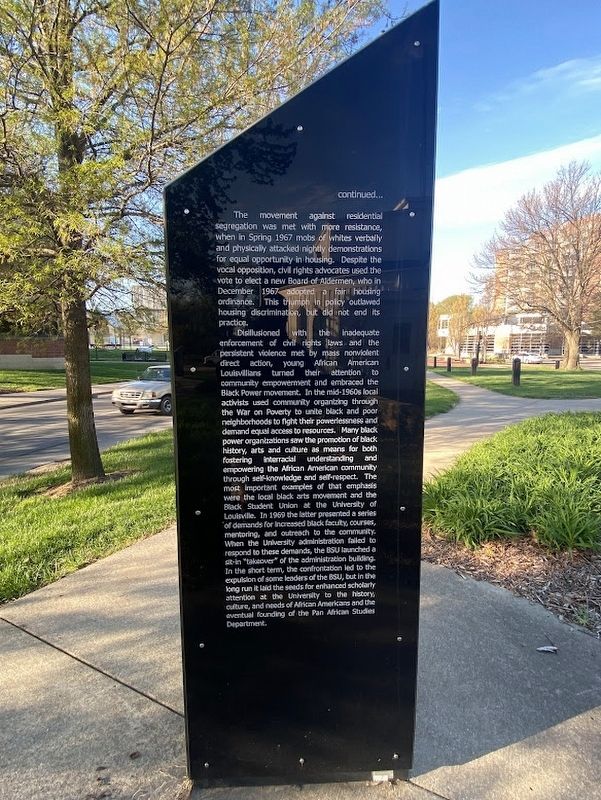
The movement against residential segregation was met with more resistance, when in Spring 1967 mobs of whites verbally and physically attacked nightly demonstrations for equal opportunity in
Photographed by Darren Jefferson Clay, April 7, 2024
2. Freedom Park: A Journey to Freedom Marker
housing. Despite the vocal opposition, civil rights advocates used the vote to elect a new Board of Aldermen, who in December 1967 adopted a fair housing ordinance. This triumph in policy outlawed housing discrimination, but did not end its practice.
Disillusioned with the inadequate enforcement of civil rights laws and the persistent violence met by mass nonviolent direct action, young African American Louisvillians turned their attention to community empowerment and embraced the Black Power movement. In the mid-1960s local activists used community organizing through the War on Poverty to unite black and poor neighborhoods to fight their powerlessness and demand equal access to resources. Many black power organizations saw the promotion of black history, arts and culture as means for both fostering interracial understanding and empowering the African American community through self-knowledge and self-respect. The most important examples of that emphasis were the local black arts movement and the Black Student Union at the University of Louisville. In 1969 the latter presented a series of demands for increased black faculty, courses,
Photographed by Darren Jefferson Clay, April 7, 2024
3. Freedom Park: A Journey to Freedom Marker
mentoring, and outreach to the community. When the University administration failed to respond to these demands, the BSU launched a sit-in "takeover" of the administration building. In the short term, the confrontation led to the expulsion of some leaders of the BSU, but in the long run it laid the seeds for enhanced scholarly attention at the University to the history, culture, and needs of African Americans and the eventual founding of the Pan African Studies Department.
Topics. This historical marker is listed in these topic lists: African Americans • Civil Rights • Education. A significant historical month for this entry is May 1963.
Location. 38° 13.18′ N, 85° 45.648′ W. Marker is in Louisville, Kentucky, in Jefferson County. It is in University. It is on South 2nd Street (Kentucky Route 1020) south of West Cardinal Boulevard, on the left when traveling north. Touch for map. Marker is at or near this postal address: 1911 S 3rd St, Louisville KY 40208, United States of America. Touch for directions.
Regionally, this marker is in the American South, specifically in the Upper South, and in the Ohio River Valley. Globally,
Photographed by Darren Jefferson Clay, April 7, 2024
4. Freedom Park: A Journey to Freedom Marker
it is in North America, the Western Hemisphere, the Western World, and the Anglosphere. Historically, it finds itself in what was once the territory of the Mississippian Culture and also the Antebellum South.
Credits. This page was last revised on May 20, 2024. It was originally submitted on April 28, 2024, by Darren Jefferson Clay of Duluth, Georgia. This page has been viewed 181 times since then and 7 times this year. Photos:1, 2, 3, 4. submitted on May 19, 2024, by Darren Jefferson Clay of Duluth, Georgia. • Devry Becker Jones was the editor who published this page.