
Petit-Montrouge in Paris in Département de Paris, Île-de-France, France — Western Europe
Catacombes
| — | Histoire de Paris | — |

Photographed by Andrew Ruppenstein, April 27, 2024
1. Catacombes Marker

The ancient quarries of Tombe-Issoire, exploited since the early Middle Ages, were transformed, from 1785, to accommodate the essuary deposit of the ancient Les Innocents Cemetery, located near Les Halles, where the remains of residents of Paris had lain for centuries. The City bought an old house of the Commandery of Saint-Jean de Lateran on rue Dareau, under which an underground enclosure of 11,000 square meters was created; its meanders extend over nearly 1,500 meters, under the space between rue Dareau, d'Alembert, Hallé and Parc Montsouris. The bones of approximately six million Parisians are thus arranged along the galleries,
this page online
Topics and series. This historical marker is listed in this topic list: Cemeteries & Burial Sites. In addition, it is included in the Histoire de Paris series list. A significant historical year for this entry is 1785.
Location. 48° 50.037′ N, 2° 19.946′ E. Marker is in Paris, Île-de-France, in Département de Paris. It is in Petit-Montrouge. It is at the intersection of Avenue du Colonel Henri Rol-Tanguy and Place Denfert-Rochereau, on the right when traveling north on Avenue du Colonel Henri Rol-Tanguy. Touch for map. Marker is at or near this postal address: 3 Avenue du Colonel Henri Rol-Tanguy, Paris, Île-de-France 75014, France. Touch for directions.

Regionally, it is in the North

Photographed by Andrew Ruppenstein, April 27, 2024
2. Catacombes Marker - wide view
The marker is visible on the left side of the building, while the entrance to the catacombs is on the right.
Other nearby markers. At least 8 other markers are within walking distance of this marker: Autour des Catacombes / The Catacombs Neighborhood (here, next to this marker); Square de l’Abbé Migne (1880) (within shouting distance of this marker); Le Lion de Belfort/ The Lion of Belfort (within shouting distance of this marker); Colonel Henri Rol-Tanguy (within shouting distance of this marker); Square Claude Nicolas Ledoux 1894 (about 90 meters away, measured in a direct line); Square Jacques Antoine 1896 (about 120 meters away); Gare de Denfert-Rochereau / Denfert-Rochereau Station (about 120 meters away); Georges Lamarque (about 120 meters away). Touch for a list and map of all markers in Paris.
Also see . . . Catacombs of Paris (Wikipedia).
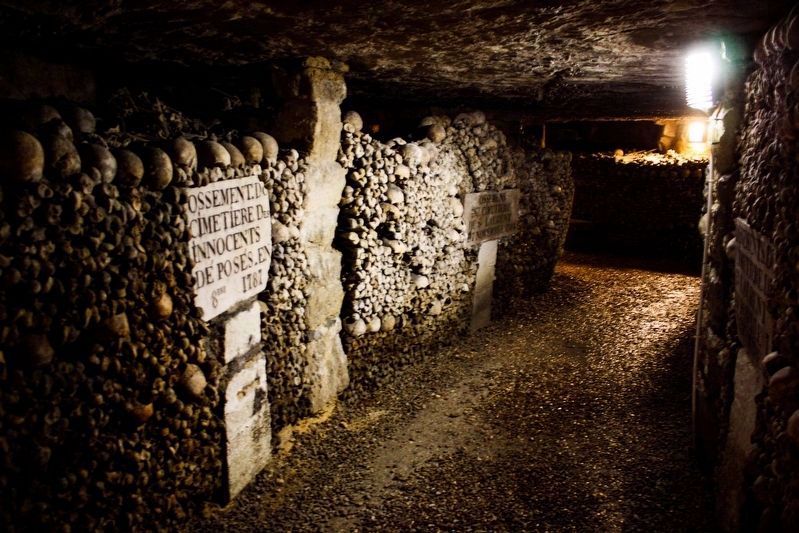
Overview: The Catacombs of Paris (French: Catacombes de Paris) are underground ossuaries in Paris, France, which hold the remains of(Submitted on April 30, 2024.)more than six million people. Built to consolidate Paris's ancient stone quarries, they extend south from the Barrière d'Enfer ("Gate of Hell") former city gate; the ossuary was created as part of the effort to eliminate the effects of the city's overflowing cemeteries. Preparation work began shortly after a 1774 series of basement wall collapses around the Holy Innocents' Cemetery added a sense of urgency to the cemetery-eliminating measure, and from 1786, nightly processions of covered wagons transferred remains from most of Paris's cemeteries to a mine shaft opened near the Rue de la Tombe-Issoire.Shadowgate from Novara, Italy via Wikimedia Commons under CC 2.0 license, August 16, 20133. Catacombs of Paris
The ossuary remained largely forgotten until it became a novelty-place for concerts and other private events in the early 19th century; after further renovations and the construction of accesses around Place Denfert-Rochereau, it was opened to public visitation from 1874. Since 2013, the Catacombs have numbered among the fourteen City of Paris Museums managed by Paris Musées. Although the ossuary comprises only a small section of the underground mines of Paris, Parisians often refer to the entire tunnel network as the catacombs.
Additional keywords. panneau
Vlastimil Juricek, slightly modified by Entheta, via Wikimedia Commons under CC 3.0, May 22, 2006
4. Paris Catacombs
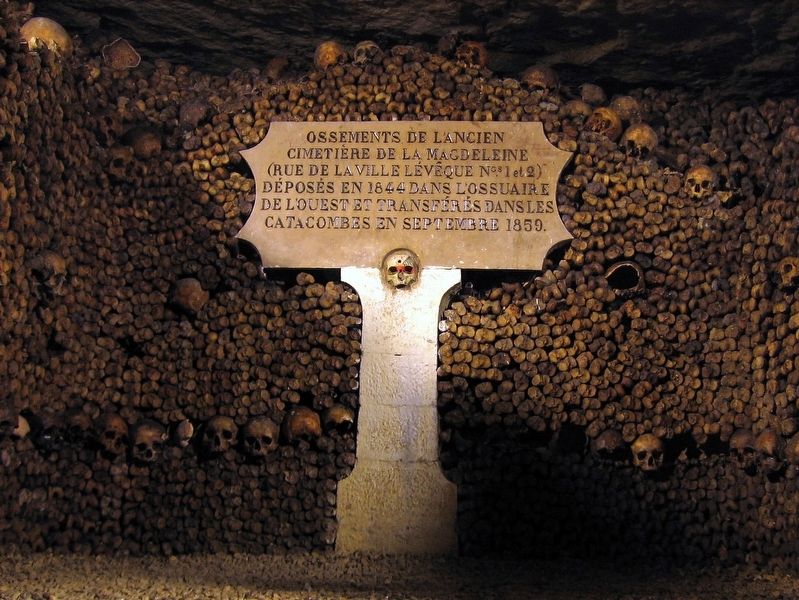
Bones from the former Magdeleine cemetery (La Ville Leveque Street numbers 1 and 2). Deposited in 1844 in the western ossuary (bone repository) and transfered to the catacombs in September 1859.

Photographed by A. Breger, 1910
5. Catacombs - with sign commemorating the visit of Prince Oscar of Sweden on May 7, 1867
Credits. This page was last revised on April 24, 2025. It was originally submitted on April 30, 2024, by Andrew Ruppenstein of Lamorinda, California. This page has been viewed 410 times since then and 67 times this year. Photos: 1, 2, 3, 4, 5. submitted on April 30, 2024, by Andrew Ruppenstein of Lamorinda, California.
