Dunning in Chicago in Cook County, Illinois — The American Midwest (Great Lakes)
Unidentified Victims of the 1871 Chicago Fire
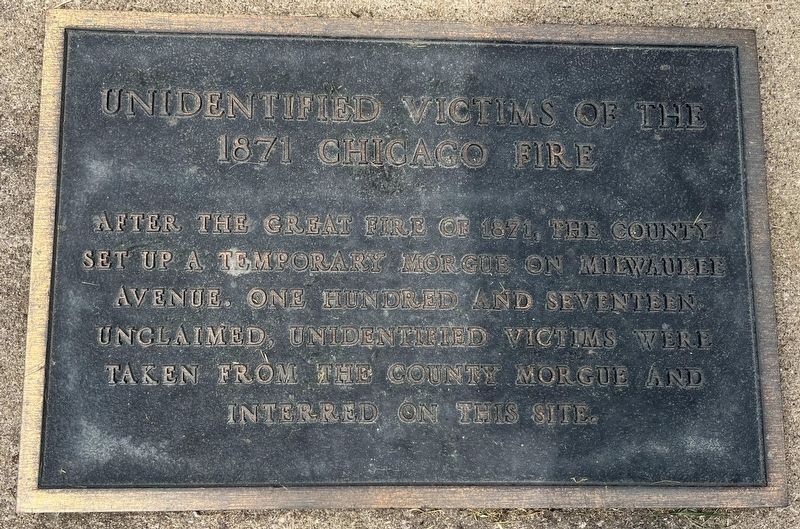
Photographed by Sean Flynn, May 2, 2024
1. Unidentified Victims of the 1871 Chicago Fire Marker
Topics and series. This historical marker is listed in these topic lists: Cemeteries & Burial Sites • Disasters • Parks & Recreational Areas. In addition, it is included in the The Great Chicago Fire of 1871 series list. A significant historical date for this entry is October 8, 1871.
Location. 41° 57.315′ N, 87° 47.464′ W. Marker is in Chicago, Illinois, in Cook County. It is in Dunning. It can be reached from West Belle Plaine Avenue near North Neenah Avenue. The memorial is in Read Dunning Memorial Park. Touch for map. Marker is in this post office area: Chicago IL 60634, United States of America.
this page online

Regionally, this marker is on Chicago’s North Side. It is also in the American Midwest. Globally, it is in North America, on the Great Lakes, in the Western Hemisphere, in the Western World, and in the Anglosphere. Historically, it finds itself in what was once the Viceroyalty of New France, the territory of the Mississippian Culture, and the Northwest Territory.
Other nearby markers. At least 15 other markers are within walking distance of this marker: Civil War Veterans (here, next to this marker); Cook County Cemetery at Dunning — 1854 (here, next to this marker); Unknown and Itinerant Poor of Cook County (here, next to this marker); The Cook County Insane Asylum (here, next to this marker); The Sick and Infirm at Dunning (a few steps from this marker); Cook County Poorhouse
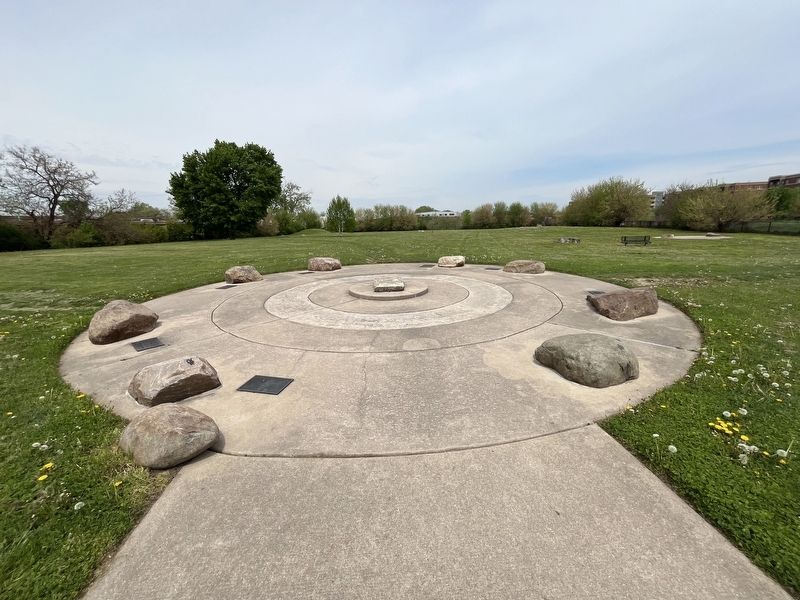
Photographed by Sean Flynn, May 2, 2024
2. Memorials to the people buried in this cemetery
The marker is one of seven in Read Dunning Memorial Park.
More about this marker. The marker is one of eight that surround an 1884 dedication stone in the center of this park. The park features seven concrete circles dedicated to seven groups spread across the 3 acres, each circle representing
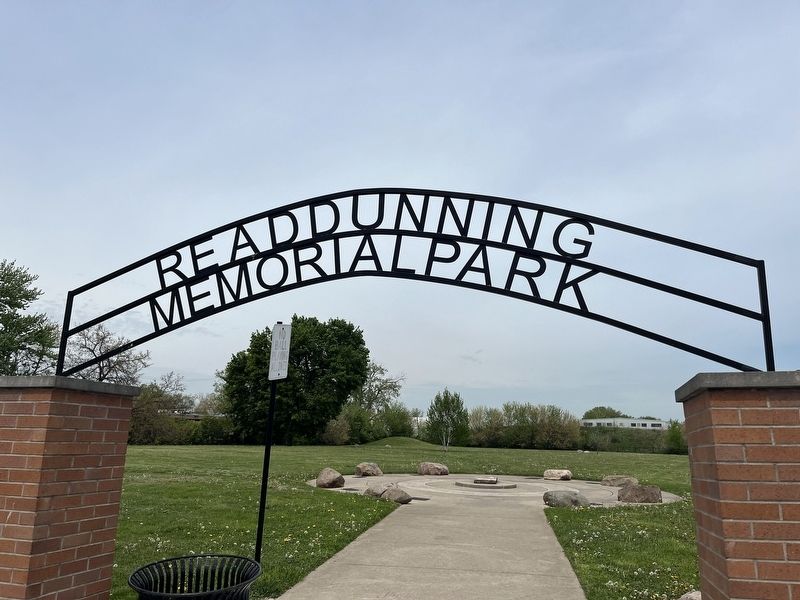
Photographed by Sean Flynn, May 2, 2024
3. The entrance to Read Dunning Memorial Park
Regarding Unidentified Victims of the 1871 Chicago Fire. The Great Chicago Fire is believed to have killed about 300 people, although the exact number is unknown and may have been higher or lower. About 120 people who could not be identified were brought to Dunning, which is about eight miles northwest of the most heavily burned districts.
Overall, more than 38,000 people are believed to have been buried in potter's fields, called Cook County Cemetery, that cover an area roughly bounded on the south by Irving Park Road, on the north and west by Harlem Avenue and Forest Preserve
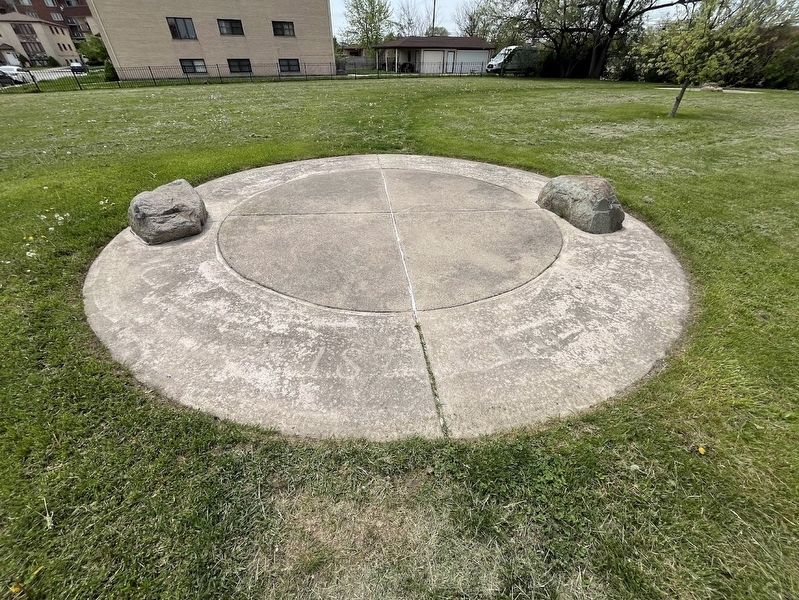
Photographed by Sean Flynn
4. Victims of the 1871 Chicago Fire
Seven concrete circles like this one are spread throughout the 3-acre memorial park, each identifying one of the sets of victims referenced on the plaques. This one, in the southern end of the park, is dedicated to 100+ victims of the Great Chicago Fire of 1871 who are buried here.
Improvements to Oak Park Avenue (about a third of a mile west of here as the crow flies) in the mid-2010s brought this graveyard back in the public memory as more remains were found, as did the 2018 building of a new school on Oak Park
Photographed by Chicago History Museum (ICHi-063773)
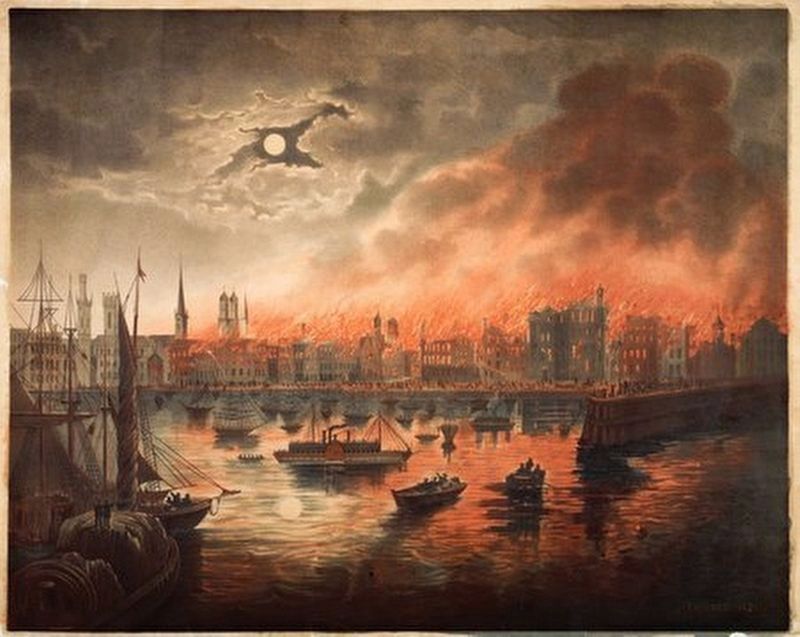
5. View of the Chicago Fire at Night
Caption for this painting, from the Chicago History Museum: "View of the Chicago Fire of 1871 at night under full moon, Chicago, Illinois."
Also see . . . Grave Mistake-the Story of Cook County Cemetery at Dunning. A reprint of a 1989 article in the Chicago Reader looking at the history of the Cook County Cemetery and how developers in the 1980s bumped into the nearly forgotten graves on Chicago's northwest side.
Excerpt: "Nowhere else in the country has a cemetery with hundreds or thousands of graves been so nearly forgotten that a developer had to rediscover it by accident. 'It is a very unusual situation,' says assistant city corporation counsel Nancy Marin, with characteristic understatement."(Submitted on May 3, 2024, by Sean P. Flynn of Oak Park, Illinois.)
Credits. This page was last revised on September 16, 2025. It was originally submitted on May 2, 2024, by Sean P. Flynn of Oak Park, Illinois. This page has been viewed 1,376 times since then and 69 times this year. Photos: 1, 2. submitted on May 2, 2024, by Sean P. Flynn of Oak Park, Illinois. 3, 4, 5. submitted on May 3, 2024, by Sean P. Flynn of Oak Park, Illinois.
